
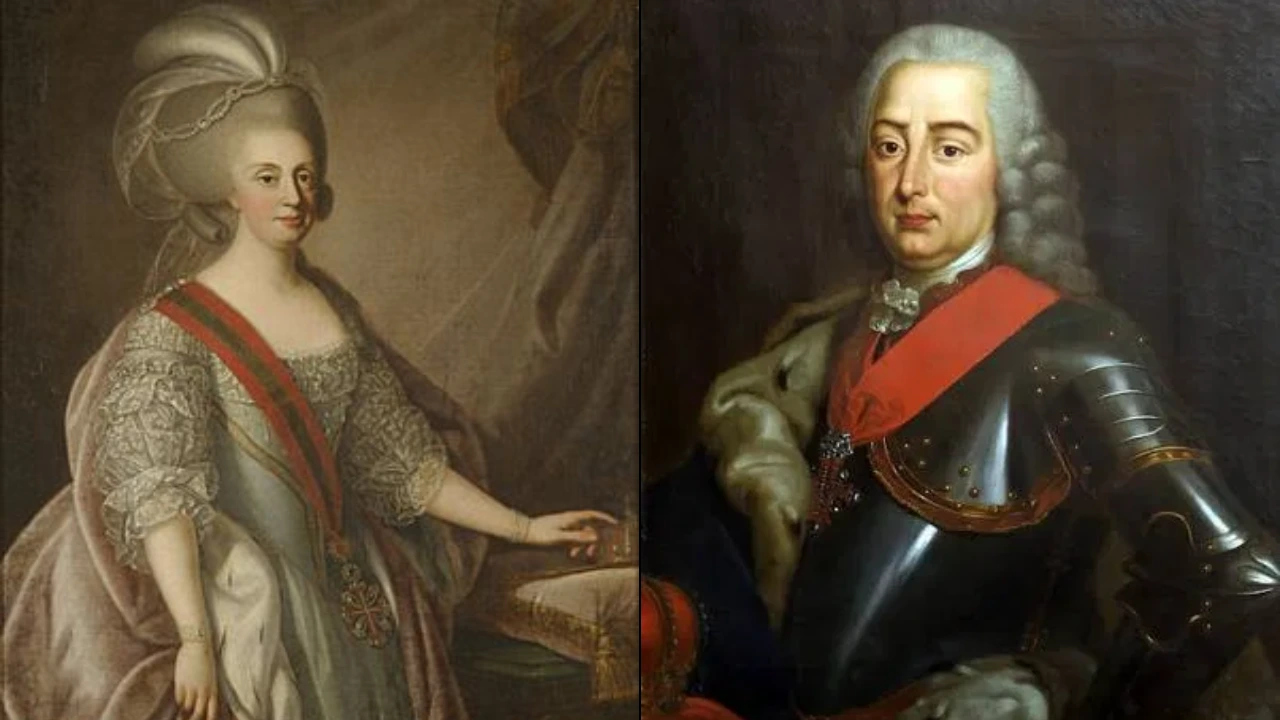
Portugal’s first queen regnant governed for nearly forty years, expanded her empire into Africa and Brazil, and spent her final two decades confined to her apartments at the Palace of Queluz, where visitors described hearing screams unlike anything they had ever encountered in their lives.
On November 29, 1807, a woman in her early seventies was carried through the streets of Lisbon toward the harbor. She believed she was being kidnapped. She was, in fact, the Queen of Portugal.
Her attendants loaded her aboard the carrack Príncipe Real as French forces advanced on the city. For approximately three months she crossed the Atlantic in a state of acute distress, her screaming audible throughout the ship and, by contemporary accounts, terrifying its crew. When the fleet arrived in Salvador da Bahia in January 1808, the queen who had once governed the Iberian Peninsula’s oldest monarchy stepped ashore barely aware of either her own name or her surroundings.
It had not always been this way. Maria I of Portugal had once been one of the most capable monarchs in Europe. She had dismissed a minister who had dominated the country for more than two decades. She had expanded her empire’s commercial reach deep into Africa. She had made a genuine impression as a decisive, intelligent ruler. Then the people she loved began to die, and the woman she had been went with them.
Faith and Catastrophe Shaped the Future Queen
Maria Francisca Isabel Josefa Antónia Gertrudes Rita Joana was born on December 17, 1734, at the Ribeira Palace in Lisbon, the eldest of four daughters of Dom José, heir to the Portuguese crown, and Infanta Mariana Victoria of Spain. Her grandfather was King John V of Portugal.
Under the instruction of Jesuit tutors, her education centred on Roman Catholic theology, though she also studied French, Latin, painting, singing, and music alongside her sisters. She was deeply devout almost from childhood. After a near-fatal illness in 1753 from which she attributed her survival to divine intervention, her religious convictions became the organizing principle of her life and remained so until that life became unrecognizable.
When her father succeeded to the throne as King José I in 1750, Maria became his heir presumptive. The assumption was that the king and his wife might still produce a male heir. As the 1750s wore on and that prospect receded, her accession became the only realistic outcome.
It was not a straightforward inheritance. On the morning of November 1, 1755, when Maria was twenty years old, one of the most destructive earthquakes in recorded history struck Lisbon. The earthquake measured approximately 8.5 to 9.0 on the moment magnitude scale. Its epicentre lay roughly 200 kilometres off the south-west coast of Portugal, but its worst effects concentrated in the capital, which was first struck by a massive tsunami and then consumed by firestorms that burned for days. Some estimates suggest as many as 50,000 people died. The Ribeira Palace was destroyed. Maria and her family lived in tents at Belém for months. Her father, King José, emerged from the disaster with a severe aversion to enclosed stone buildings and ordered the construction of a timber residence at Ajuda, where the royal court operated from an elaborate complex of wooden structures for years afterward. He never again lived under a solid roof.
By her mid-twenties, Maria remained unmarried, which was unusual even by the flexible standards of European royal courts. A specific legal constraint governed her situation: Portuguese law barred her from inheriting the throne if she married a foreign prince. The solution, proposed as early as 1749, was a marriage within the family. On June 6, 1760, Maria married her paternal uncle, Infante Dom Pedro, King José’s younger brother. She was 25. He was 42. The political logic was clear: Pedro was considered politically unambitious, and his elevation to king consort when Maria inherited would reassure a court uneasy about female rule. Contemporary accounts suggest the arrangement was also personally agreeable. The couple shared a strong religious devotion and, by all available evidence, a genuine mutual regard. They had six children together, of whom three survived to adulthood: their eldest son José, their second son João, and their daughter Mariana Victoria. Only João would outlive his mother.
Maria Dismissed Portugal’s Most Powerful Man
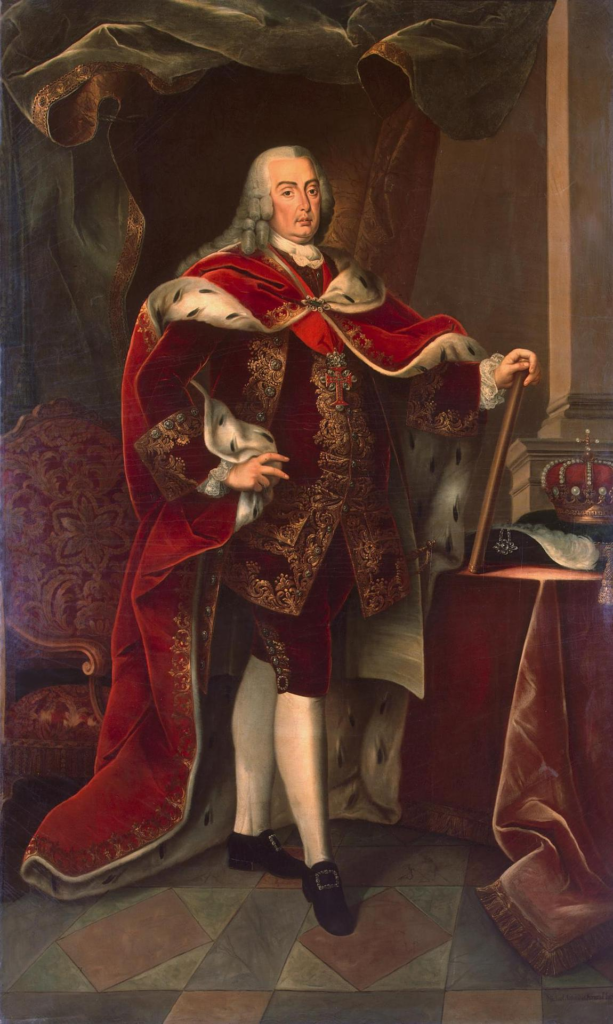
King José I died on February 24, 1777. Maria was 42. She became, in that moment, the first undisputed queen regnant in Portugal’s long history. Her husband became King Pedro III, but his role was ceremonial. Sovereign authority was hers alone.
Her first acts were decisive and deliberate. Within days of her accession she began dismantling the influence of Sebastião José de Carvalho e Melo, 1st Marquis of Pombal, the chief minister who had dominated her father’s court for more than two decades. Pombal had suppressed the Jesuits, reduced the Church’s role in governance, and ordered the execution of members of the high nobility in episodes that had disturbed Maria deeply for years. She dismissed him, presided over an investigation that found him guilty of abuses of power, and then, reluctant to impose a harsher sentence that would reflect badly on her father’s memory, pardoned him due to his age and declining health. Pombal spent his remaining years in political exile.
The early years of her reign showed what she was capable of. Portugal joined the League of Armed Neutrality in July 1782, aligning with European states resisting British interference with neutral merchant shipping. The previous year, in 1781, her government had negotiated the transfer of Delagoa Bay on the coast of present-day Mozambique from the Austrian East India Company to Portugal, adding a significant commercial trading post to the empire. She commissioned the completion of the Palace of Queluz and oversaw the inauguration of the Palace of Ajuda. She was an effective ruler.
She would remain one for roughly nine years.
Three Deaths in Five Months Destroyed Her
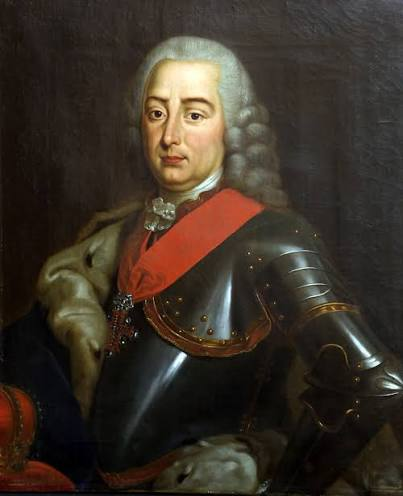
On May 25, 1786, Pedro III died. Maria had been married to him for twenty-six years. She was devastated. She forbade all entertainments at court. Contemporary accounts describe the atmosphere around the queen as resembling a permanent funeral. Her mental state, which had produced a documented breakdown as early as October 1780 when she collapsed while signing a pardon, began to deteriorate sharply.
Then her children died.
On September 11, 1788, her eldest son and heir, Prince José, died of smallpox. He was 27 years old. On November 2, her daughter Mariana Victoria died of the same illness, just days after giving birth to her third child. She was 19. Within four weeks of Mariana’s death, her confessor Inácio de São Caetano, Titular Archbishop of Salonica, also died.
Three people. Gone within five months.
By early 1789, Maria was exhibiting symptoms those around her had never witnessed before: intense depression alternating with violent manic episodes, screaming fits in which she declared herself damned and insisted the devil was inside her, attacks on her servants, and periods of complete catatonia in which she could not move or speak. She reportedly saw visions of her late confessor. The queen who had once dismissed Portugal’s most powerful minister with brisk efficiency could no longer govern her own apartments.
The cause of this collapse has never been definitively settled. The deaths clearly triggered it. But scholars have noted that two of Maria’s sisters experienced similar conditions, and that both her maternal grandfather, Philip V of Spain, and her maternal uncle, Ferdinand VI of Spain, descended into madness in the later years of their reigns. Whether the losses of 1786 to 1788 broke something that was always going to break, or whether they alone were sufficient, remains an open question.
In February 1792, with Maria’s condition showing no sign of improvement, the Portuguese government summoned Francis Willis, the English physician who had treated King George III of Britain during his own episodes of mental distress. Willis came to Lisbon. His role was limited by the Portuguese court’s refusal to transfer Maria to England for treatment. After assessing her condition, he declared her incurable. She was formally deemed incapable of governing, and her son João, Prince of Brazil, took over administration of the kingdom on her behalf.
When the Real Barraca de Ajuda burned down in 1794, the court relocated to the Palace of Queluz, where Maria would spend the remaining years of her time in Portugal. Visitors heard the screaming. They wrote about it. One documented being inflicted with “a sensation of horror such as I had never felt before.” She was subjected to the standard medical interventions of the era: bloodletting, enemas, cold treatments. None of them worked. She was in her late fifties. She would live for another twenty-four years.
Napoleon Forced the Court to Flee Portugal
The catastrophe building across Europe since the French Revolution arrived in Portugal in stages. Spanish forces backed by France seized border territories in 1801. By late 1807, with Napoleon in effective control of much of the continent, a Franco-Spanish invasion force began marching toward Lisbon.
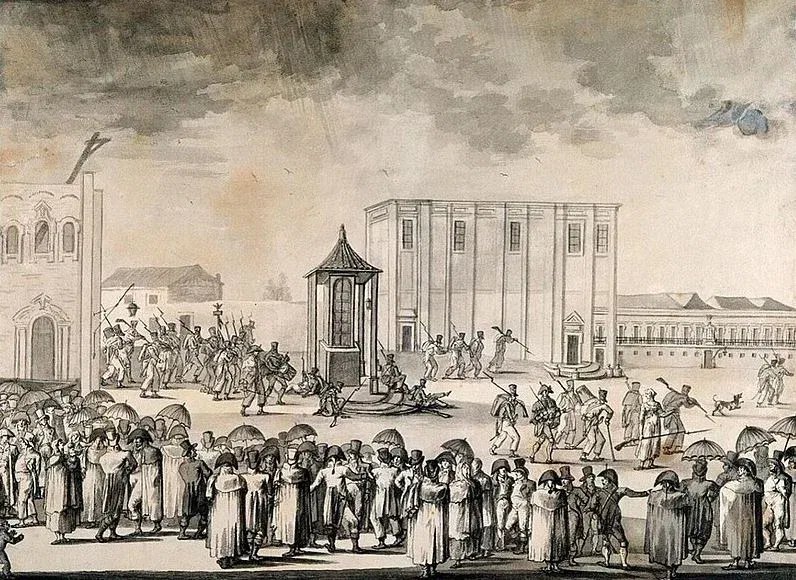
Prince Regent João made his decision. The entire House of Braganza would relocate to Brazil. Getting Maria to the harbor required force. She screamed through the streets of Lisbon on November 29, 1807, convinced she was being kidnapped, and had to be physically carried aboard the Príncipe Real. The crossing lasted approximately three months. She screamed through much of it.
Portugal, meanwhile, became the theater of the Peninsular War, with British forces under General Arthur Wellesley leading the campaign to drive French troops from the country and into Spain. Portuguese forces under British command played a significant role in the effort. Maria’s government, operating from exile in Brazil, provided material support throughout. In 1815, in recognition of Brazil’s strategic importance during the wars, Prince Regent João elevated the colony to the status of a kingdom. Maria was proclaimed Queen of the United Kingdom of Portugal, Brazil and the Algarves.
She almost certainly had no idea.
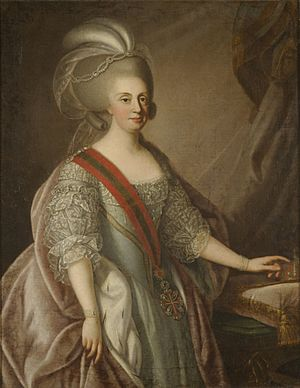
Maria I Died in Rio de Janeiro at Eighty-One
Maria I died on March 20, 1816, at the Convent of Carmo in Rio de Janeiro. She was 81 years old. She had spent eight years in Brazil in a state of progressive incapacitation, her reign functionally over for more than two decades before her death. Her son was proclaimed King John VI upon her passing. In 1821, her remains were returned to Lisbon and interred at the Estrela Basilica, which she had helped to found during the years when she was still capable of deciding things.
There has never been a consensus on her diagnosis. Researchers have proposed bipolar disorder, major depressive disorder with psychotic features, and porphyria. What the historical record establishes without dispute is that she governed Portugal with genuine competence for roughly nine years, then spent the next thirty-two years in progressive collapse, carried from palace to exile to convent, screaming at things no one else could see.
In Portugal she is remembered as Maria the Pious. In Brazil she is called Maria the Mad. Both names were earned by the same woman, in the same life, and she became one before she became the other.
What she called herself during the screaming hours at Queluz, no one thought to ask.
Leave a Reply