
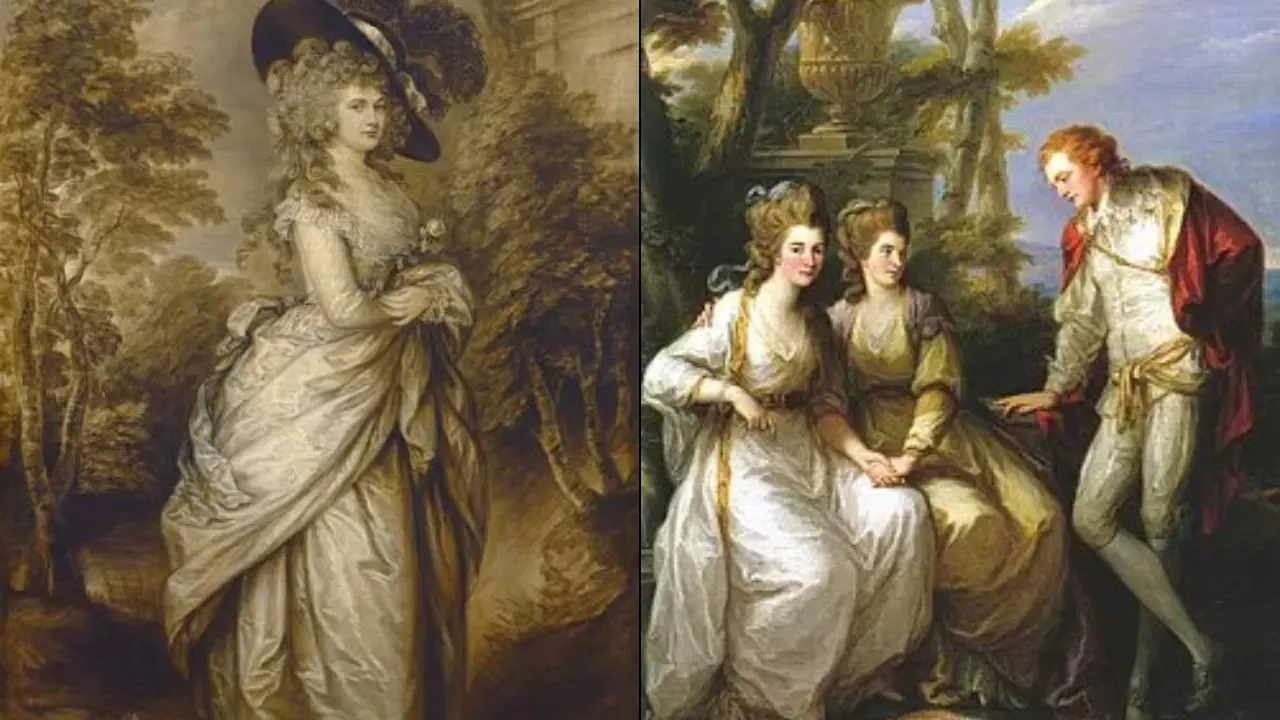
Behind the fashion triumphs and political campaigns of Georgian England’s most celebrated woman lay £100,000 in hidden debt, a ménage à trois beneath her own roof, and a daughter she was forced to surrender in France.
The general election of 1784 brought the Duchess of Devonshire to the streets of Westminster on foot. She walked until blisters formed, pressing into the crowds, meeting butchers and dustmen and tradesmen as equals, trading jokes and conversation for Whig votes. Cartoonists caricatured her for it. Newspapers accused her of trading kisses for votes. She kept walking.
No one in those crowds knew she owed £100,000.
A Gilded Marriage Concealed Cold Silence
Georgiana Spencer was born on June 7, 1757, at Althorp in Northamptonshire, the eldest child of John Spencer, later the 1st Earl Spencer, and his wife, Margaret Georgiana Poyntz. The Spencers occupied a position near the top of English aristocratic society. Her father built Spencer House at St. James’s in London, entertained prominent literary and political figures, and was by contemporary accounts an unusually affectionate parent in an era that rarely demanded such things from men of his standing. Georgiana was her mother’s acknowledged favourite. She grew up with the expectation that she would be met with warmth by the people closest to her.
It was not the world she was about to marry into.
On her seventeenth birthday, June 7, 1774, Georgiana married William Cavendish, the 5th Duke of Devonshire, at Wimbledon Parish Church. He was nine years her senior and one of the wealthiest men in England. The ceremony was deliberately small, attended only by close family. The Duke’s contemporaries described him as “incapable of any strong emotion, and destitute of all energy and activity of mind.” Georgiana had believed his reserve might conceal something warmer, something like her father’s introverted devotion. She was mistaken. She learned quickly that her role was to produce an heir and fulfil her social obligations. Nothing more was on offer.
She responded by filling the silence with everything else available to her.
Fashion Transformed Her into a National Obsession
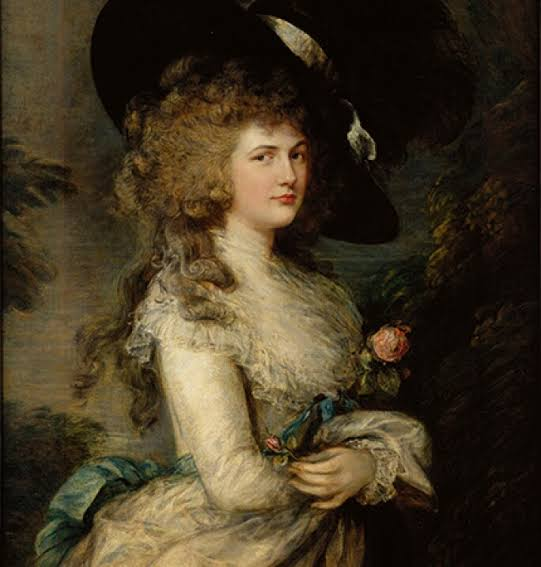
Within months of her marriage, Georgiana had emerged as the dominant figure in Georgian fashion. Every outfit was copied. Every hairstyle spread through London high society within days. In 1774, Lord Stormont presented her with a four-foot ostrich feather from Paris. Overnight, towering feathered headdresses became the defining aesthetic of the decade. Caricaturists across London scrambled to mock them. Georgiana was already wearing the next thing.
The press watched her without pause. Horace Walpole, who had observed every celebrated woman of the century, called her “a phenomenon”: not quite a conventional beauty, but possessed of warmth, wit, and a quality he struggled to name. At a society event, the Duchess of Manchester pointedly refused to speak to the French actor Monsieur Tessier because he earned his living on stage. Georgiana danced with him. None of this was performance. It appeared to be who she actually was.
But behind the spectacle, Georgiana was accumulating debt she could not admit to, suffering miscarriages she could not discuss, and drinking heavily in the company of some of the most dissolute figures in Georgian society. Letters to close friends in the late 1770s and early 1780s described feelings historians have since identified as symptoms of depression. The English press continued to celebrate her as England’s most admired woman. She continued to smile.
A Distant Cousin Made Her His Political Weapon
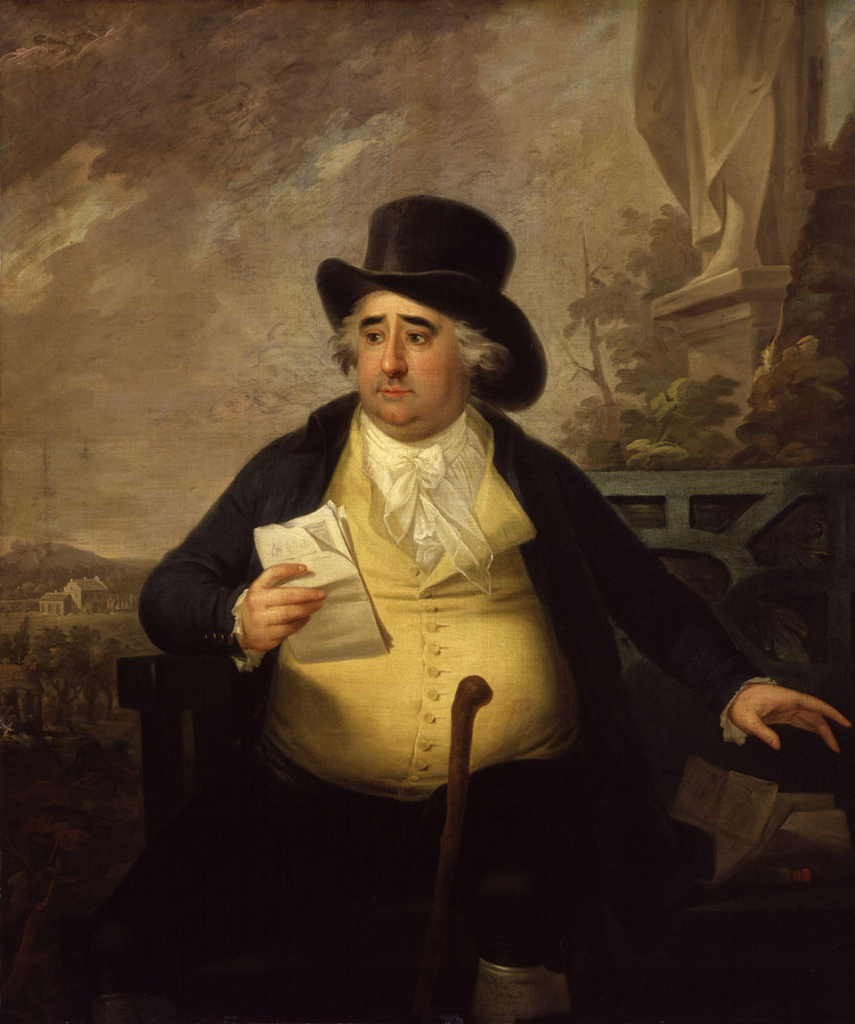
In 1778, Charles James Fox, the leading figure in the Whig party and Georgiana’s distant cousin, approached her with a proposal. He had identified something useful in her celebrity: the capacity to make political causes feel warm and personal and desirable. At a time when women could not stand for Parliament and were broadly excluded from formal political life, Georgiana agreed to campaign openly for Fox and the Whigs.
She dressed in semi-military garb and encouraged the women of London high society to do the same. She hosted political dinners at Devonshire House in Mayfair that functioned as strategy sessions. She served as intermediary between Fox and the Prince of Wales, the future King George IV, whose support the Whigs needed and whose open hostility toward his father, the periodically unstable King George III, made him a significant political figure in his own right.
For a few years, it worked brilliantly.
The 1784 general election ended it. King George III allied himself with Tory leader William Pitt to drive Fox from his Westminster seat, and the press turned on Georgiana with a ferocity that stunned her. Political cartoons depicted her soliciting votes through sexual favors. Newspapers attacked her character in terms that made her, as she later admitted, feel publicly stripped. Fox held his seat. The duchess withdrew from visible political life, stung far more deeply than she allowed anyone to see.
Bess Foster Moved Into the Marriage Permanently
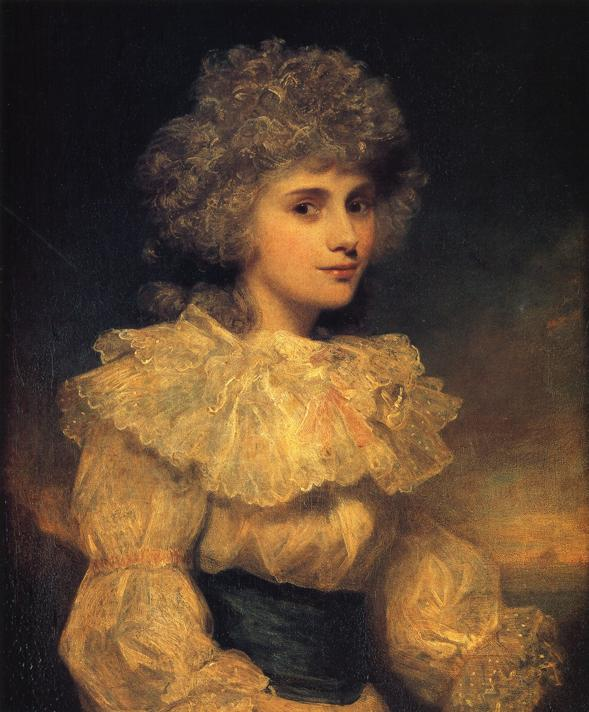
In 1782, while on a retreat from London with the Duke, Georgiana met Lady Elizabeth Foster at the city of Bath. Known as Bess, she was the daughter of the 4th Earl of Bristol and had become destitute after separating from her husband and losing custody of her sons. Georgiana was drawn to her immediately. With the Duke’s agreement, Bess was invited to come and live permanently with the family at Devonshire House.
The arrangement shifted within months.
The Duke began a sexual relationship with Bess. Georgiana, who had found in her new friend something she had never found in her marriage, a companion who was genuinely present and genuinely interested in her, became quietly complicit. Whether she welcomed it or simply accepted it remains unresolvable. Her letters to Bess from this period are extravagant in their devotion: “My dear Bess, do you hear the voice of my heart crying to you?” At Bess’s death, decades after Georgiana’s own, a locket of Georgiana’s hair was found around her neck. A bracelet containing her hair lay on the table beside the deathbed.
The three of them moved through Georgian society as a unit.
Georgiana gave birth to two surviving daughters in these years: Lady Georgiana Dorothy Cavendish on July 12, 1783, and Lady Harriet Elizabeth Cavendish on August 29, 1785. In the same period, Bess gave birth to two of the Duke’s children, a daughter, Caroline Rosalie St Jules, and a son, Augustus Clifford. All four children were raised together under the Cavendish roof.
The household had become something for which Georgian England had no adequate name.
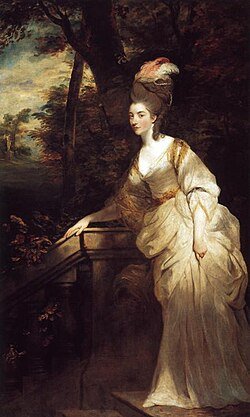
Debt and an Affair Ended Her Freedom
By 1784, Georgiana’s gambling debts had reached £100,000, approximately £13 million in present-day terms. She had borrowed from the Prince of Wales. She had borrowed from her close friend Mary Graham until Graham’s husband discovered it. She had sought funds from the banker Thomas Coutts. Each time the Duke was informed, she confessed to a figure smaller than the truth, accepted his payment, gambled the money away, and fell further behind. She wrote to a confidante: “I never had courage to own it, and tried to win it at play, by which means it became immense.”
She knew what she was doing. She could not stop.
On May 21, 1790, she gave birth to a son and male heir, William George Spencer Cavendish, later the 6th Duke of Devonshire. As social convention dictated, the birth of an heir gave a wife the latitude to take a lover. The man Georgiana chose was Charles Grey, a young Whig politician who would later serve as Prime Minister. By 1791, she was pregnant with his child.
The Duke had fathered illegitimate children with Bess without consequence. Grey’s child was different. It represented a public scandal he was unwilling to absorb. He gave Georgiana an ultimatum: accept exile from England or face divorce. She chose exile.
On February 20, 1792, Georgiana gave birth to a daughter, Eliza Courtney, in France. The child was surrendered to the Grey family and raised in England without her. Georgiana had not expected to survive the birth. She had already written what she believed was a farewell letter to her infant son: “As soon as you are old enough to understand this letter, it will be given to you. It contains the only present I can make you, my blessing, written in my blood.”
She survived the birth. She did not survive losing Eliza intact.
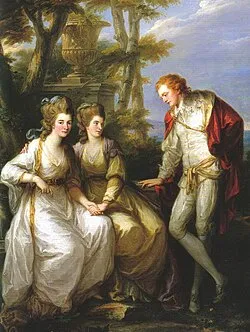
Exile Lasted Years and Left Its Marks
The 1790s were the bleakest decade of Georgiana’s life. She traveled through France, Switzerland, and Italy with her sister Harriet and her legitimate children, eventually settling in Naples. She wrote to her eldest daughter from exile in terms that make the separation almost unbearable to read: “Every hour I pass away from you, I regret you; if I amuse myself or see anything I admire I long to share the happiness with you.”
In 1793, after her husband’s fury had sufficiently cooled, she was permitted to return to England. The homecoming brought no sustained relief. In 1796, an infection destroyed the sight in one eye and left a disfiguring scar across her face. Contemporaries noted, with some surprise, that the injury appeared to free her from something she had never managed to put down. “Those scars released her from her fears,” one observer recorded. “All the inhibitions about whether she was beautiful enough or whether she was up to the job left her.”
She quit gambling. She resumed writing. She re-entered political life.
She Rebuilt Herself and Was Gone
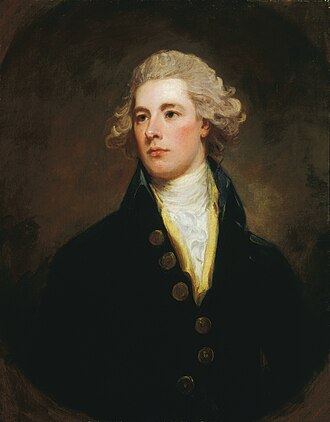
In 1801, William Pitt resigned as Prime Minister and the fractured Whig coalition required rebuilding. Georgiana resumed the intermediary role she had performed so effectively two decades earlier, working between Charles James Fox and the Prince of Wales to help construct the political alliance that would eventually govern Britain during the most critical phase of the Napoleonic Wars. She was effective. She was trusted.
On March 30, 1806, Georgiana Cavendish died at Devonshire House in London, aged 48. The cause was a liver abscess, almost certainly the consequence of years of excessive drinking. Surrounding her at the end were her husband, her mother, her sister, her eldest daughter, and Lady Elizabeth Foster.
The Duke, who had displayed almost no visible emotion throughout thirty years of marriage, wept openly. Contemporaries reported him “more deeply affected than anyone thought possible.”
He married Bess within two years.
After her death, the full extent of her debts was discovered. Thousands of Londoners gathered at Piccadilly to mourn her. The Prince of Wales said: “The best natured and the best-bred woman in England is gone.” Her son spent years paying off what she had never been able to fully confess. Eliza Courtney, the daughter surrendered in France, grew up with the Grey family, married, and named her own daughter Georgiana.
The great-great-great-grandaunt of Diana, Princess of Wales was buried at All Saints Parish Church in Derby. She had been celebrated in every newspaper in England for thirty years. They had described everything except what it cost Georgiana Cavendish.
Leave a Reply