
In 1927, five dying New Jersey factory workers filed a lawsuit against the corporation that had knowingly let them swallow radioactive paint for years, then attributed their deaths to syphilis.
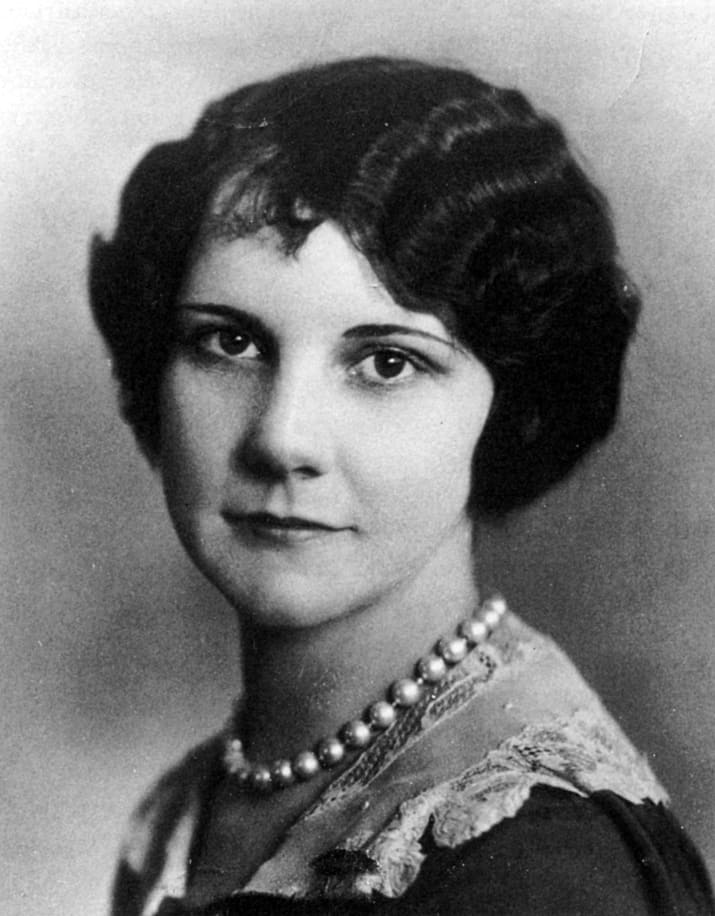
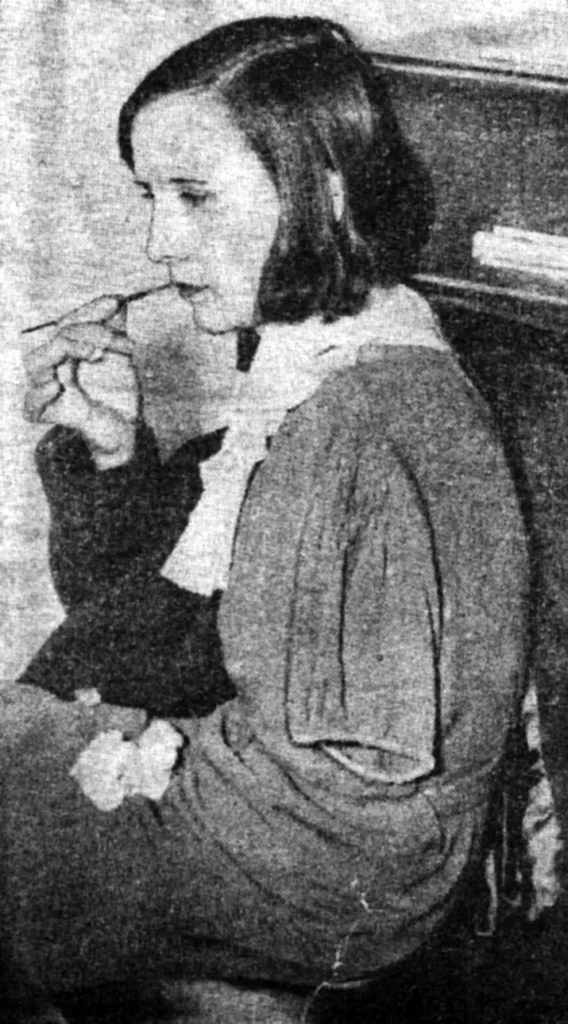
On a morning in January 1928, Grace Fryer appeared in a Newark courtroom for the first time. She could not raise her arm to take the oath. Her spine had collapsed so badly that she wore a steel brace just to sit upright. She was 28 years old.
She had spent two years trying to find a lawyer willing to take her case. Two years of rejections while her body fell apart around her. The corporation that had employed her knew exactly what was happening. It had known for a long time.
Who Was Grace Fryer
Grace Fryer was born on March 14, 1899, in Orange, New Jersey, the daughter of Daniel Fryer, a union representative. By all accounts she was sharp, sociable, and deeply committed to the idea that she should pull her weight.
When the United States entered the First World War on April 6, 1917, two of her brothers were sent overseas. Four days later, Grace found work at the United States Radium Corporation, known as USRC, in her hometown. She was 18 years old.
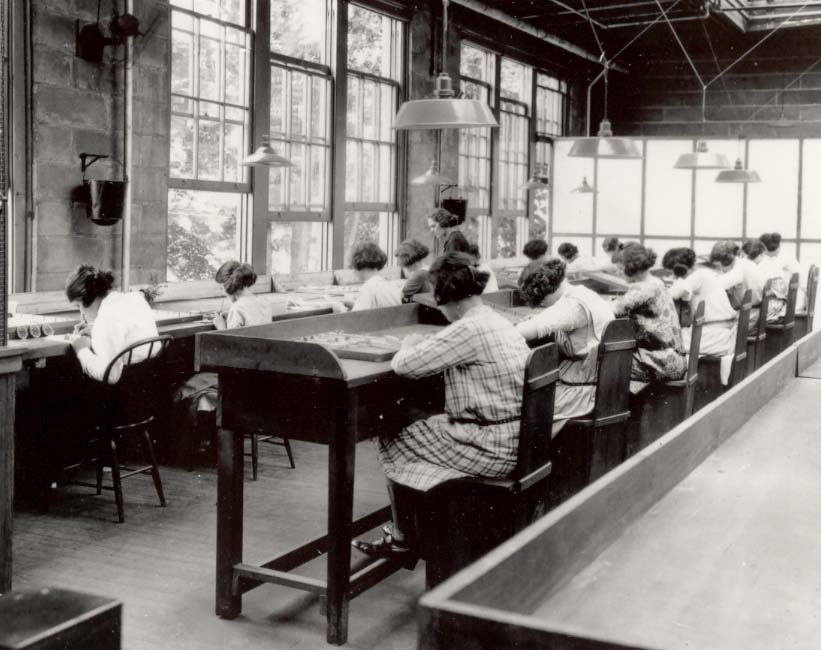
USRC produced a luminescent paint called Undark, applied to the dials and hands of military watches so that soldiers could read them in darkness. The factory employed as many as 300 workers, most of them young women. Their wages were roughly triple those of a standard factory job, making them among the highest-paid female workers in the country. Contemporary accounts described dial painting as the elite job for poor working girls.
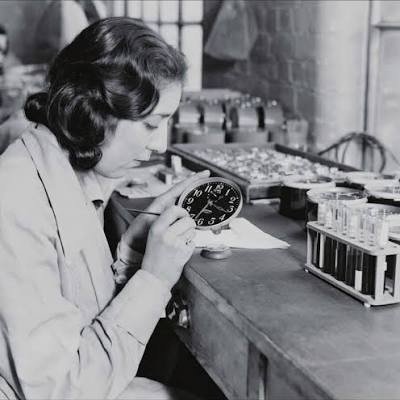
The studio where Grace worked shimmered. The girls mixed their own paint in small crucibles and applied it to tiny watch dials with camel-hair brushes. After every few strokes, the brush lost its point. Workers were taught to restore it using their lips. The technique was called lip-pointing: lips, dip, paint. The gesture repeated hundreds of times per shift. The women were told the paint was harmless. Managers assured those who asked that the only side effect of swallowing small amounts was rosy cheeks.
Many painted their nails, their teeth, their faces with the glow-in-the-dark paint so they could shine at evening dances.
Photographs from those years show girls glowing in the dark like lanterns. Contemporaries called them the Ghost Girls.
The scientists at USRC did not glow. They worked behind lead screens, used tongs, and wore lead aprons. USRC had distributed literature to the medical community describing the injurious effects of radium. That literature did not reach the factory floor.
In 1922, Amelia Maggia, known to her colleagues as Molly, left her job at USRC. She was too ill to continue. It had started with toothache. Then several teeth fell out. Then came pains so severe she could not walk. Doctors could find nothing conclusive. In the end, Molly lost all her teeth. Her jawbone, eaten from within, was simply lifted from her mouth by her dentist.
Molly Maggia died on September 12, 1922. She was 24 years old. She was the first dial painter to die of what would eventually be identified as radium poisoning.
She would not be the last.
USRC Buried Evidence and Blamed Syphilis
As more dial painters fell ill and died, USRC launched a disinformation campaign of deliberate precision. Working in cooperation with physicians, the company ensured that official causes of death were recorded as syphilis. The strategy was surgical in its cruelty: syphilis was a notorious sexually transmitted infection, and attributing deaths to it destroyed the women’s reputations while insulating the corporation from any legal exposure.
In the early 1920s, USRC hired Cecil Kent Drinker of the Harvard School of Public Health to examine the Orange factory and determine why employees were dying. Drinker and his wife, Katherine Rotan Drinker, found a working environment saturated with radium-contaminated dust. Workers had no protective equipment of any kind. Their conclusion was unambiguous: continuous exposure to radium was causing the deaths.
USRC’s president, Arthur Roeder, rejected the findings and threatened to sue Drinker if he published them. Drinker initially acquiesced. Later, when a Harvard colleague named Alice Hamilton discovered that Roeder had submitted an altered version of the report to the New Jersey Department of Labor, Drinker published the unaltered findings regardless.
For years, the altered report had been the only version the wider scientific community knew.
Grace Fryer’s Spine Began to Give Way
By 1925, Grace’s health had deteriorated sharply. Her jaw had weakened. Her spine was collapsing. She was fitted with a steel back brace. Her own physician raised the possibility that her condition might be connected to her years at USRC.
Grace consulted a specialist named Frederick Flynn, who examined her and concluded that her condition had nothing to do with her former employer. Flynn was not a physician. He was an industrial toxicologist working under contract to USRC.
That same year, USRC’s own chief chemist, Dr. Edwin Leman, died under circumstances consistent with those of the dial painters he had worked alongside.
In 1925, Dr. Harrison Martland, county physician of Newark, conducted his own investigation. Through testing, Martland established definitively that the radium the women had ingested was emitting constant radiation from inside their own bones, punching holes through them and destroying them from within. The damage was irreversible. The poisoning was fatal.
The Ghost Girls, who had once loved the shimmer they carried home from work, now understood what it had always meant.
Grace Fryer decided to sue. The radium industry was powerful, politically connected, and actively working to discredit Martland’s findings. For two years, every lawyer she approached turned her down.
Her persistence eventually came to the attention of a young attorney named Raymond Berry. He agreed to take the case. Berry filed suit on behalf of Grace and four of her colleagues: Edna Hussman, Katherine Schaub, Quinta McDonald, and Albina Larice. Together they sought $250,000 each in damages.
The five women became known as the Radium Girls.
“It is not for myself I care,” Grace told reporters. “I am thinking more of the hundreds of girls to whom this may serve as an example.”
The Court Delayed While the Women Died
The case became an international scandal. USRC played every delay available to it.
By the time of the women’s first court appearance in January 1928, two of the five were bedridden. None of them could raise an arm to take the oath. The April hearing was postponed because the women were too ill to attend. A judge then adjourned the case until September, citing witnesses who were traveling in Europe. One newspaper editor described the decision as a damnable travesty of justice.
Public outrage forced the hearing back to June. By then, some of the five women had been given four months to live.
USRC moved to settle out of court. Desperate and running out of time, the Radium Girls accepted. Each woman received $10,000, a $600 annual annuity paid at $12 per week for the rest of her life, and full payment of all medical and legal costs. The sum was considerably less than they had sought.
Grace had accomplished what she had set out to do. The story was in every newspaper in the country. The industry’s practices were no longer hidden.
Catherine Donohue Carried the Fight to Illinois
The New Jersey case reached women who had never heard of Orange or Grace Fryer.
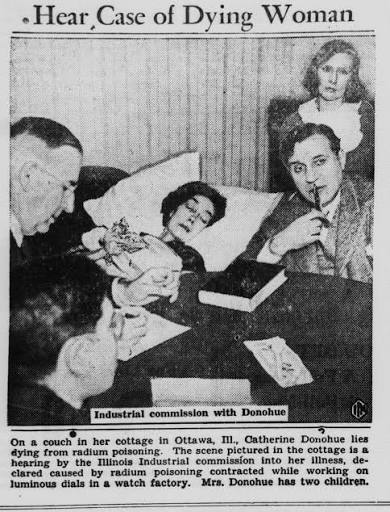
Catherine Wolfe Donohue was a dial painter at the Radium Dial Company in Ottawa, Illinois, which had operated since 1922 using the same lip-pointing technique under identical conditions. When workers in Ottawa began showing signs of illness in 1926 and 1927, Radium Dial ran internal tests to assess the toxicity of its own paint. Management declined to share the results with the workers being tested.
When news of the New Jersey cases arrived in Ottawa, managers told employees that radium was safe and that the New Jersey women had contracted a viral infection.
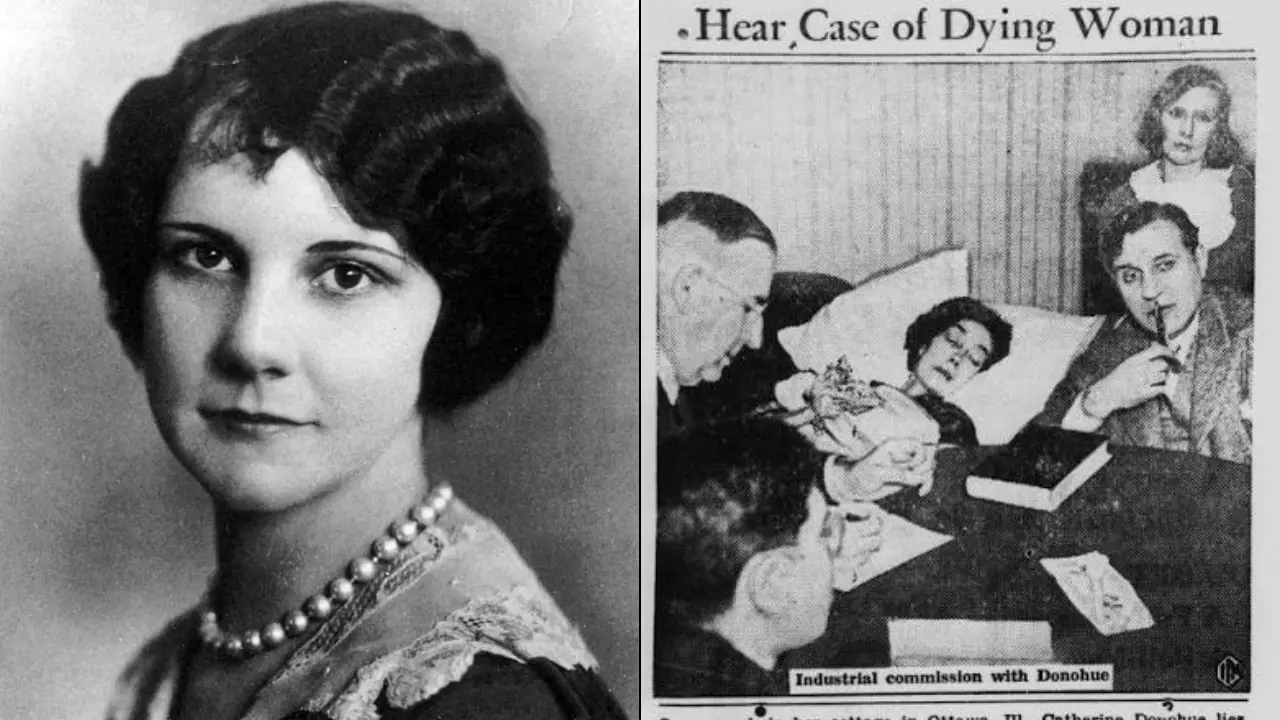
Donohue filed her own suit. She was shunned in her community for taking legal action against one of the few employers still operating during the Great Depression. In the spring of 1938, the Illinois Industrial Commission ruled in her favor.
She gave her testimony from her deathbed.
Catherine Wolfe Donohue died on July 27, 1938. She was 35 years old. The appeal reached the United States Supreme Court, which declined to hear it on October 23, 1939, upholding the lower ruling.
The Law Finally Changed
The cases brought by the Radium Girls and Catherine Donohue established that individual workers could sue corporations for damages arising from labor abuse. Industrial safety standards were overhauled nationwide. In 1949, Congress passed legislation guaranteeing compensation for all workers suffering from occupational diseases.
Radium-based paint continued to be used in dial production into the 1970s. The last factory manufacturing it shut down in 1978.
Grace Fryer died on October 27, 1933, in Orange, New Jersey. She was 34 years old.
The inventor of radium dial paint, Dr. Sabin Arnold von Sochocky, had died five years earlier, in November 1928. He was the 16th known victim of the substance he created.
Several of the women Grace worked alongside are buried in Orange’s Rosedale Cemetery. Due to the radium still embedded in their bones, their remains continue to emit radiation today. The Ghost Girls are still glowing.
Leave a Reply