
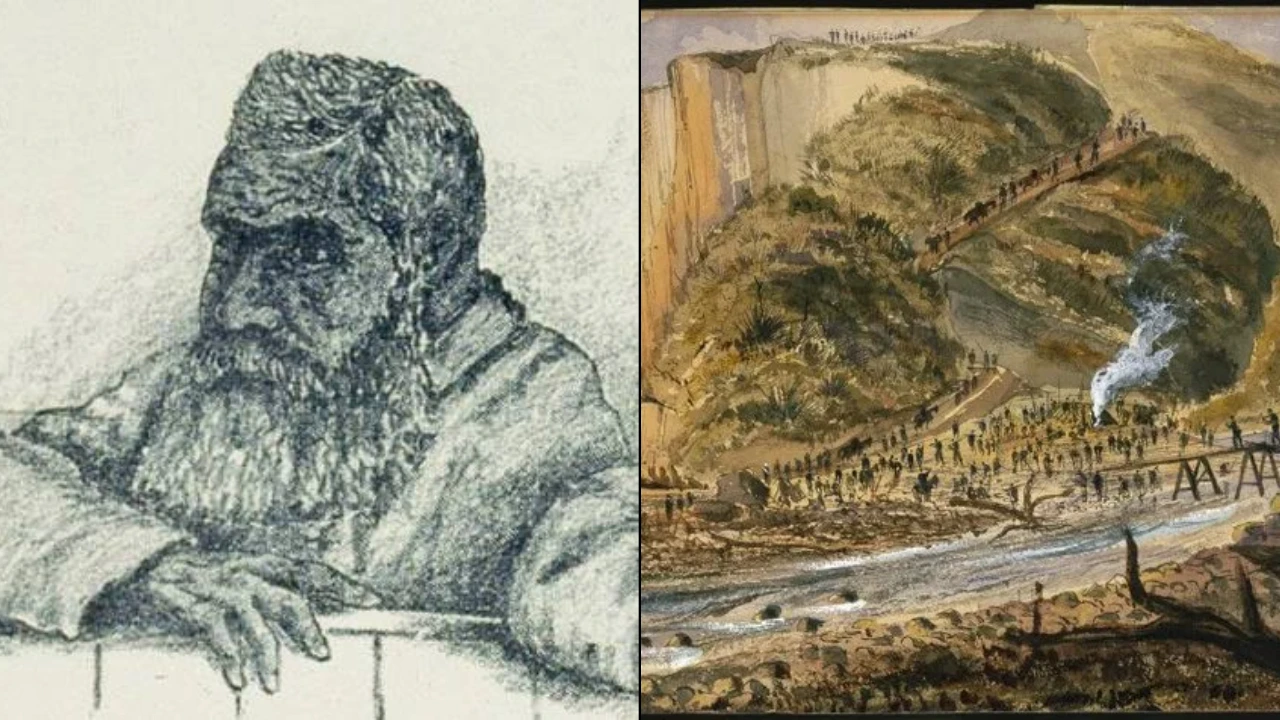
Born a carpenter’s son in a remote Maine port town, Kimball Bent spent fifty years on the run from the British Empire and never once looked back.
Bent Escapes Eastport and Enlists in Two Armies
Kimball Bent was born on August 24, 1837, in Eastport, Maine, the fourth of seven children of John Bent, a shipbuilder and carpenter, and his wife Eliza Bagley. Eastport sat at the furthest northeastern edge of the United States, a cold working port on an island in the Bay of Fundy, separated from New Brunswick by the width of a narrow channel. It was geographically remote, economically modest, and for Kimball Bent, evidently intolerable. He ran away to sea at 17.
He spent three years aboard U.S. Navy vessels, travelling the Atlantic seaboard as a sailor and gunner. By his own later account, recorded by journalist James Cowan in the early 1900s, he became a capable seaman who trained new recruits in the operation of muzzle-loading six-pounder and eight-pounder guns. He returned to Eastport after his three-year service. He left again almost immediately, sailing for Liverpool, England, where he reportedly arrived penniless, his money spent on drink.
On October 18, 1859, Bent enlisted in the 57th (West Middlesex) Regiment of Foot. He was 22 years old. He later claimed he had a wife and three children back in Maine. He never mentioned them again.
Sent to Cork, Ireland, for training, Bent deserted within weeks. He had spotted a ship in Cork harbour whose captain he recognized from his U.S. Navy days, and that evening he slipped out of the barracks and boarded the vessel quietly. The escape lasted less than 300 miles. A violent storm disabled the ship and a rescue vessel, heading in the wrong direction, carried the survivors to Glasgow. British military police were waiting on the dock.
A court-martial sentenced Bent to 84 days in prison. He served every day, then was shipped with the 57th to Bombay, India, where the regiment performed two years of garrison duty. In 1861 came orders for New Zealand. The 57th was needed there because a war had been building across the Taranaki region since 1860, when the British colonial government confiscated Māori land at Waitara to force settlement. Tribes that had resisted dispossession for years were now fighting back with force. The 57th arrived in Auckland after 89 days at sea.
There is a well-known name in New Zealand for the significant number of Māori who chose to fight alongside the British during the New Zealand Wars: kūpapa Māori. Far less known is the tiny handful of European soldiers who made the opposite decision and crossed to the Māori side. Most of them left almost no historical record. Kimball Bent was the exception.
A Punishment the British Army Cannot Make Him Accept
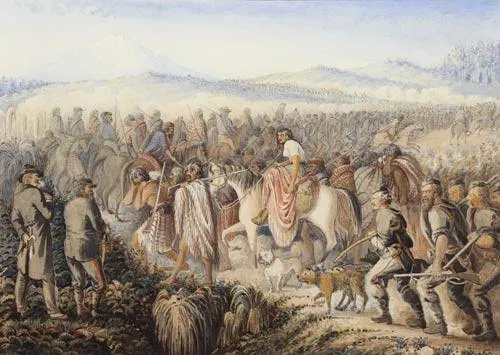
Between 1860 and 1865, Bent accumulated what regimental records described as an extensive list of offenses: drunkenness, petty theft, insubordination, and general contempt for military order. A sergeant of the 57th described him as “a man repeatedly punished for acts of petty thievery and drunkenness.” Bent reportedly drank even more heavily to cope with the conditions of fighting in the Taranaki bush, where the regiment engaged Hauhau fighters in dense, difficult terrain against an enemy that knew the ground and they did not.
In March 1865, the 57th was posted to Manawapou, South Taranaki, near the Tangahoe River. One rainy day, an officer ordered Bent to collect firewood. Bent refused. He was sentenced to 50 lashes on the triangles before his entire company. A regimental doctor intervened, certifying that Bent was physically incapable of surviving the full punishment. The sentence was reduced to 25.
He then served a prison term in Wellington.
When he returned to Taranaki, he had already decided. He told his fellow soldiers: “I can’t be worse off with the Māoris than I am here. If they do tomahawk me it will be the end of all my troubles. I don’t very much care.”
On June 12, 1865, Bent told the men around him that he wanted to bathe in the Tangahoe River.
He did not come back.
A Chief Decides Not to Kill a Wet Soldier
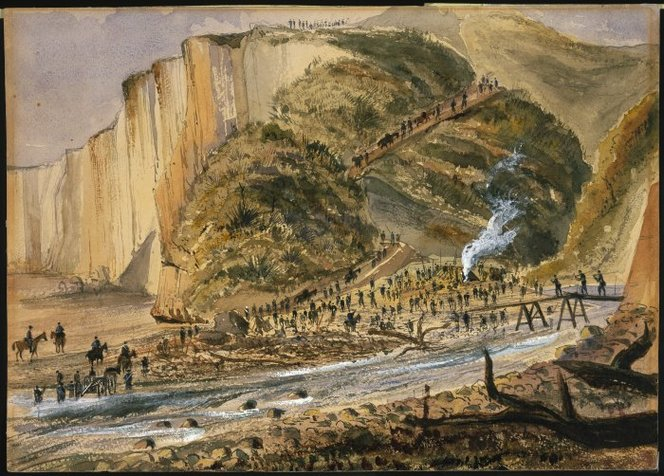
On the bank of the Tangahoe River, a Ngāti Ruanui rangatira named Tito Hanataua was on horseback, scouting a nearby British fort, when he came face to face with a dripping man in a British Army scarlet uniform. Bent begged to be taken with him. Tito Hanataua considered the request. He asked Bent his name. Kimball Bent, the soldier said. Too hard, the chief replied. They would give him a better name. A Māori name. If his tribe did not kill him first.
The tribe did not kill him.
Bent was kept as a mokai, a protected captive whose status sat somewhere between servant and ward. He was given the name Ringiringi, one of Tito Hanataua’s own names, a mark of grudging adoption into the household. He carried out whatever tasks were asked of him: reinforcing fortifications, tending to the wounded, fetching and carrying. He learned the rhythms of Hauhau camp life.
Pai Mārire, sometimes called Hau Hau, was a religious movement founded by the prophet Te Ua Horopapera Haumene in the early 1860s. It blended Christian scripture with traditional Māori spiritual practice, teaching that Māori who followed its rituals would receive divine protection and that the land confiscations were a violation of God’s covenant. By the mid-1860s it had become the ideological framework of Māori resistance across Taranaki, giving the war effort a spiritual coherence that outlasted individual military reverses. It was into this world that Bent was absorbed, not merely as a prisoner of war but as a participant in its rituals and ceremonies.
In January 1866, British forces under General Trevor Chute advanced on Otapawa, a fortified Hauhau settlement where Bent had been living. The 57th Regiment bore the brunt of the assault. During the battle, Bent’s voice was recognized from the defenders’ side, shouting at the Māori fighters to fire low. His old regiment was now the enemy. The settlement fell on January 14, 1866, and its residents fled deeper into the bush.
It was at Otapawa that Bent had met Te Ua Horopapera Haumene himself, the prophet who had founded the movement. Haumene treated Bent with warmth, sharing food and tobacco and a flax cloak. Bent later described him as a strongly built man in his forties who carried a sacred staff and wore European clothing. After the fall of Otapawa, Haumene’s influence waned and the military leadership of the resistance passed to a more formidable figure entirely.
Bent Fights Tītokowaru’s War Against His Own Regiment
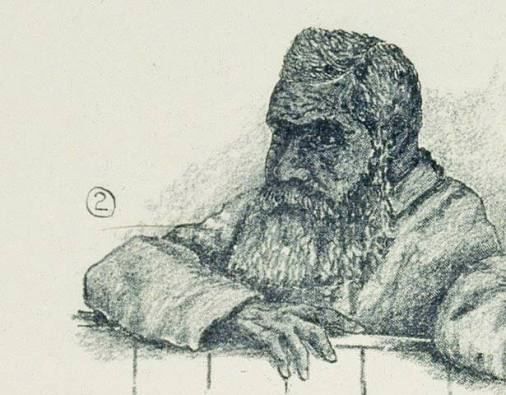
Riwha Tītokowaru was a chief of the Ngāruahine hapū of South Taranaki, and by 1867 he had emerged as the most dangerous Māori commander the British colonial forces had yet faced. A strategist of genuine brilliance, he trained his men in concealment, surprise attacks, the construction of fortified positions with concealed rifle pits, and the tactical use of terrain that consistently neutralized the Europeans’ numerical advantages. In 1867, Kimball Bent joined his forces.
Tītokowaru’s War began in earnest in June 1868 when his fighters attacked the colonial outpost at Turuturumōkai in a pre-dawn raid, killing ten of the garrison’s 22 defenders. The response came on August 21 and then again on September 7, 1868, when Lieutenant-Colonel Thomas McDonnell led 360 colonial troops against Tītokowaru’s forest stronghold at Te Ngutu o te Manu. They outnumbered the defenders by six to one. Sixty Ngāti Ruanui defenders led by Tītokowaru won a brilliant victory at the Battle of Te Ngutu o te Manu. The colonial force had lost its way approaching the position. When it finally reached the clearing in front of the pā, the visible defences appeared modest. The concealed positions in the forest had not been seen at all. McDonnell ordered a retreat, but not before 24 of his men, including Major Gustavus von Tempsky, had been killed.
Von Tempsky was the most celebrated soldier in colonial New Zealand: a Prussian adventurer, watercolourist, and Forest Rangers commander who had become a folk hero to European settlers. He was shot in the head near the palisade while awaiting orders. All attempts to recover his body failed. It was Kimball Bent, according to later accounts preserved by Cowan, who identified the body of von Tempsky after the battle. The man who had deserted the British Army had watched its most famous soldier die from the other side of the fight.
On November 7, 1868, Colonel George Whitmore attacked Tītokowaru at Moturoa, inland from Waverley, with over 300 men. Whitmore’s frontal assault proved ineffective against well-constructed ramparts and concealed riflemen. Another defeat. The colonial forces withdrew and regrouped.
Then, in early February 1869, the war ended in a manner that nobody quite expected. When the assault on Tauranga-ika was launched on February 3, the pā was found to have been abandoned. The reasons are uncertain. According to Kimball Bent, a major disagreement had arisen on the evening before the expected battle, and the decision had been taken to withdraw into the bush. Māori accounts attributed the collapse to a breach of tapu, a violation of sacred law that stripped Tītokowaru of his spiritual authority over his followers. The colonial forces won a war they had not been winning. They won it by walking into an empty fort.
Bent vanished.
He spent years hiding first in the Taranaki backblocks and later in the Wairau district of Blenheim. He remained a wanted deserter with a price on his head. The Hawke’s Bay Herald had reported his activities as early as September 1868, calling him a deserter among the Hau Haus and describing his supposed treacheries against European settlers in language designed to alarm its readers. New Zealand newspapers continued to run accounts of “the renegade Kimball Bent” through the war years and beyond.
The authorities eventually stopped looking.
Bent came, in time, under the protection of a chief named Rupe, of Taiporohenui. When Bent successfully treated Rupe’s son through a serious illness, Rupe rewarded him with a new wife. Her name was Rihi, also recorded in some sources as Te Hau-Rorori-Ua. Rihi and Bent lived together for nearly three years and had one child. Both the child and Rihi died. The records grow fragmentary afterward. Bent is understood to have continued living among the Māori, taking Rupe’s granddaughter as a second wife, though the details are jumbled and drawn almost entirely from Bent’s own later testimony, which Cowan consistently flagged as self-serving and selective.
Through the 1870s and 1880s Bent worked at whatever the seasons offered: builder, fisherman, tattooist, horticulturist, traditional healer using Māori medicine, confectioner. An isolated report from 1886 records him baking and decorating six large wedding cakes and 60 smaller ones for the opening of a meeting house. He had by then spent more than 20 years in the bush and was barely able to speak English. Relatives reportedly contacted him and urged him to return to Maine. He refused every time. He would not go back, he said, until he could establish his innocence of the charges against him.
He never returned.
A Journalist Finds the Last Renegade Alive
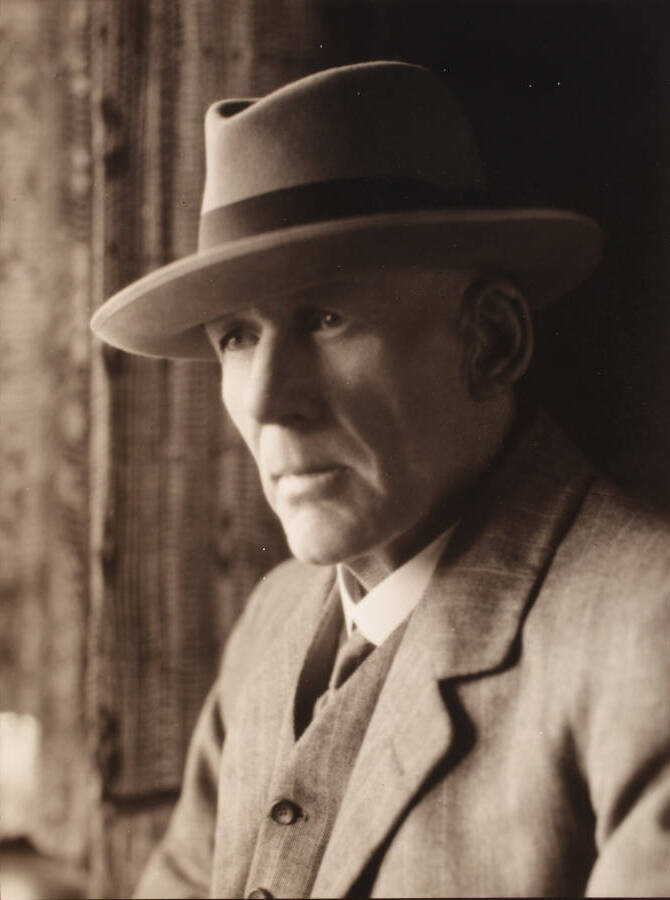
In 1903, James Cowan, a New Zealand journalist and historian, tracked down an old man living quietly in the Wairau district and persuaded him to talk. Bent was 65 years old, physically worn, and struggling to form English sentences after decades without using the language. What he told Cowan was vivid, detailed, and impossible to verify in many of its particulars. Cowan wrote plainly that Bent was undoubtedly a liar: in his youth, to save his own skin; in later life, to retrieve his reputation. But Cowan also noted that many of Bent’s stories were not improbable, and that much of the information he provided carried no motive for self-justification. Cowan spent years cross-referencing Bent’s account against survivors from both sides.
The Adventures of Kimble Bent: A Story of Wild Life in the New Zealand Bush was published in 1911. It was, by contemporary accounts, a sensation.
Bent maintained until the end of his life that he had done the right thing in deserting. The lashes, the prison terms, the drills, the firewood order: each one had been a reasonable man’s response to an institution that had no reasonable use for him. He had found, in the Taranaki bush among a people defending their land from confiscation, something he had never found in the British Army.
On May 22, 1916, Kimball Bent died in Wairau Hospital, Blenheim, New Zealand. He was 78 years old. He was buried in an unmarked grave at Omaka Cemetery. The exact location of that grave is known today only to the descendants of the Māori family who sheltered him in his final years.
Tītokowaru outlived him by decades, eventually becoming a committed supporter of the pacifist prophets Te Whiti o Rongomai and Tohu Kākahi at Parihaka. The man whose war Bent had served in died peacefully. Bent died in a hospital in a country he had chosen over his own.
His story was fictionalised in Maurice Shadbolt’s 1990 historical novel Monday’s Warriors, and again in the 2011 graphic novel Kimble Bent Malcontent: The Wild Adventures of a Runaway Soldier in Old-Time New Zealand by Chris Grosz. New Zealand historians continue to argue about what Bent actually contributed to Tītokowaru’s campaigns and how much of Cowan’s account should be trusted.
The British Army’s records have only ever said one thing about him.
They were still right.
Leave a Reply