
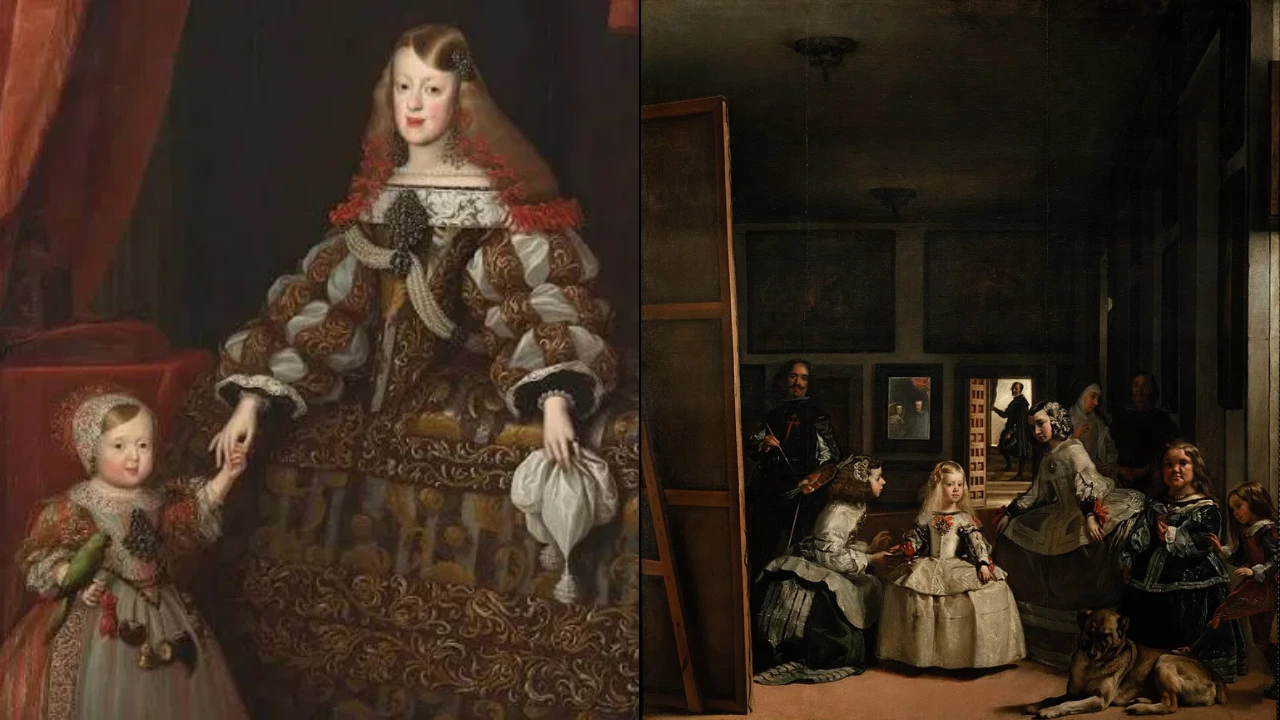
For 49 years, María Bárbola held the official title of Enana de la Reina at the most powerful royal court in Europe. No record survives of where she was born, when she died, or a single word she ever spoke.
On March 30, 1700, a royal decree ended her life at court. King Philip V, reorganizing the Spanish royal household in line with new Enlightenment principles, abolished the office of court dwarf. María Bárbola, who had served the royal family for forty-nine years, packed her belongings and left Madrid. She returned to Austria. After that, nothing.
What remains of her is a painting.
Bárbola Arrived on the Queen’s Coattails
The courts of Madrid and Vienna in the seventeenth century were not merely allied. They were the same dynasty, split across two capitals. Since the abdication of the Holy Roman Emperor Charles V in the late 1550s, the Habsburg family had governed Spain from Madrid and the Holy Roman Empire from Vienna as separate branches of the same house. The two courts conducted business, exchanged ambassadors, shared political intelligence, and regularly sent their children to marry one another. The consanguinity was not accidental. It was policy.
It was this policy that brought Mariana of Austria to Spain, and Mariana of Austria who brought María Bárbola with her.
Mariana was born December 24, 1634, the daughter of Holy Roman Emperor Ferdinand III and his wife Maria Anna of Spain, who was Philip IV’s own sister. As a child, Mariana had been betrothed to Philip’s son, Balthasar Carlos, Prince of Asturias. When Balthasar Carlos died suddenly in 1646, Philip IV was left without a male heir and without a queen. He was also Mariana’s uncle. The solution the Habsburg system produced was for Philip to seek Mariana’s hand himself. On October 7, 1649, the 44-year-old king married his 14-year-old niece in the town of Navalcarnero, outside Madrid. The age difference was thirty years. The ceremony proceeded.
Mariana brought her household from Vienna. By 1651, María Bárbola appeared in the court records of the Spanish royal household, listed among the queen’s attendants. Her official title was Enana de la Reina. Dwarf of the Queen.
Where exactly Bárbola was born remains disputed. Wikipedia identifies her as Austrian. Multiple art historians and the Prado’s own documentation describe her as German. Both are plausible in the same way: in the mid-seventeenth century, the German-speaking Habsburg territories encompassed what is now both Austria and Germany, and the distinction between them was not what it later became. What is consistent across the sources is that she came from those territories, traveled to Spain in Mariana’s household, and was most likely born with achondroplasia. She stood approximately 4 feet tall. In an era when most Europeans did not reach fifty, she reportedly lived past seventy.
The surname Bárbola may carry a history of contempt. The name reportedly derives from the Ancient Greek barbaros, meaning foreign or uncivilized, from which the word barbarian descends. If so, it was not a name she was born with. It was a label applied to her.
Philip IV Built a Court Around Dwarfs
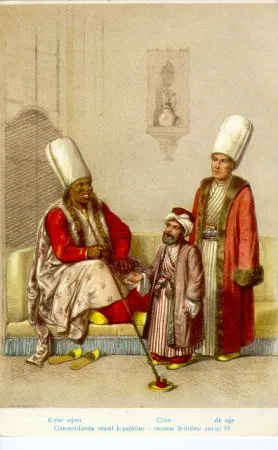
The presence of people with dwarfism at European royal courts was not accidental or informal. From London to Paris to Vienna to Madrid, dwarfs occupied specific, documented roles within royal households. They served as companions, as entertainers, as attendants, and as living emblems of a court’s wealth and reach. Acquiring a notable dwarf required networks, negotiation, and money, and displaying one in your household signaled power. They were often richly dressed, frequently present in the most intimate spaces of royal life, and denied almost all autonomy in exchange for protection and maintenance.
Philip IV of Spain took this practice further than most. Court records indicate he employed over 100 people with dwarfism in his household at various points during his reign. He had a well-documented personal affinity for them. Velázquez, his court painter, reflected this: the portraits he produced of individual dwarfs, including Don Sebastián de Morra and Don Diego de Acedo, treated their subjects with the same technical precision and psychological seriousness he applied to generals and nobles. He painted them seated, reading, staring directly at the viewer, conveying interior lives that the convention of the time did not require and rarely attempted.
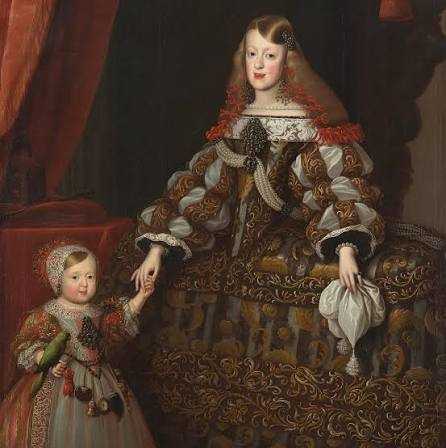
Bárbola was a companion to the Infanta Margaret Theresa, the daughter born to Philip IV and Mariana in 1651, the same year Bárbola entered the household records. The Infanta became her primary charge. Bárbola would watch that child grow up, accompany her through the ceremonies and routines of court life, and outlive her.
The favors Bárbola received suggest she carried real standing within the queen’s household. According to the original source material for this article, court records show that in 1658, a grant was made to Bárbola of one pound of snow for each summer day. Before refrigeration, snow in the summer heat of Madrid was a luxury commodity, produced through emerging techniques and deployed in the making of sorbets and chilled drinks. The grant was not symbolic. It was a daily delivery, recorded as formal recognition of her position.
Velázquez Painted Her Without Apology
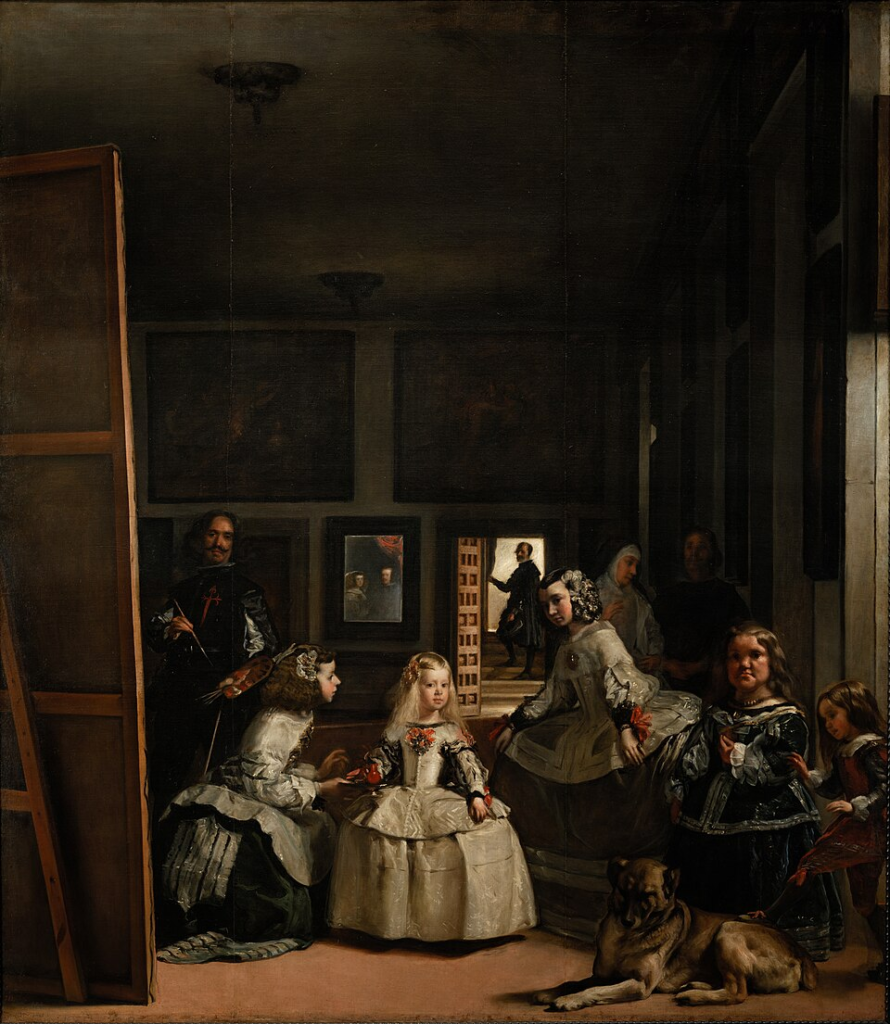
In 1656, Velázquez completed Las Meninas in a chamber of the Royal Alcázar of Madrid, the fortified palace that served as Philip IV’s official residence. The painting depicts a specific, apparently unremarkable afternoon: the five-year-old Infanta Margaret Theresa stands at the center of the composition, attended by her maids of honor. Her chaperone, Marcela de Ulloa, converses in the background with an unidentified figure. The queen’s chamberlain, Don José Nieto Velázquez, stands at the far end of the room on a lit staircase. And at the back wall, in a frame that may be a mirror or may be a painting hanging on the wall itself, two blurred figures look directly out of the canvas. They are Philip IV and Mariana of Austria. Art historians have debated the nature of that image for centuries without settling it.
Velázquez himself appears in the painting, brush raised, watching from behind a large canvas. The red cross of the Order of Santiago is visible on his chest. He was not awarded that knighthood until 1659, three years after completing Las Meninas. After Velázquez’s death in 1660, Philip IV ordered a court painter to add the cross to the composition, in the painter’s posthumous honor. It is there still.
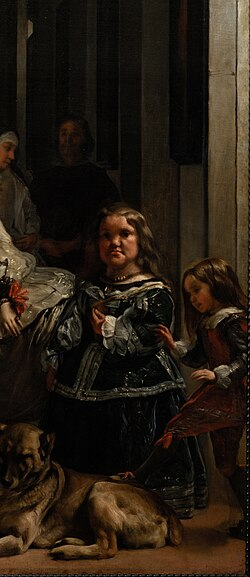
On the right side of the canvas stand two figures. Nicolás Pertusato, an Italian-born court jester, rests his foot on the back of a sleeping Spanish mastiff with what reads as playful distraction. Beside him, to his right, stands María Bárbola. She holds nothing, performs nothing, addresses no one within the frame. Her chin is level. Her gaze meets the viewer’s directly.
This was not the convention. Contemporary portrayals of dwarfs in European art typically depicted them in subservient or comic poses, physically diminished by the composition, shown with animals they were expected to tend. Velázquez had done otherwise before: his individual dwarf portraits were already unusual for their psychological weight. But in Las Meninas, Bárbola shares the compositional status of everyone else in the room. The contrast with Pertusato is sharp and deliberate. He nudges a dog. She watches everything.
A nineteenth-century critic described her as horribly ugly and a little monster. Velázquez did not appear to share that view.
Philip V Abolished the World She Knew
Margaret Theresa, the child Bárbola had accompanied since infancy, left Madrid in 1666 to marry Leopold I, Holy Roman Emperor, in a union that continued the Habsburg practice of cousin marrying cousin. She died in Vienna in 1673, at twenty-one years old, after four pregnancies in seven years. Bárbola, still in service at the Spanish court, outlived her by more than a quarter century.
The world around her was changing. By the late seventeenth century, the Scientific Revolution and the Enlightenment had begun to reshape how educated Europeans understood knowledge, nature, and the proper conduct of institutions. The keeping of court dwarfs, court fools, and court jesters, practices rooted in medieval and Renaissance ideas about spectacle and the ordering of bodies, increasingly struck reformers as irrational, cruel, and out of step with a modernizing age. Courts across Europe began phasing these roles out.
Spain’s turn came under Philip V, the first Bourbon king, who acceded to the throne after the death of the childless Charles II in November 1700. Philip V brought French administrative ideas about rationalized governance to a court that had not changed its fundamental structure in over a century. On March 30, 1700, he issued his decree. The offices of court dwarf, court fool, and several related positions were abolished.
María Bárbola, now approximately seventy years old and the last of a line of court officials that had existed at the Spanish royal household for generations, was dismissed. She returned to Austria, the country she had left as a young woman when Mariana of Austria’s household set out for Spain in 1649. There is no record of who received her. No record of where she lived. No record of her death.
The Gaze That Outlasted the Court
In 1957, Pablo Picasso produced a series of 58 paintings reinterpreting Las Meninas. He returned to María Bárbola more than once across the series, breaking her into the planes and angles of cubism. Art historians note that across multiple variations, her direct forward gaze persisted through every transformation of style.
Las Meninas itself survived the 1734 fire that destroyed the Royal Alcázar entirely. The painting was damaged and subsequently restored by court painter Juan García de Miranda. It was also cut down on both sides at some point, for reasons no one has established. It hangs today in the Museo del Prado in Madrid, in a room of its own, and the scholarly literature it has generated spans centuries.
Every year, visitors stand before it and study the figures it contains. The Infanta who would die at twenty-one. The painter who would die at sixty-one. The monarchs blurred in the mirror or the painting at the back of the room.
And on the right side of the canvas, the woman born somewhere in central Europe sometime around 1630, standing in that Madrid chamber in 1656, looking back. Born in a year no record confirms. Dead in a year no record marks. She arrived in Spain in someone else’s household, served a child who did not outlive her, held a title that would eventually be abolished, and returned to a country that had no record of expecting her.
The painting survived. The palace burned. The court dissolved. The woman in the painting kept looking.
Leave a Reply