
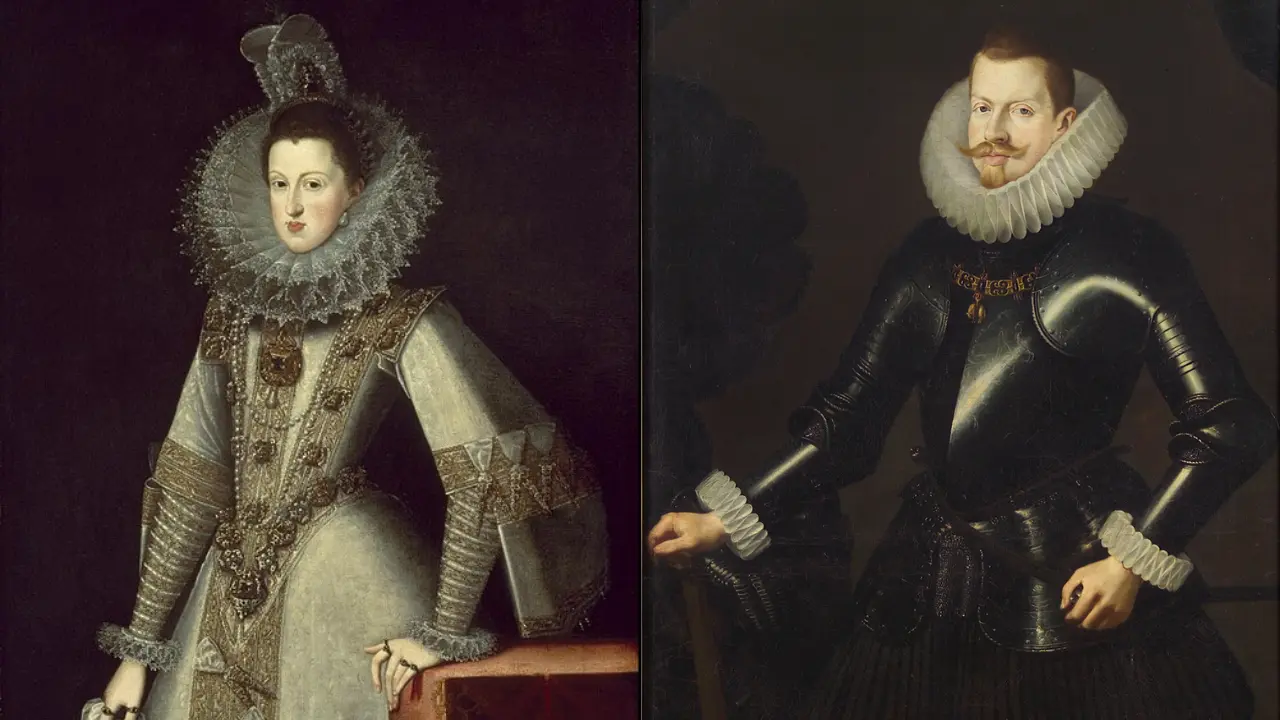
On October 3, 1611, Queen Margaret of Austria died in the royal apartments at Valladolid. The cause was complications from childbirth. Eleven days earlier, she had delivered her eighth child, a son named Alfonso Mauricio, who would not survive his first birthday. Margaret had been pregnant for much of her twelve-year marriage. The cycle had now claimed her.
She was 26 years old.
Philip III, King of Spain, did not remarry. He was 33 when she died, ruler of the largest empire on earth, with decades of reign ahead of him. He died ten years later, still a widower.
The Habsburgs Built Their Empire on Their Own Blood
Margaret was born on December 25, 1584, in Graz, the capital of Styria in what is now southern Austria. Her father was Charles II, Archduke of Inner Austria. Her mother was Maria Anna of Bavaria. The union was intimate even by Habsburg standards Charles and Maria Anna were first cousins once removed, their bloodlines already interlocked through generations of dynastic calculation. Against those genetic odds, twelve of their fifteen children survived into adulthood. Margaret, their eighth child, was born into a household already arranged around ambition.
The Habsburg dynasty had dominated Europe since the late Middle Ages. By the sixteenth century, it controlled Austria, Hungary, Bohemia, and Croatia from Vienna, while a parallel branch ruled Spain and its vast colonial empire. That split had come when Charles V, Holy Roman Emperor and King of Spain, divided his inheritance: Spain and its overseas territories passed to his son Philip II, while the Austrian lands went to his brother Ferdinand I. Two branches of the same family now governed much of the known world from opposite ends of the continent, and both remained obsessed with keeping power within the bloodline.
Margaret belonged to the Styrian line, a junior branch of the Austrian Habsburgs based in Graz rather than Vienna. The senior Viennese line was led, at the time of her birth, by Emperor Rudolf II, a reclusive and eccentric ruler more absorbed by art, alchemy, and the occult than governance. Rudolf had no legitimate heirs. His brother Matthias was also childless. Into that succession vacancy, the Styrian branch pressed quietly forward. Margaret’s older brother Ferdinand stood to inherit the senior Austrian Habsburg title one day. That possibility transformed the entire Graz household into a political instrument.
Margaret was educated accordingly. She studied Latin, the shared language of scholarship and Catholic liturgy across early modern Europe. She learned calligraphy, music, and the geography of a dynasty that stretched from Madrid to Manila. She was also schooled in the political fault lines of her age. The Protestant Reformation had fractured the illusion of Catholic unity across the Holy Roman Empire since 1517, and the tension between Protestant and Catholic states had not resolved. Margaret grew up inside that unfinished conflict.
Spain Received a Queen and Gained a Political Operator
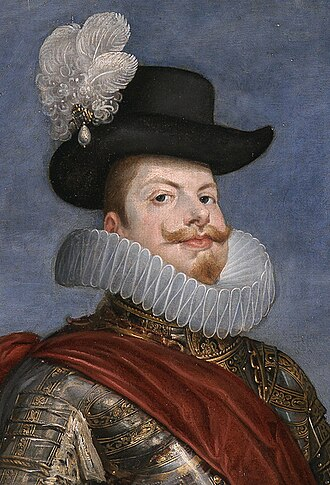
By the time Margaret turned fourteen, the calculations around her future had been resolved. Philip III of Spain, newly crowned after the death of his formidable father Philip II, required a Habsburg bride. The Styrian branch required Spanish resources and diplomatic backing. Margaret’s marriage served both purposes.
She arrived in Spain in early 1599 to considerable ceremony and expectation. The wedding took place on April 18, 1599. Philip had just turned twenty-one, already burdened with the debts and unresolved wars his father had left behind. Margaret was fourteen. With that single ceremony, she became Queen of Spain, Portugal, Naples, and the Indies, and the nominal ruler of an empire that encompassed vast stretches of the Americas, the Caribbean, Africa, Asia, and the Pacific.
What awaited her was not the power the ceremony implied.
Philip III was not the man his father had been. Philip II had governed through relentless attention, controlling policy through exhaustive correspondence and personal directive. Philip III was impressionable, easily swayed, and disinclined to govern at all. The effective power of the Spanish crown resided with Francisco Gómez de Sandoval, the Duke of Lerma, a nobleman who had cultivated Philip’s trust since before his accession and who now functioned as the kingdom’s true administrator. Lerma had no interest in sharing that authority with a teenage Austrian queen.
Margaret had every intention of claiming a portion of it regardless.
Margaret Outmaneuvered the Duke of Lerma
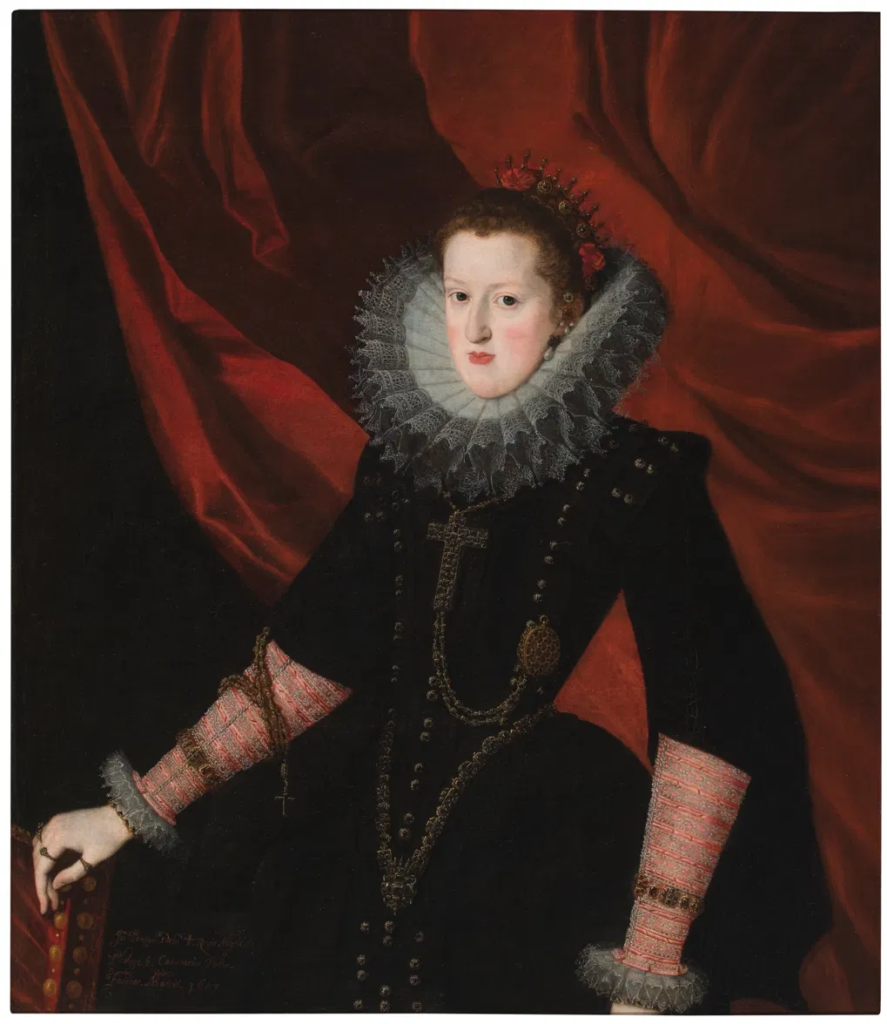
Her marriage to Philip was, by the common measure of royal unions, a close one. Philip was attentive. She was determined. She was also clear-eyed about the limits of her formal position and the avenues available to work around them.
Lerma controlled access to the king. He managed appointments, shaped foreign policy, and filtered the advice Philip received. He recognized, without pleasure, that the young queen had political instincts considerably sharper than her husband’s. He worked to confine her influence, managing her access to formal channels and dismissing her counsel on affairs of state.
She built a coalition outside his authority instead.
Margaret’s primary allies were two Austrian Habsburg women already resident at the Spanish court. The first was Empress María of Austria, widow of Emperor Maximilian II, who had chosen to remain in Spain rather than return to Vienna and who wielded significant informal authority until her death in 1603. The second was María’s daughter, Margarita de la Cruz, a royal nun of noted piety and extensive courtly connections who outlasted her mother at court by decades. Together, the three women operated outside the formal structures of male court power, shaping policy through personal access, strategic counsel, and the proximity that Philip’s devotion to his wife continued to provide.
Their objective was specific. Margaret wanted Spain to commit diplomatic and military support to her brother Ferdinand’s ambitions in central Europe and to the restoration of Austrian Habsburg supremacy across the fractured Holy Roman Empire. Lerma resisted the entanglement.
Margaret prevailed.
Philip III’s foreign policy tilted steadily toward Austria across his reign. When Ferdinand II faced a Protestant revolt in Bohemia in 1618, sparking the conflict that became the Thirty Years War, Spain committed resources and forces to the Austrian cause without hesitation. The alignment had been built across years of quiet, persistent pressure. Margaret was seven years dead by the time it bore its most consequential fruit.
Eight Children in Ten Years, One Body to Bear Them
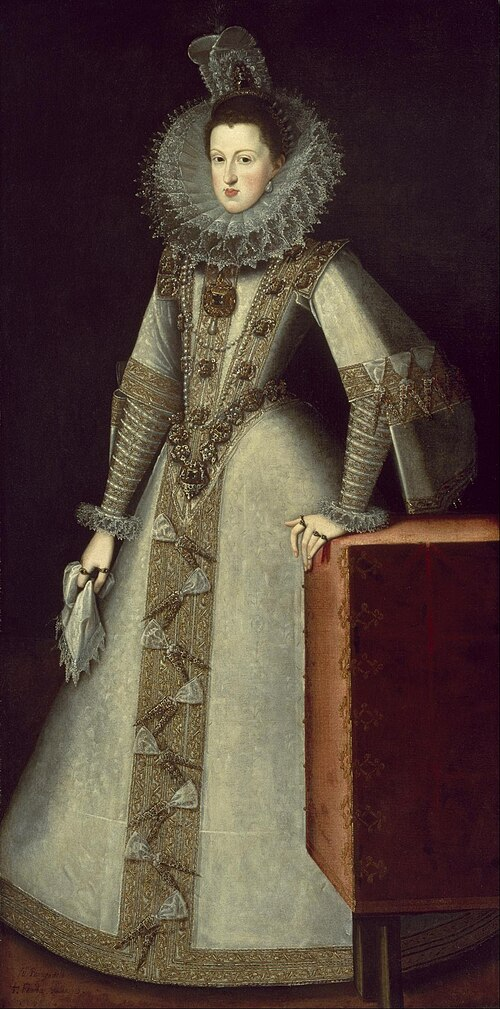
Margaret bore eight children between 1601 and 1611. Both she and Philip were the product of multiple generations of close Habsburg intermarriage, which meant each pregnancy compounded a genetic inheritance already compressed by centuries of consanguineous unions.
The results varied sharply. Ana María Mauricia, born September 22, 1601, was the eldest. Betrothed to the future Louis XIII of France around the age of ten, she married him in 1615 at fourteen. The marriage was difficult. She suffered multiple miscarriages before giving birth, in 1638, to a son who became Louis XIV, the Sun King, and the most powerful absolute monarch in European history. A second daughter, María, born March 1, 1603, died four days later.
Philip, born April 8, 1605, would reign over Spain for forty-four years as Philip IV. A daughter, María Ana, born in 1606, married her first cousin Ferdinand III of the Austrian Habsburgs, binding the two branches of the dynasty tighter still. Their union produced six children; three survived to adulthood.
Carlos, born September 15, 1607, lived to his mid-twenties, a respected but secondary figure at court. Fernando, born May 16, 1609, entered the church, became a cardinal, and served as Governor-General of the Spanish Netherlands until his death in 1641. A daughter, Margarita, born in 1610, died at six. The eighth child, Alfonso Mauricio, was born September 22, 1611.
His birth killed his mother.
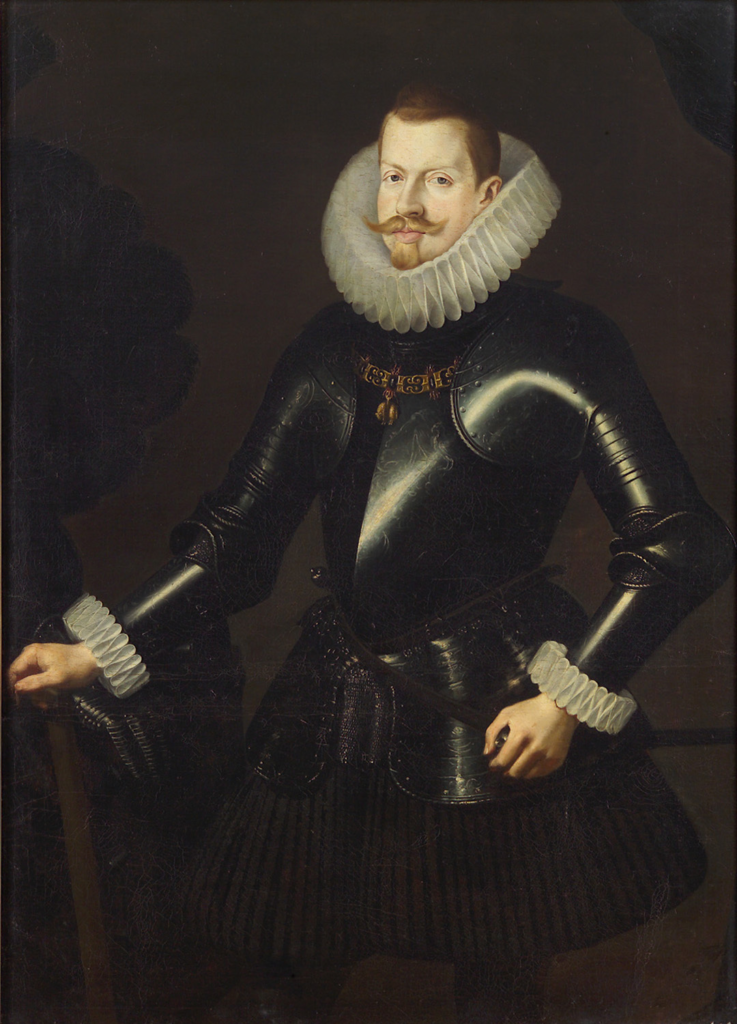
The Dynasty Paid in Full
Philip III never fully recovered his footing after Margaret’s death. The political infrastructure she had assembled did not collapse with her, but the intelligence animating it was gone. Lerma, freed of her counter-pressure, consolidated his grip on the court before being driven from power by his own son in 1618.
Philip III died on March 31, 1621. He was 42.
The dynasty continued its logic. Philip IV, Margaret’s son, married his own niece, Mariana of Austria, the daughter of Margaret’s daughter María Ana. That union collapsed the Habsburg family tree into something closer to a circle than a branch. Their son, Charles II, was born in 1661. He was the accumulated consequence of two centuries of Habsburg self-enclosure: physically frail, cognitively impaired, his jaw so deformed he could barely chew. He could not produce an heir. When he died in 1700, the Spanish Habsburg line died with him.
Margaret of Austria died at 26, eleven days after her eighth delivery, in a room in Valladolid. The dynasty she had given her life to preserve ended in the body of a man who could not survive long enough to continue it.
Leave a Reply