
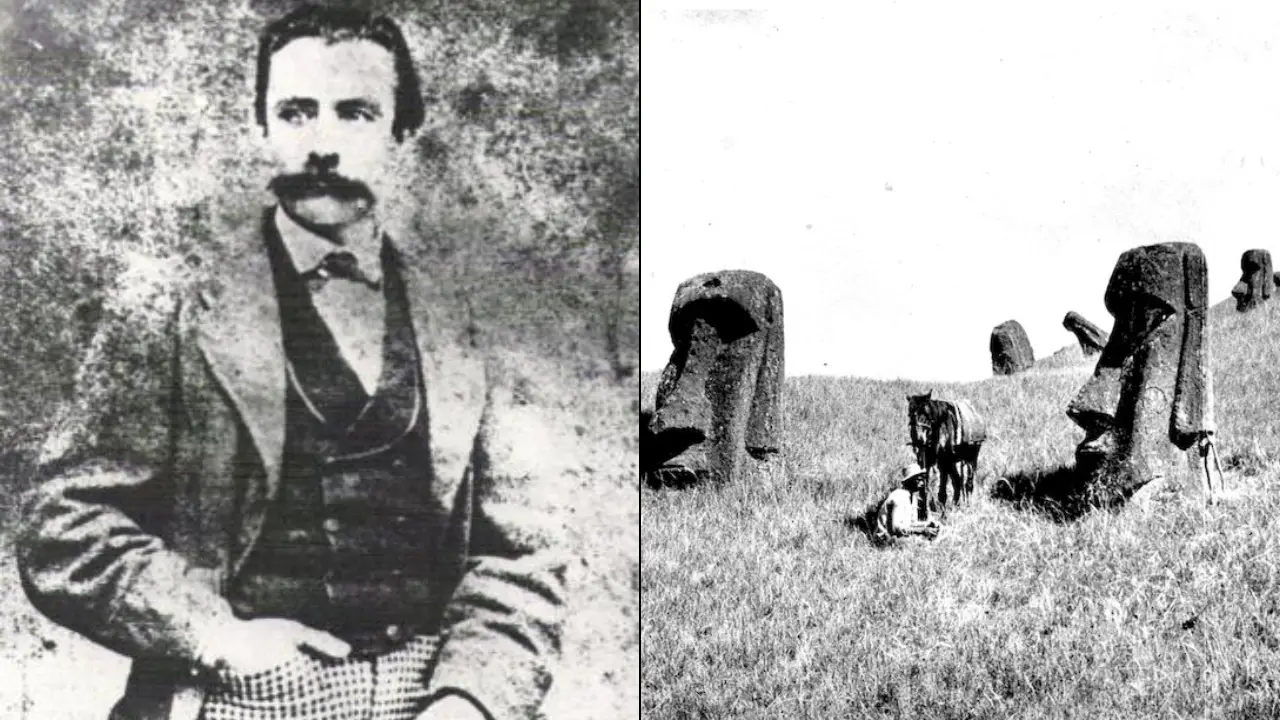
Jean-Baptiste Onésime Dutrou-Bornier arrived on Easter Island in April 1868 and immediately burned his boat.
It was not an accident. The yacht Aora’i, the vessel that had carried him across the Pacific to this tiny triangle of land 2,300 miles from the nearest continent, was set alight on the shore. Whatever the official explanation, the meaning was plain. Dutrou-Bornier had no intention of leaving. The island had fewer than 930 people left alive on it, survivors of a decade of Peruvian slave raids and epidemic disease. He had seen the opening they left.
By the time he was dead, eight years later, only 111 remained.
A Man With Nothing Left to Lose Becomes a Sailor
Jean-Baptiste Onésime Dutrou-Bornier was born on November 19, 1834, in Montmorillon, a small town in the Nouvelle-Aquitaine region of central-western France. His father worked as a solicitor. At 14, Dutrou-Bornier abandoned any expectation of a legal career and made his way north to Le Havre, the great port city on the Normandy coast, where he found work as a junior mariner in a maritime trading house.
His early years at sea went largely undocumented, the kind of life that produced no records because it produced nothing remarkable. The Crimean War changed that. Dutrou-Bornier served as an artillery gunner in the French Imperial Navy during the Siege of Sevastopol in 1853 and 1854, and by 1860, he had passed his examinations and qualified as a master mariner. On May 10, 1862, he married Marie Valentine Foulon, a pianist, in Paris. Their son, Georges Augustin René, was born the following year.
Within two years, he had abandoned them both.
By 1865, Dutrou-Bornier had purchased a one-third share in the three-masted schooner Tampico and departed for the Pacific. He never returned to France. He sailed to Peru, where he became entangled in illegal arms dealing, was arrested, and was sentenced to death without a fair trial. The French consul secured his release. He crossed the Pacific to Tahiti, where he established himself as a recruiter of plantation labor from the surrounding islands, a business that placed him at the very edge of legality in a region where the line between labor recruitment and human trafficking was thin and often crossed.
He was not yet done with criminal enterprise. He had merely found a larger stage.
Easter Island’s Wounds Left It Open to the Wrong Man
To understand what Dutrou-Bornier found when he arrived, it is necessary to understand what Easter Island had already survived.
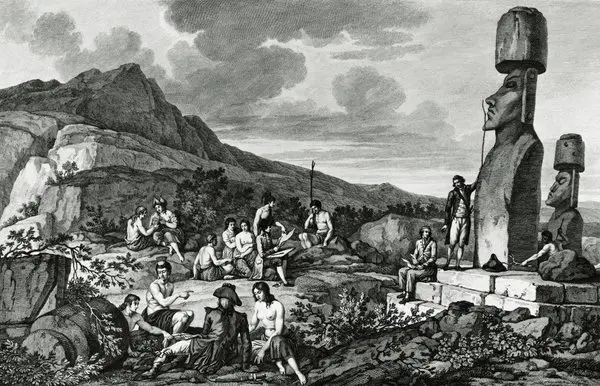
The Rapa Nui, a Polynesian people who had settled the island somewhere between the years 300 and 1200 CE, had built one of the most isolated human civilizations on earth. When the Dutch navigator Jacob Roggeveen became the first European to reach the island on Easter Sunday, April 5, 1722, he estimated a population of 2,000 to 3,000 people. A century and a half of sporadic contact followed, including forced labor recruitment by passing whaling ships. Then, in December 1862, eight Peruvian slave ships arrived. Their crews assembled on the beach, spread out trade goods as bait, then opened fire. Over 1,400 Rapanui, roughly half the island’s population, were seized and shipped to Peru to work plantations and domestic service positions under brutal conditions. Most died of tuberculosis, smallpox, and dysentery. Of roughly 100 eventually repatriated, 85 died at sea. The 15 who made it back brought smallpox with them.
International protest eventually forced Peru to act. But the damage was done. In 1867, a tuberculosis epidemic swept the island, killing a quarter of the 1,200 people who had survived the slave raids. It claimed the last ariki mau, the royal line’s final heir, a 13-year-old boy named Manu Rangi. When Father Hippolyte Roussel conducted the island’s first census, he counted 930 people. The Rapanui’s political structures, their religious leadership, and much of the population capable of passing on cultural knowledge were gone.
In November 1866, Dutrou-Bornier arrived at Easter Island for the first time, transporting two missionaries named Kaspar Zumbohm and Theodore Escolan. He noted the situation. He returned in March 1867 to recruit laborers, lost a substantial portion of his wealth gambling, and was forced to forfeit his share of the Tampico as a result of fraudulent dealings. He acquired a small yacht called the Aora’i. He returned to Easter Island in April 1868 and burned it on the beach.
He never left.
Dutrou-Bornier Buys Land No One Had the Right to Sell
He established himself at Mataveri, on the southwest edge of the island. Then he began to buy.
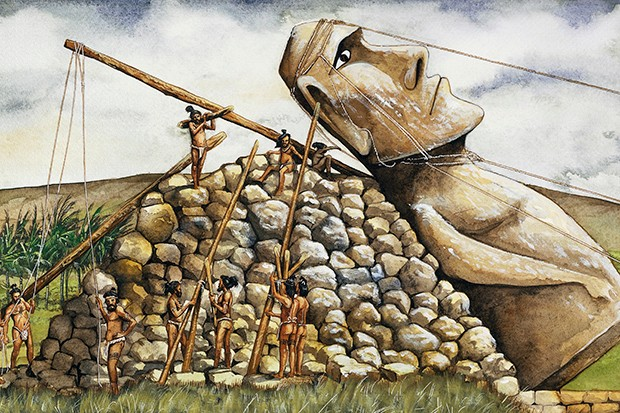
The Rapanui had no framework for private land ownership. Land belonged to lineages, not individuals, and the concept of selling it outright was not part of their culture or legal understanding. Dutrou-Bornier exploited this systematically. He purchased land from people who did not understand what they were selling, accumulating parcels across the island until he controlled almost all of it. The only territory he could not claim was the small area around Hanga Roa occupied by the Catholic missionaries.
In 1869, he seized Pua ‘Aku Renga, the woman known as Koreto, from her husband. She was already married to a Rapanui man. Dutrou-Bornier forced the separation and took her as his second wife, a marriage that made him a bigamist under French law, as Marie Valentine Foulon was still alive in Paris. He declared Koreto queen of the island, a title that had no legitimacy under Rapanui tradition and was recognized by no external authority. He petitioned France to declare Easter Island a protectorate, which would have formalized his position. The French government refused. He ruled anyway.
His backers were the commercial firm Maison Brander, run by the Scottish merchant John Brander out of Tahiti. The arrangement was mutually profitable: Dutrou-Bornier would clear the island of its people and run it as a sheep ranch, supplying wool for export through Brander’s network. The Rapanui who refused to leave or work for him would be shipped to Tahiti to labor on Brander’s plantations. Those who resisted received rifles, cannon fire, and burning huts until they reconsidered.
Rifles and Fire Empty the Villages
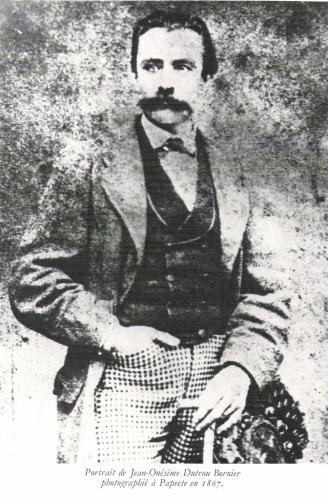
He did not govern alone. Dutrou-Bornier recruited a faction of Rapanui whom he allowed to abandon their recently adopted Christianity and revert to older religious practices, a form of loyalty purchase that drove a wedge through the already fractured community. Armed with rifles and a cannon, his supporters enforced his authority across the island. Huts were burned when necessary. The kidnapping of young women, reportedly between the ages of 16 and 20, became part of his pattern of control.
The missionaries watched this unfold for years before acting. By 1871, their relationship with Dutrou-Bornier had collapsed entirely. Father Hippolyte Roussel organized an evacuation. On his own authority and with the resources available to him, he removed 275 Rapanui from Easter Island, transporting them to Mangareva and Tahiti. He intended it as a rescue. He was not wrong to do it.
It left 230 people on Easter Island.
Most of them were elderly men. Younger Rapanui, those with the physical capability to resist or flee, had already been deported to Tahiti or had left with the missionaries. The few remaining watched Dutrou-Bornier consolidate control over an island that was now almost entirely his, legally speaking, though the legal basis for those transactions would be contested for decades.
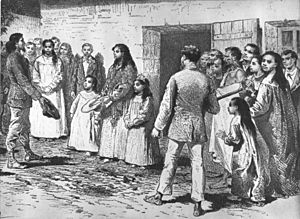
A Quarrel Over a Dress Ends Eight Years of Terror
On August 6, 1876, Jean-Baptiste Onésime Dutrou-Bornier was killed.
The argument was reportedly over a dress. Historians have generally treated this explanation as plausible, if incomplete. Dutrou-Bornier’s sustained kidnapping of young Rapanui women had generated an accumulation of grievance that needed only a specific trigger to produce specific violence. The killer’s identity was never formally established. No investigation of any consequence followed. He was 41 years old.
Neither of his surviving wives received much from his estate. Marie Valentine Foulon was his legal heir under French law, but the assets in question were on an island at the edge of the world, and their ownership was immediately disputed. Koreto briefly installed their daughter Caroline as queen on the island. Neither arrangement lasted. The legal complications around Dutrou-Bornier’s land transactions persisted for decades, and much of Easter Island remained under the control of outside commercial interests long after his death. The population in 1877, the year after he was killed, stood at 111 people. Only 36 of them had any offspring.
In less than a decade, more than 97 percent of the island’s population had died or been displaced. The Peruvian slave raids had started the destruction. Epidemic disease had continued it. Dutrou-Bornier had come for what remained.
What the Rapanui lost in those years was not only people. The religious leaders who understood the rongorongo script, the island’s unique written language, had been among those taken in the slave raids. By the time the island’s population began to slowly recover under the later management of Alexander Salmon Jr., who arrived in 1878, no one alive could read what the tablets said. Researchers who arrived in the following decades, unaware of what had just occurred, looked at a landscape with no trees, no fields, and a tiny scattered population, and concluded they were seeing the ruins of an ancient catastrophic collapse.
They were not wrong about the collapse. They were wrong about when it happened.
Leave a Reply