
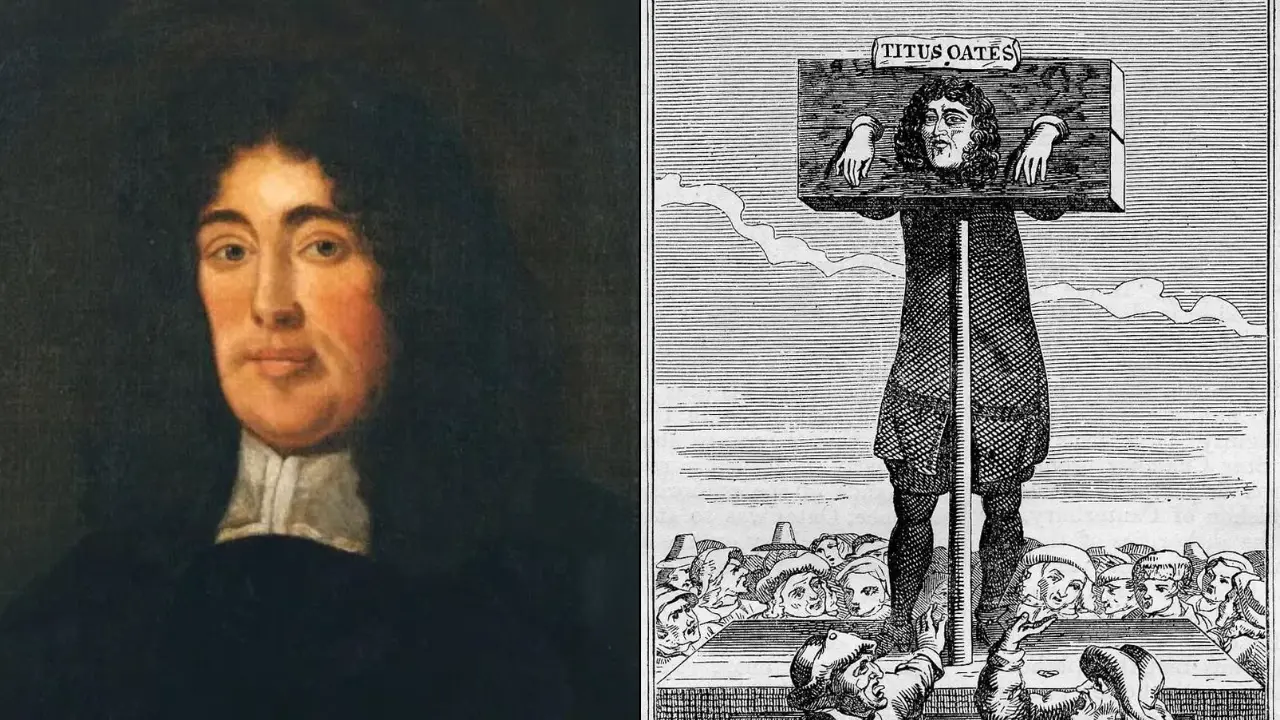
In 1679, England’s most trusted Catholic doctor stood trial for poisoning his own king on charges so obviously false that Charles II reportedly wept when the jury acquitted him. The man accusing him could not identify his handwriting. The document offered as proof had been written by someone else.
On July 18, 1679, Sir George Wakeman stood at the bar of the Old Bailey charged with high treason. The indictment held that he had agreed to poison King Charles II, for a fee of £15,000, through the king’s own posset. The prosecution intended to use his conviction to destroy the Queen.
The case rested entirely on the testimony of Titus Oates.
Wakeman Earns His Place at Court
The Wakeman family’s loyalty to the Stuart crown was not a position. It was a record. George was born the son of Edward Wakeman of the Inner Temple, raised a Roman Catholic, educated abroad in the continental tradition that English Catholic families relied on when their own institutions were closed to them. His elder brother Richard raised a troop of cavalry for Charles I. The family understood clearly what it meant to back the wrong king in the wrong moment and chose to do it anyway.
George’s own test came during the Interregnum. He returned to England and became involved in a plot against Oliver Cromwell. He was caught and imprisoned. He remained in prison until the eve of the Restoration, when Charles II released him and created him a baronet on February 13, 1661.
That debt was not forgotten on either side.
By 1668 he was attending Sir Joseph Williamson, a rising administrator who would become Secretary of State. Two years later, his appointment as physician-in-ordinary to Queen Catherine of Braganza reflected his standing as the foremost Catholic physician in England. For nearly a decade, his life was precisely what a man of his background might hope for. Quiet. Respected. Stable.
In 1678, Titus Oates destroyed it.
Oates Invents a Conspiracy to Kill the King
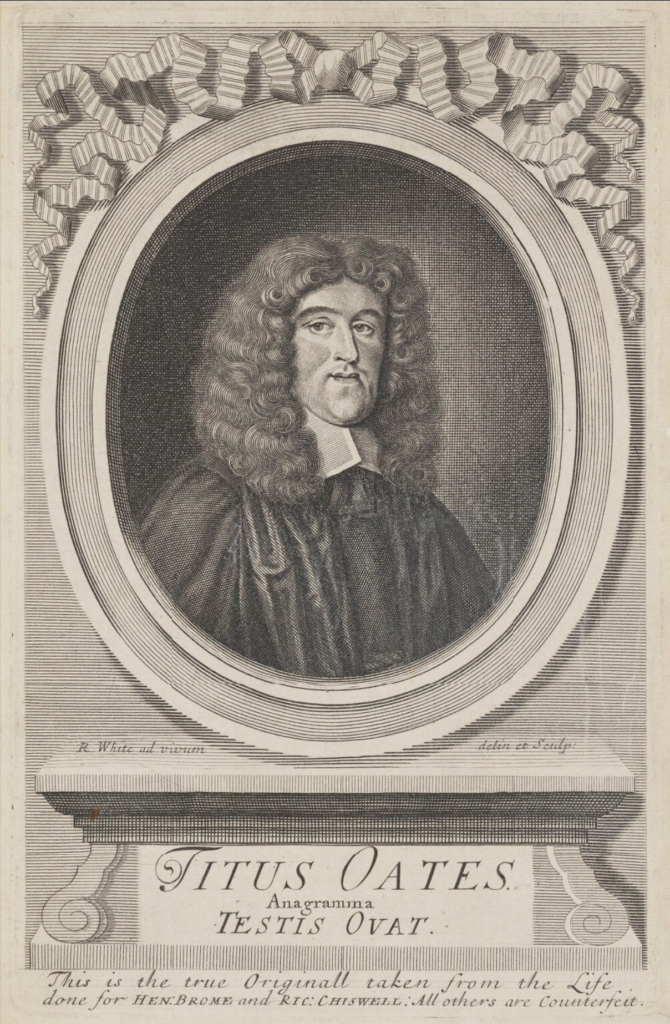
Oates was a Protestant clergyman with no discernible conscience and a gift for detailed invention. In 1678 he collaborated with Israel Tonge, a clergyman and educator, to produce a manuscript alleging a vast Catholic conspiracy to assassinate Charles II. The document ran to over eighty accusations, named one hundred Jesuits and their supporters, and described multiple methods for killing the king, including shooting, stabbing, and poison. The poison route identified the Queen’s physician as the mechanism. It was a document designed to incriminate an entire religion.
A man named Christopher Kirkby brought it to the king’s attention on August 28, 1678, approaching Charles during his morning walk in St. James’s Park. Charles, who knew his court and his enemies with equal clarity, was unmoved. He directed the matter to Thomas Osborne, 1st Earl of Danby, and instructed him to investigate.
Danby did. What followed was catastrophic.
On September 6, 1678, the magistrate Sir Edmund Berry Godfrey received Oates’s formal deposition. Shortly afterward, Godfrey was found dead. The murder was never solved. That single unsolved killing transformed a questionable manuscript into a national emergency. By the time hysteria had properly taken hold, men were being tried and executed on the word of Titus Oates alone.
By November 28, 1678, Oates had elevated his accusations against Wakeman to their final form. He claimed to have personally witnessed a bribe being negotiated. Wakeman had first been offered £10,000 to poison the king’s posset, Oates said. Wakeman refused. The sum was raised to £15,000. Wakeman accepted. As a further incentive, he had been promised appointment as physician-general to the army when the plot succeeded. Oates stated he had heard part of this conversation himself, outside Queen Catherine’s closet at Somerset House, where a door had been conveniently left ajar.
The accusation pointed directly at the Queen. Oates claimed Catherine not only knew of the plan but had consented to it, motivated by rage at her husband’s infidelities. Oates was accusing England’s Catholic queen of high treason.
Everyone who knew Catherine of Braganza knew she adored her husband. It was one of the most publicly observed facts in England.
Wakeman Dismantles the Case Against Him
The Popish Plot had already killed. By the time Wakeman came to trial, men had been convicted and executed on testimony no more reliable than what Oates and his associate William Bedloe were about to deliver at the Old Bailey. The government knew the Plot was unraveling. Whig leaders knew that convicting Wakeman meant implicating the Queen, and implicating the Queen meant everything that followed from that.
Wakeman was tried on July 18, 1679. Three priests stood in the dock beside him: William Marshall, William Rumley, and James Corker. The presiding judge was Lord Chief Justice William Scroggs, assisted by Francis North, 1st Baron Guilford. Scroggs had been one of the Plot’s most credulous supporters in earlier trials. His conduct on this occasion was strikingly different, and the reasons have never been fully established.
In cases of treason at that time, the accused had no right to legal counsel. The Treason Act that would change this did not pass until 1695. Wakeman defended himself alone.
He had come prepared. Someone in authority had arranged access to the parliamentary record of the investigation, including papers from the House of Lords Journal. Who authorized the removal of those documents was never confirmed, though the most likely source was either the King himself or his council. Wakeman used them.
Oates testified that he had seen a document appointing Wakeman as physician-general to the army, and a receipt for part of the £15,000 bribe. Under examination, he admitted he was unable to identify Wakeman’s handwriting. He further admitted he could not, at the time he claimed to have witnessed these transactions, identify Wakeman by face.
Wakeman then produced the document Oates had cited. It was a prescription. It had been written by Wakeman’s assistant. It contained no reference to the king, to poison, or to any other charge in the indictment.
As for Bedloe’s claim of intimate acquaintance with Wakeman, Wakeman addressed the jury directly. A royal physician does not move in the same circles as a man like Bedloe.
Scroggs’s summation was severe. He told the jury he still believed some form of conspiracy had existed. He made clear he was not persuaded the man before him had any part in it. He urged the jury against shedding innocent blood, a caution notably absent from his conduct in earlier Plot trials. The jury asked whether they could find the defendants guilty of the lesser charge of misprision of treason. Scroggs told them they could not.
They returned not guilty verdicts for all four defendants.
It is recorded that Charles II wept when he heard the news.
The Verdict Tears London Apart
The acquittal was the beginning of the end for the Popish Plot. It would not be the end itself. Two more Catholics were tried, convicted, and executed before the hysteria finally exhausted itself. But July 18, 1679 was the first moment the public’s faith in Oates had cracked.
The public did not receive the crack graciously.
Jurors fled their homes to escape the mob. When the Marquis of Arronches, the Portuguese Ambassador, called on Scroggs in person to congratulate him on the acquittals, the crowd drew its own conclusion. A dead dog was thrown into Scroggs’s coach. There is no evidence Scroggs was bribed or influenced by anyone. The assumption was convenient, and the mob found it sufficient.
Wakeman went to Windsor Castle to pay his respects to the King and Queen. Then he left England for Brussels.
Oates did not acknowledge the verdict. In subsequent trials he continued to testify that Wakeman had received a bribe and agreed to kill the king. The acquittal, in his version, simply had not happened. He repeated the accusation in courtrooms that accepted it as freely as they had accepted everything else he had ever said.
Wakeman Vanishes From the Historical Record
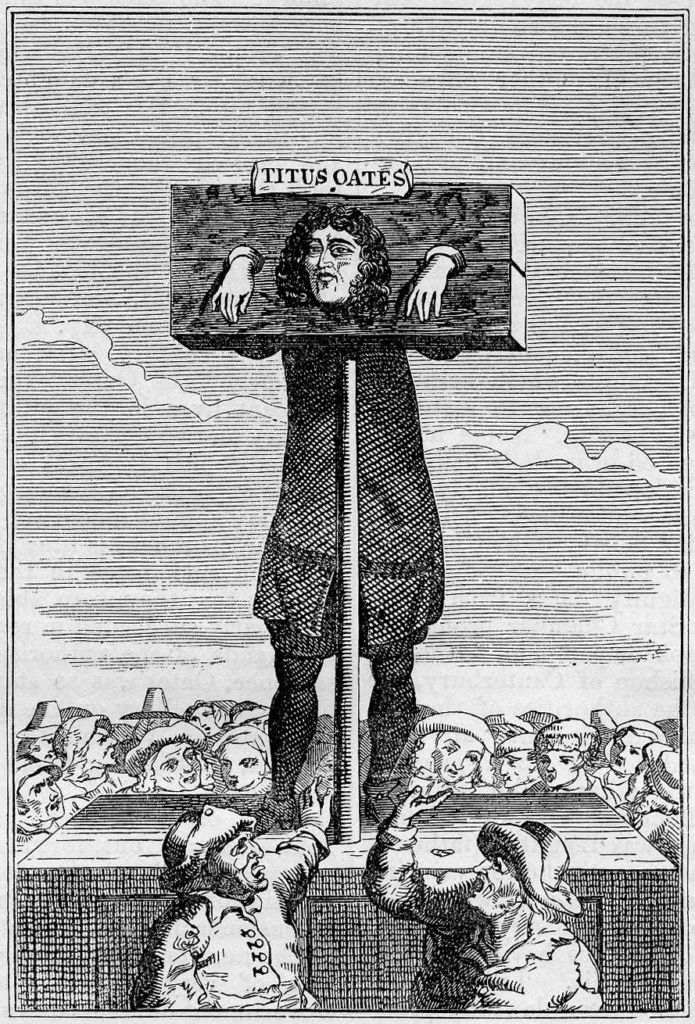
By 1685 the political climate had shifted far enough for Wakeman to return to London. Titus Oates had been charged with perjury. On May 8, 1685, Wakeman gave evidence against him at trial. Oates was convicted on two counts and imprisoned.
What Wakeman made of that moment is not recorded.
After 1685, Sir George Wakeman disappears from the historical record entirely. No account survives of where he practiced, what he treated, or how he spent the years between his testimony and his death. He is known to have died in 1688.
What the record does preserve is the outline of a man whose four decades of documented loyalty to the Stuart crown proved more durable than everything Oates threw against it. A Royalist imprisoned under Cromwell. A baronet who served the queen without incident for nine years. A defendant who dismantled a perjured prosecution with no legal counsel and no support except the papers someone powerful chose to put in his hands.
He walked out of the Old Bailey a free man. The men who had sent twenty-two other innocent Catholics to their deaths carried on for a little while longer.
Titus Oates served two years before James II pardoned him. He lived until 1705.
Leave a Reply