
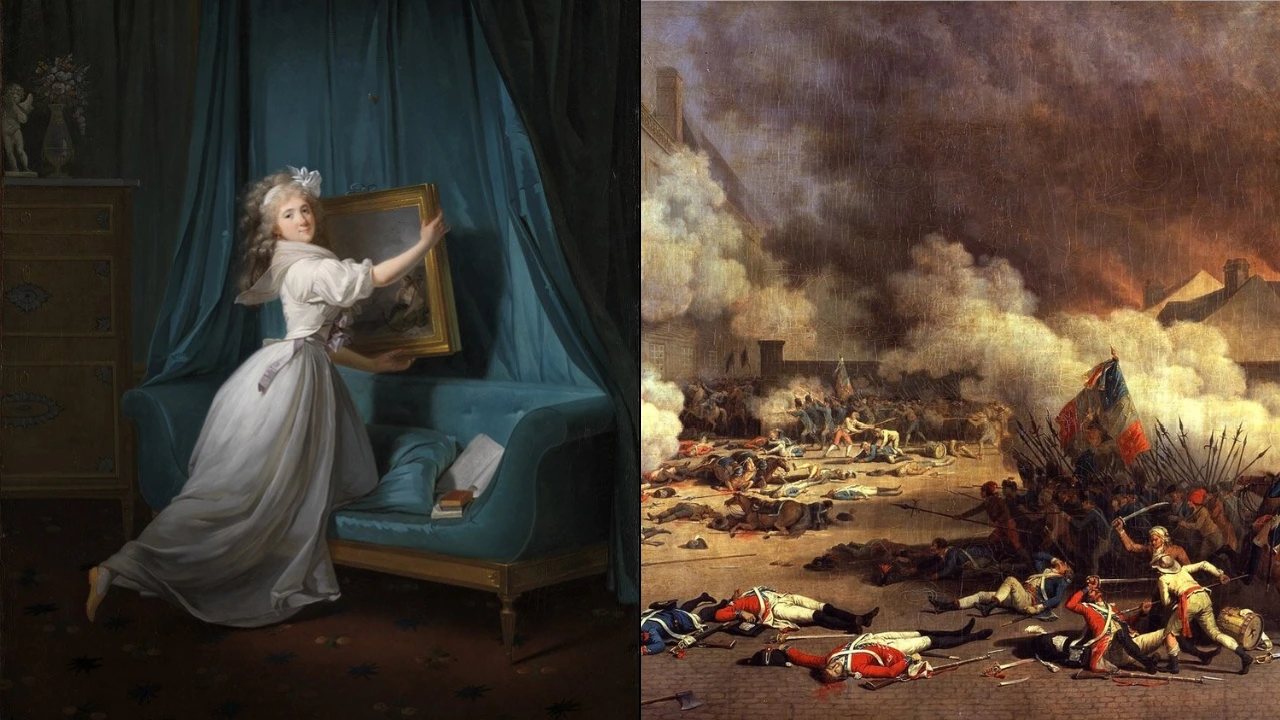
In 1775, a one-act Parisian satire mocked Catherine-Rosalie Gerard Duthé’s habit of pausing before she spoke and accidentally gave the Western world one of its most enduring and damaging stereotypes.
In the autumn of 1775, a one-act play called Les Curiosités de la Foire opened in Paris and “kept the city laughing for weeks,” according to contemporary accounts. Its subject was a real woman: Catherine-Rosalie Gerard Duthé, the most coveted courtesan in France, lampooned in the text as a barely functional automaton, a “machine: a very beautiful and extremely curious contrivance.” The joke was her pauses. Before speaking a single line, Duthé would go silent for a long, excruciating interval, long enough that her audiences had begun to assume she had nothing to say. A one-act play confirmed it. Paris never quite stopped laughing.
What Paris never worked out was whether the silence was the joke or the joke was on Paris.
The Silence That Built an Empire
Born in Versailles in 1748, Catherine-Rosalie Gerard Duthé was the daughter of a man in service to the royal palace, a family of modest but court-adjacent standing. She received a convent education, the standard arrangement for respectable girls of her era and class, and she left it as a teenager with motives historians have not been able to confirm. Two sisters known as the Mademoiselles de Vernier, daughters of a lemonade merchant who had reinvented themselves as high-class courtesans, provided a more practical education. Duthé watched and learned.
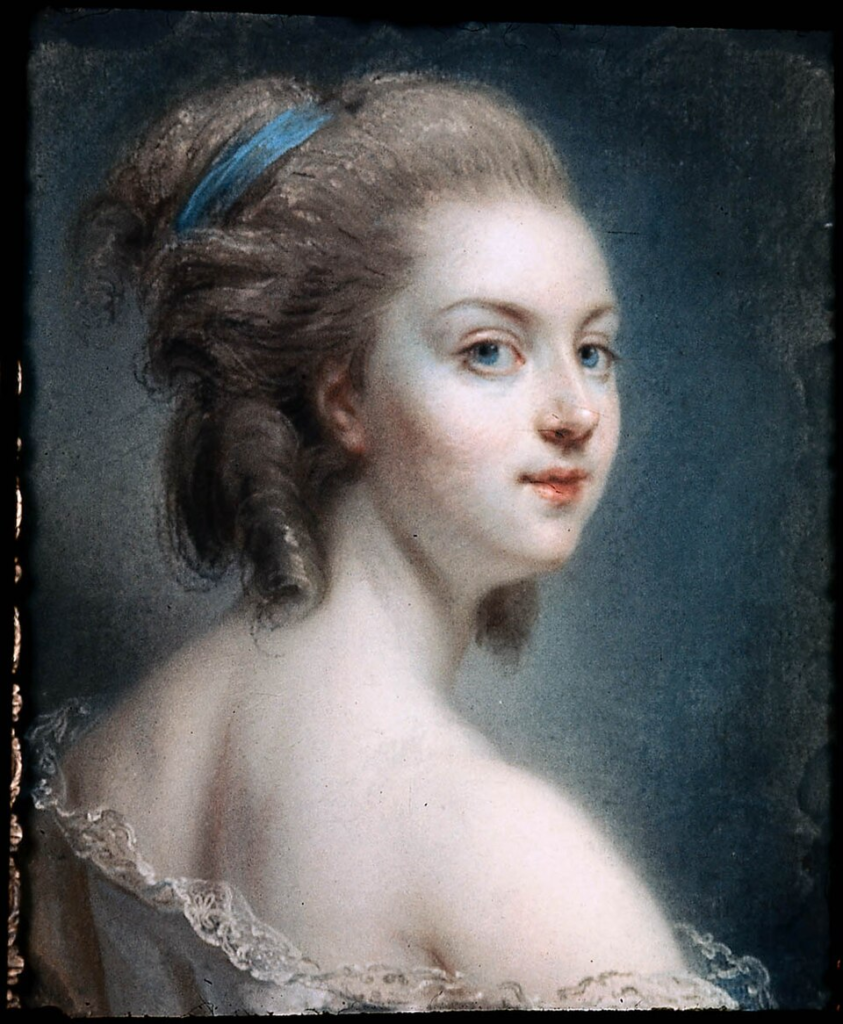
She joined the Paris Opéra as a ballet dancer, which in 18th-century Paris was roughly equivalent to placing herself in a gilded marketplace. Actresses, dancers, and opera singers in that world occupied an ambiguous social position, neither respectable nor entirely beyond reach of the right patron. Duthé proved useful to the arrangement. She was tall, blonde, and widely described as having “the finest figure in the world.” Inspector Louis Marais, head of Paris’s vice squad and a man whose professional duties brought him into contact with the city’s most beautiful women, noted her without apparent detachment: “She is one of the most beautiful women of Paris; tall, has a very good figure, splendid complexion, a most amiable face, and beautiful hair.”
The pauses, she had developed somewhere in those early years. Whether as affectation, performance, or genuine habit, no one has established. They read, to Parisian society, as vacancy. She appeared not only stupid but dumb in the literal sense. What they produced was mystery, and mystery attracted the kind of men who could afford curiosity.
She Ruined an Earl and Enchanted a Prince
Her first documented patron of consequence was George O’Brien Wyndham, the 3rd Earl of Egremont, an immensely wealthy English aristocrat who traveled to Paris in the manner of his kind, to collect French furniture and French experiences. Contemporary sources noted, not without relish, that Duthé “ruined” him, bringing him to the edge of bankruptcy. The story spread quickly through Parisian society. It had an unexpected commercial effect. A courtesan capable of ruining the Earl of Egremont was a courtesan whose fees were self-evidently beyond ordinary means. Her rates became legend. One historian noted that she “gathered appreciative customers from the highest social and political ranks.” She held Saturday dinners at her mansion attended by the philosopher Denis Diderot and the poet Charles-Pierre Colardeau. Her carriage, drawn by eight cream-white horses, was covered in gilt.
She dressed exclusively in pink. Every garment, including her undergarments, was the same color. In a city that ran on spectacle, she understood that spectacle required consistency.
Among the men competing for her attention was Louis XVI’s youngest brother, the Comte d’Artois, the future King Charles X of France. His visits were so frequent and so conspicuous that a punning remark circulated through court: having suffered indigestion from a Savoy cake at Versailles, he had gone to Paris to take some tea. The pun required knowing that his wife was Marie Thérèse of Savoy, and that “du thé,” tea in French, echoed “Duthé.” The joke worked on both levels. It mocked him rather more than it mocked her.
A Duke Used Her to Educate His Son
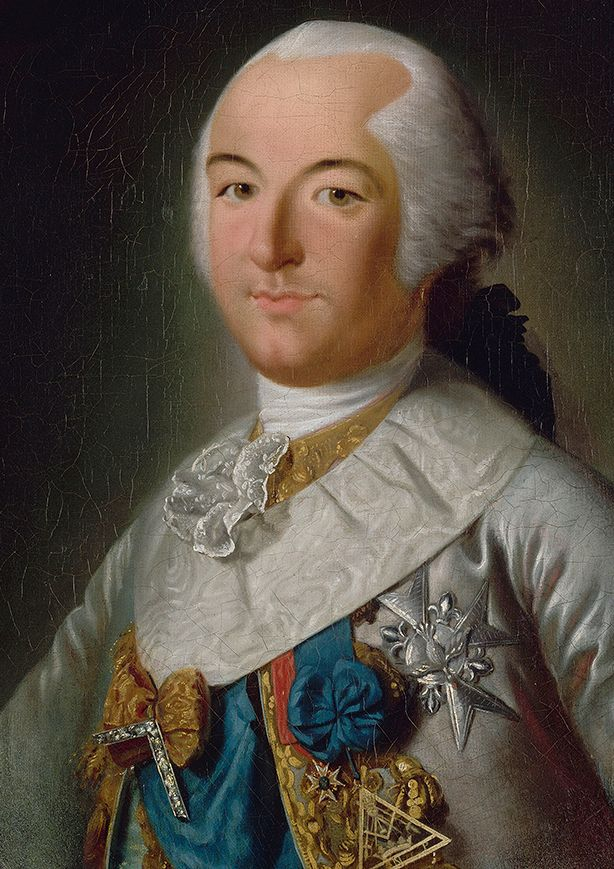
The most revealing episode of Duthé’s career arrived through a father’s idea of instruction. Louis Philippe II, Duke of Orléans, a notoriously rakish figure who would later vote for his cousin Louis XVI’s execution and die on the guillotine himself, decided that his 15-year-old son Philippe needed to learn certain facts of life. He sent the boy to Rosalie Duthé.
The experience was evidently educational. Duthé was later spotted riding in the younger Philippe’s royal carriage along the Champs-Élysées. In 18th-century Paris, only princes rode in such carriages, and the sight of a courtesan occupying one provoked exactly the response such a sight was designed to provoke. A song appeared almost immediately, set to a popular tune, with lyrics that translated roughly as “La Duthé must have suckled royally.” The carriage became a news event. The aristocrats who composed the song intended the scandal to land on her. She kept the carriage.
The son grew up to become King Louis Philippe I, King of the French from 1830 to 1848. He did not, publicly, mention Duthé.
She Tried to Enter Politics and Lost the Wrong Ally
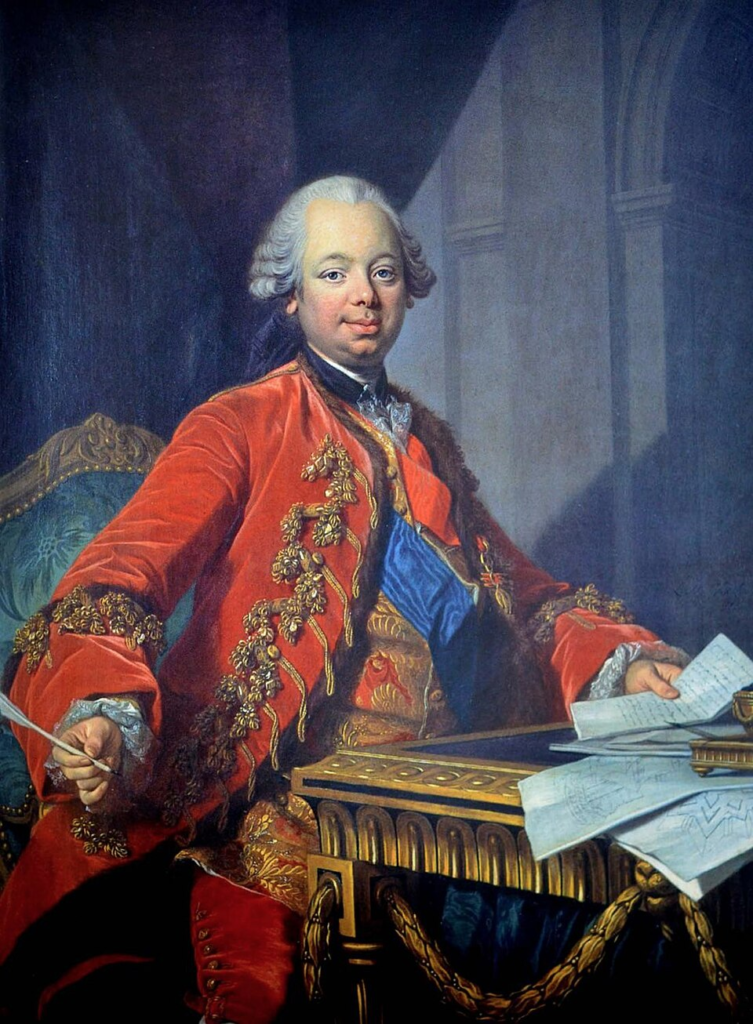
Duthé was not content with social power alone. She made a serious attempt to enter political life, seeking the backing of Étienne-François, Duke of Choiseul, who served as Louis XV’s Minister of Foreign Affairs and who had engineered the marriage between Marie Antoinette and the future Louis XVI. Choiseul’s patronage would have opened doors no salon could. The timing was catastrophic. Louis XV’s mistress, Madame du Barry, had set about destroying Choiseul, and she succeeded. He was dismissed and retired in 1770, before Duthé could benefit from their arrangement. Her political ambitions went with him.
She returned to what she did best. The portrait painters of Paris competed for her time: François-Hubert Drouais rendered her in 1768 in a full-length portrait now held by the English Rothschilds; Lié Louis Périn-Salbreux painted her at least five times, including a nude commissioned for the Comte d’Artois’s bathroom at his Bagatelle residence; Henri-Pierre Danloux, her personal favorite, completed a celebrated 1792 portrait on commission from her friend and banker Jean-Frédéric Perregaux, who reportedly contemplated the painting on his deathbed. The sculptor Jean-Antoine Houdon made a bust of her. Jean-Honoré Fragonard painted her. She was, by any measure, one of the most represented women of the century.
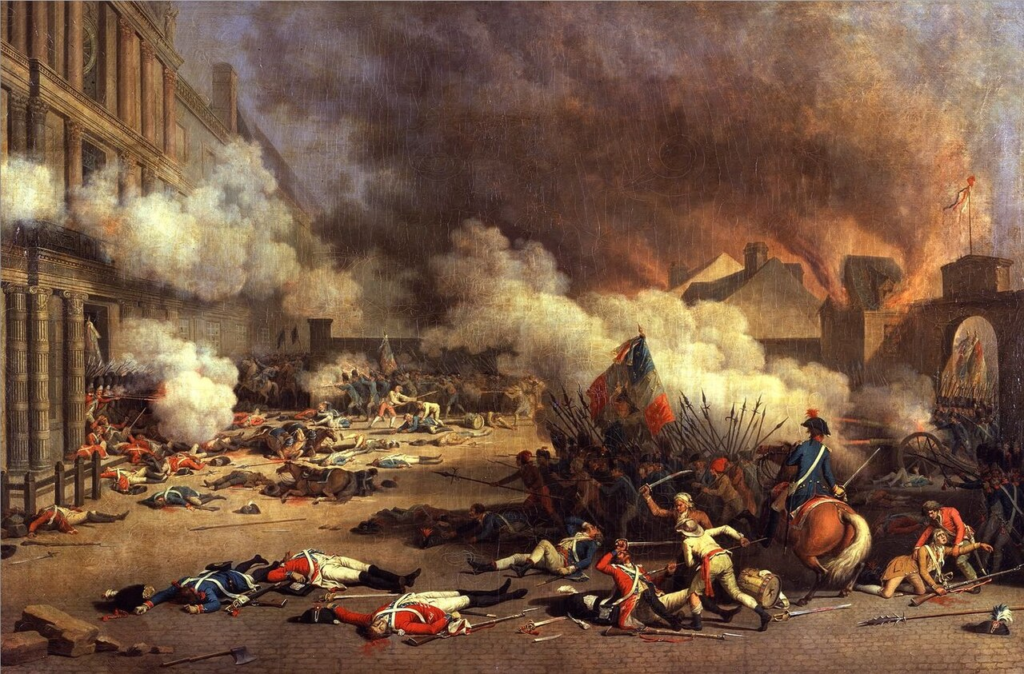
Revolution Scattered Her Court
When the French Revolution arrived in 1789, Rosalie Duthé left for England. She had seen enough of what revolutions did to the people who had been near kings. In London, she found new admirers, including the Duke of Queensberry, who asked her once about her arrangement with two brothers named Lee, one older and one younger. The older Lee would not appear with her in public; his younger brother supplied the arm for theatre trips and promenades. She told the Duke: “The younger Lee is my ‘Lit de parade’; the elder my ‘Lit de repos.’” Bed of show; bed of rest. The Duke laughed.
When the Bourbon Restoration returned France to some semblance of its old order, Duthé came back. She settled on the Rue Marboeuf near the Champs-Élysées with a considerable fortune and the gilt carriage that had once commanded the attention of all Paris. The carriage went out again. This time, according to the memoirist Captain Gronow, “instead of being admired, was much laughed at, as the style and shape were quite out of fashion.”
The woman had not changed. The city had.
Catherine-Rosalie Gerard Duthé died on September 25, 1830, at approximately 82 years old. She was buried at Père Lachaise Cemetery. Her famous gilt carriage was sold at auction for use in theatrical performances. A posthumous autobiography, Galanteries d’une Demoiselle du Monde ou Souvenirs de Mlle. Duthé, appeared in 1833, possibly written not by Duthé herself but by Baron Lamothe-Langon, who had known her personally.
Cultural historian Joanna Pitman, writing in On Blondes, named Duthé “the first officially recorded dumb blonde” in Western history. The phrase stuck, absorbed into a tradition that has produced centuries of jokes, films, and assumptions about what beauty combined with silence must mean.
Duthé apparently said nothing in response. She had been doing that for years, and it had worked extraordinarily well.
Leave a Reply