
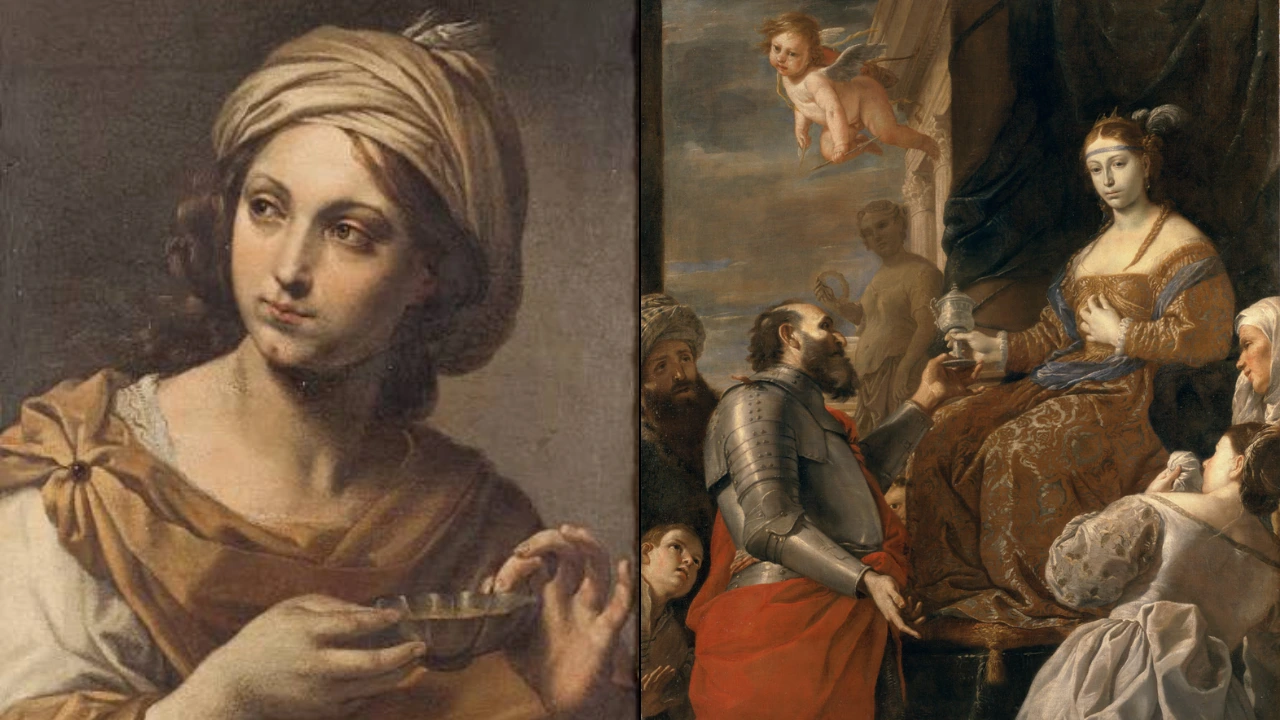
In 203 BC, Sophonisba had been married twice in three years, traded between rival Numidian kings as a diplomatic token in a war she did not start. When Scipio Africanus demanded she be surrendered as a prisoner of war, she chose a third option.
The palace at Cirta had barely stopped echoing from the battle outside when Masinissa, king of the eastern Numidians, walked through its doors in triumph. The year was 203 BC. His forces, fighting alongside the Roman general Gaius Laelius, had just defeated and captured Syphax, the Numidian king who had held the city. Syphax was already in chains. His palace, his kingdom, and his wife now belonged to the victor.
Masinissa had not yet crossed the threshold of the inner chambers when a woman approached him. She did not run. She did not weep. She fell at his feet and, according to the historian Livy, implored him with a single request: do not let her fall under Roman tyranny. If he could not save her, she told him, he should kill her himself rather than hand her to Rome.
Her name was Sophonisba. Born into Carthaginian nobility around 225 BC, she was the daughter of a powerful general named Hasdrubal Gisco, and she had spent the last several years being deployed as a political instrument in a war she did not start. Within hours of this encounter, Masinissa had decided to marry her. Within weeks, he would be ordered to send her poison instead.
Two Empires Collided and a Daughter Became a Pawn
Sophonisba was born into a Carthage that was fighting for its survival. The city-state, established centuries earlier by Phoenician settlers on the site of what is now Tunis in northeastern Tunisia, had grown into one of the most powerful mercantile republics in the ancient world. It had already lost one catastrophic war with Rome. The First Punic War, which lasted from 264 BC to 241 BC, had stripped Carthage of Sicily, Sardinia, and Corsica and handed Rome dominance of the western Mediterranean.
Carthage’s military establishment did not accept this quietly. The great general Hamilcar Barca conquered much of the Iberian Peninsula for Carthage in the years that followed, a campaign his sons Hasdrubal Barca and Hannibal continued after his death. By 218 BC, Hannibal had launched his famous crossing of the Alps to bring the fight directly to Italy. The Second Punic War had begun. Sophonisba’s father, Hasdrubal Gisco, a separate figure from the Barcid family, commanded Carthaginian forces in Iberia and later became one of the war’s key strategists in North Africa. His daughter would become his most valuable diplomatic resource.
We know almost nothing of Sophonisba’s childhood. What the ancient sources record begins when she was a young woman of political value. Cassius Dio described her as highly educated in music and literature, possessed of a quality that made even indifferent men devoted to her upon first meeting. Diodorus Siculus called her “comely in appearance, a woman of many varied moods, and one gifted with the ability to bind men to her service.” Neither historian was offering a disinterested compliment. Both understood what Hasdrubal Gisco understood: Sophonisba was an asset, and assets were deployed.
Hasdrubal Gisco Traded His Daughter for an Army
The war’s fortunes shifted decisively in 206 BC. Scipio Africanus drove Carthaginian forces out of the Iberian Peninsula at the Battle of Ilipa. Hasdrubal Gisco fled back to North Africa. What he needed now was allies, and fast. The Romans would come to Africa next.
Numidia, the region stretching across what is now eastern Algeria and northeastern Tunisia, was divided between two rival powers. Masinissa ruled the eastern Massylii and had originally been allied to Carthage. Syphax ruled the western Masaesyli and had, around 214 BC, entered into an alliance with Rome. By 206 BC, the situation had shifted. Masinissa, watching Carthage lose ground in Iberia, had quietly begun negotiating with Scipio. Syphax, for his part, was persuadable.
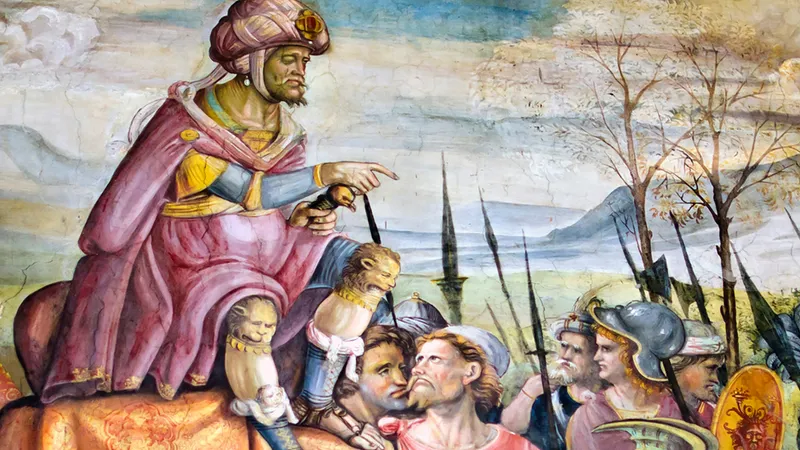
Sophonisba had initially been betrothed to Masinissa as part of an earlier diplomatic arrangement between Carthage and the eastern Numidians. With Masinissa now moving toward Rome, Hasdrubal Gisco and the Carthaginian Senate changed course. They recalled the betrothal and reassigned it. She would marry Syphax instead.
The marriage took place in 206 BC. According to Appian, Syphax had actively pressed for the match, threatening Carthage until they conceded. Cassius Dio attributed the decision to simpler calculation: Syphax commanded a larger army. In either account, Sophonisba’s own wishes appear nowhere in the historical record. She married the man Carthage needed.
The result was immediately consequential. Syphax renounced his Roman alliance and threw his military resources behind Carthage. Masinissa, locked out of Numidia and fully understanding what had been done to him, went directly to Scipio and offered him everything he had.
Sophonisba Convinced a King to Hold the Line
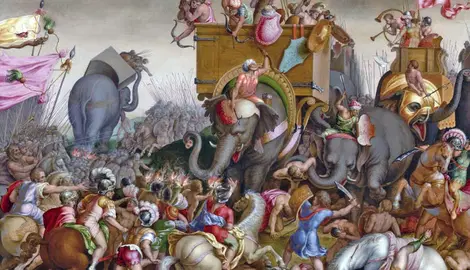
The war in North Africa moved quickly after Scipio landed his forces in 204 BC. Within a year, he and Masinissa had won a major engagement against Hasdrubal Gisco and Syphax near Utica. By the spring of 203 BC, they crushed what remained of the combined force at the Battle of the Great Plains, fought along the Bagradas River valley southwest of Carthage.
Syphax fled north to Cirta, the city that corresponds to modern-day Constantine in northeastern Algeria. There, he considered opening negotiations with Rome. Sophonisba intervened and persuaded him to fight on.
It was the last act of political influence she would ever exercise. Scipio dispatched Gaius Laelius and Masinissa to pursue Syphax north. Syphax gathered a fresh army of largely untrained recruits, rode out to meet them, and was defeated and captured. During the fighting, a wound left his horse uncontrollable and the animal threw him. Roman soldiers took him on the ground.
Scipio Africanus Refused to Honor the Marriage
What happened next inside Syphax’s palace at Cirta is recorded in the most detail by Livy. Masinissa entered and found Sophonisba. She fell at his feet. She asked him not to let the Romans have her. By that evening, he had reached a decision.
He married her the same day. Livy records his reasoning: by making her his wife immediately, neither Laelius nor Scipio could claim as a prisoner someone who was now the queen of a Roman ally. It was a legal maneuver dressed as a wedding.
Laelius arrived from the Roman encampment outside to find the marriage already concluded. He refused to accept it and sent word to Scipio.
The reply came back with clarity. Syphax, en route to Rome in chains, appeared before Scipio first. Still furious about Sophonisba’s rapid remarriage, he argued that this woman, daughter of a Carthaginian general and deeply loyal to Carthage, would turn Masinissa against Rome the same way she had turned him. Scipio was persuaded. He sent orders: inform Masinissa that Sophonisba was to be surrendered as a prisoner of war, to be brought to Rome for the triumphal parade.
Masinissa Sent Her Poison and She Drank It Willingly
Masinissa had known Sophonisba’s name, if not her face, for years. She had been betrothed to him before Carthage gave her to his rival. Whatever he felt in that Cirta palace, the order from Scipio closed the question.
He went to Sophonisba. He told her he could not protect her from Rome. He told her that the one thing remaining in his power was the choice she had asked for the night they met. She had said: if you cannot save me, do not let them have me.
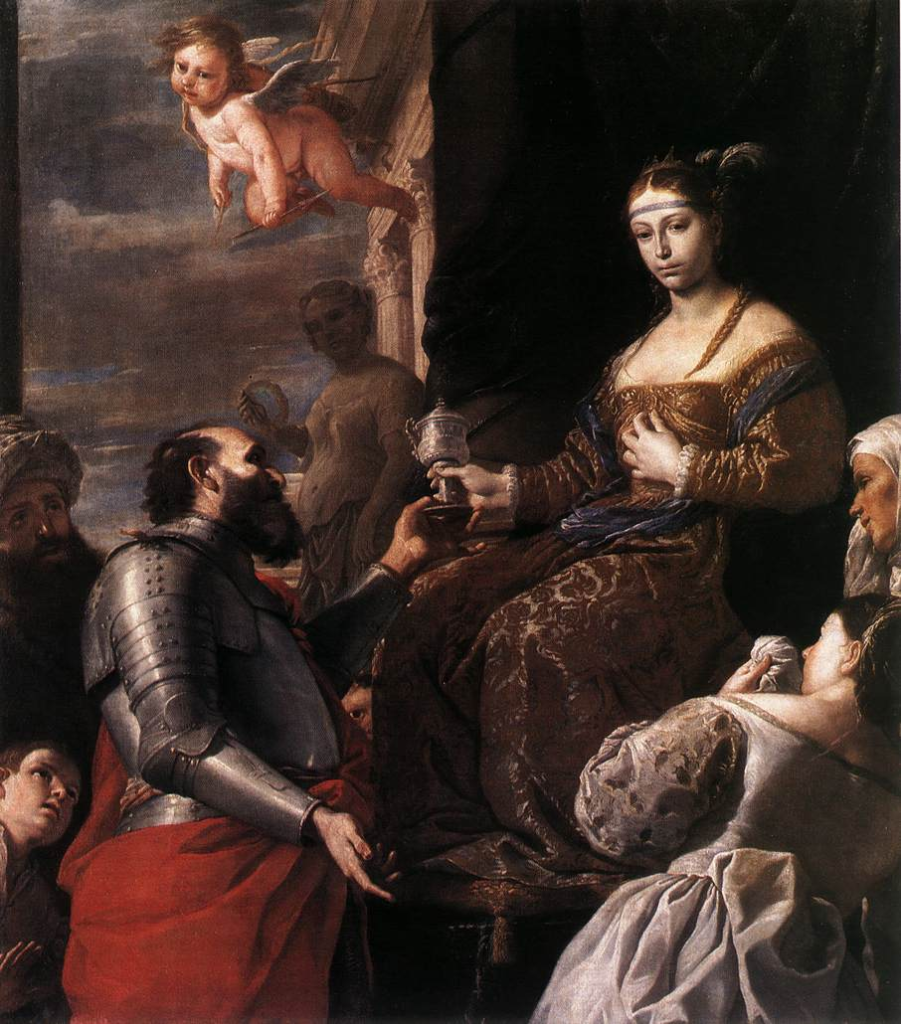
He found a cup of poison.
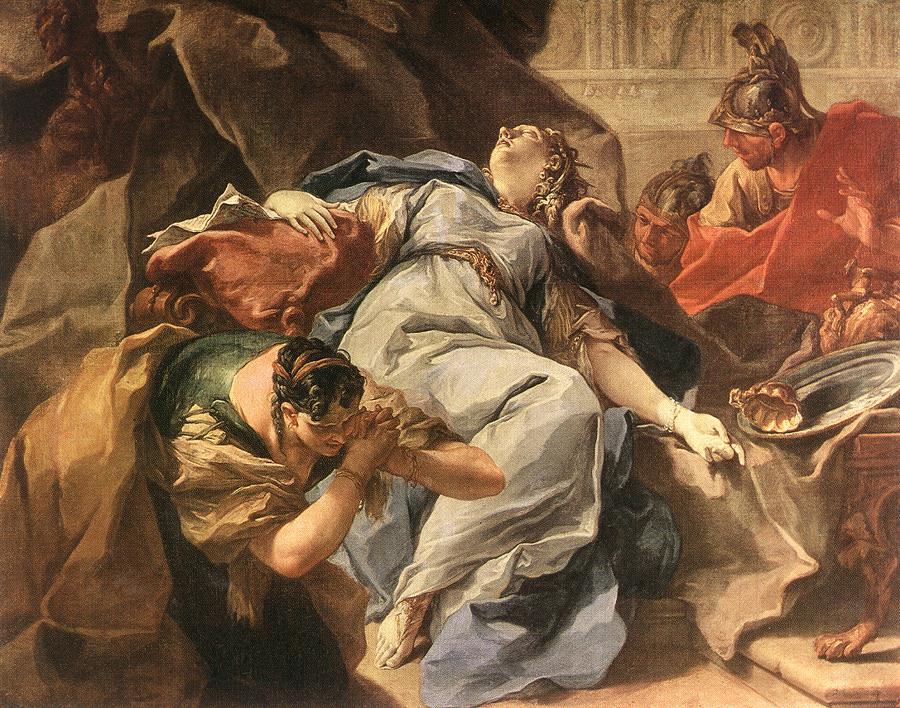
Sophonisba received it with composure. She reportedly told him that she accepted the wedding gift, though it was bitter, and that she died better for having been briefly his wife than she would have died as a Roman prisoner. Then she drank.
She was approximately 22 years old.
Syphax was transported to Rome, displayed in Scipio’s triumphal parade, and died in detention at Tibur, the town known today as Tivoli, in 201 BC. Hasdrubal Gisco, Sophonisba’s father, did not outlast the war either. Having returned to Carthage after the collapse of his forces, he took his own life in 202 BC to escape execution by a Carthaginian mob turned against him for the military disaster.
Sophonisba’s name in Punic, Saponi-Baal, means “May Baal watch over me.” The god she invoked at birth did not, in the end, intervene.
Centuries of Artists Could Not Let Her Go
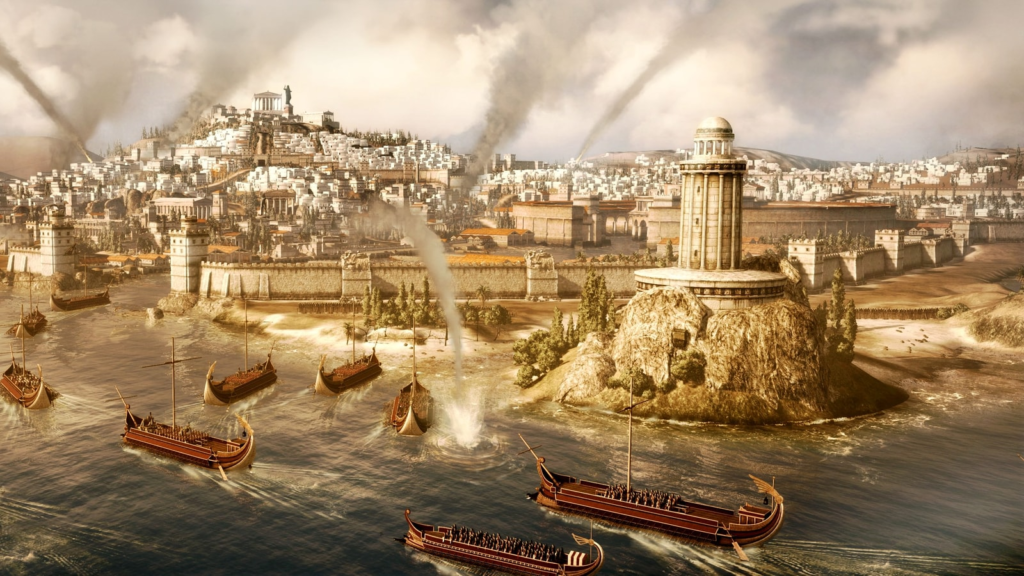
Carthage itself did not survive long after its most celebrated daughter. A third war with Rome began in 149 BC and ended three years later with the complete destruction of the city in 146 BC.
The story of Sophonisba traveled differently. Roman writers found in her death a symbol of Carthaginian defiance: a civilization that chose annihilation over submission. The poet Virgil, writing in the late first century BC, is widely believed to have drawn on her story when constructing Dido, the Carthaginian queen who kills herself rather than submit to the will of a man who will not stay. The parallels are close enough that scholars treat the influence as established rather than speculative.
Francesco Petrarch gave her the most extended literary treatment of the medieval period in his epic poem Africa. Painters followed across two centuries. Giambattista Pittoni, Mattia Preti, and Simone Cantarini all produced versions of the same scene: Sophonisba at the moment of the cup. John Marston staged The Wonder of Women, or The Tragedy of Sophonisba in London in 1606. Nathaniel Lee staged Sophonisba, or Hannibal’s Overthrow seventy years later. Pierre Corneille, Voltaire, and Jean Mairet wrote her in France. Composers from Henry Purcell to Christoph Gluck set her death to music.
None of it required embellishment. A woman was used to secure a military alliance, remarried under siege to the man she had once been promised to, condemned by a fallen king’s jealous last words to her conqueror, and offered a choice between poison and chains.
She drank before Rome could take her.
That was enough.
Leave a Reply