
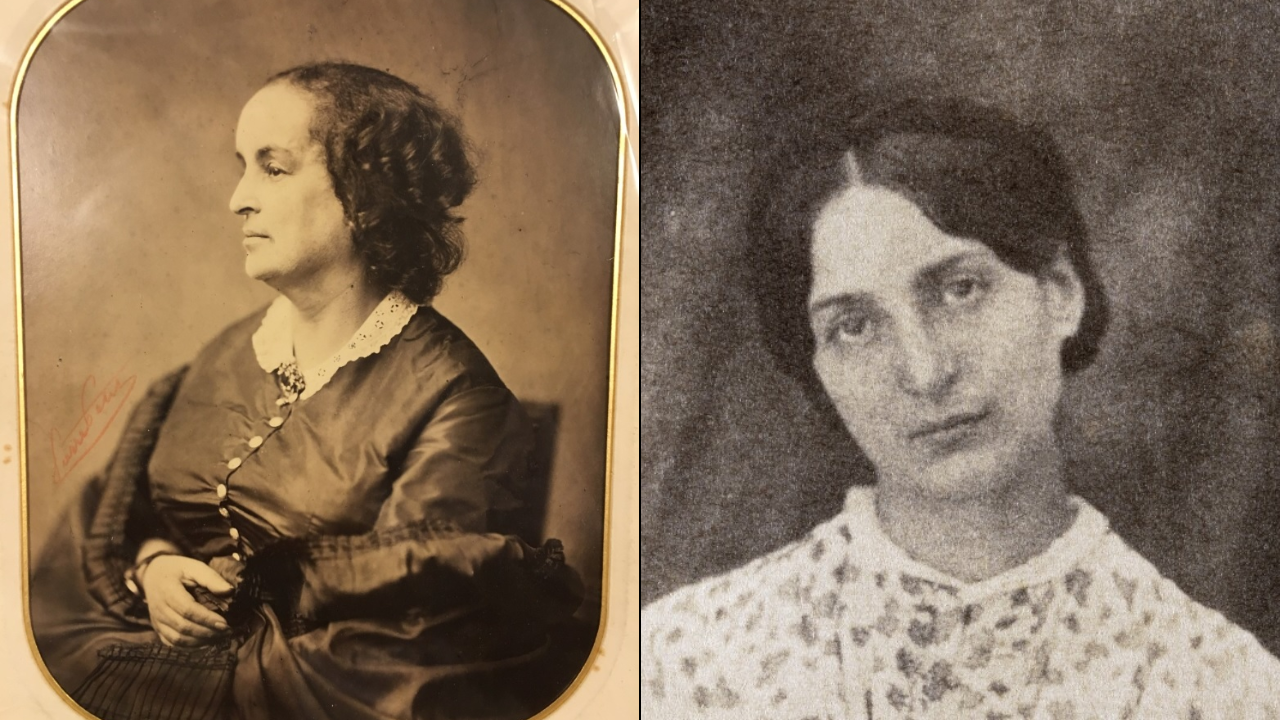
The youngest daughter of Victor Hugo spent fourteen years in the grip of erotomania, following a British lieutenant from Guernsey to Halifax to Barbados before the man whose name she had borrowed could not even remember hers.
She Walked Past Him Without Recognition
Sometime in the late 1860s, on a road in Bridgetown, Barbados, Adèle Hugo walked past Albert Pinson and did not know who he was. She had followed this man from the English Channel to the Atlantic coast of Canada to the Caribbean. She had told her father she had married him, a lie that had made the local papers. She had paid his debts, written him letters, sought out a hypnotist to bend his will.
She had given up her father, her mother, her correspondence, and finally her own lucidity in pursuit of him. And now, passing him in the street, she looked straight through hiM
Pinson watched her go.
A Sister’s Death Left Her Marked
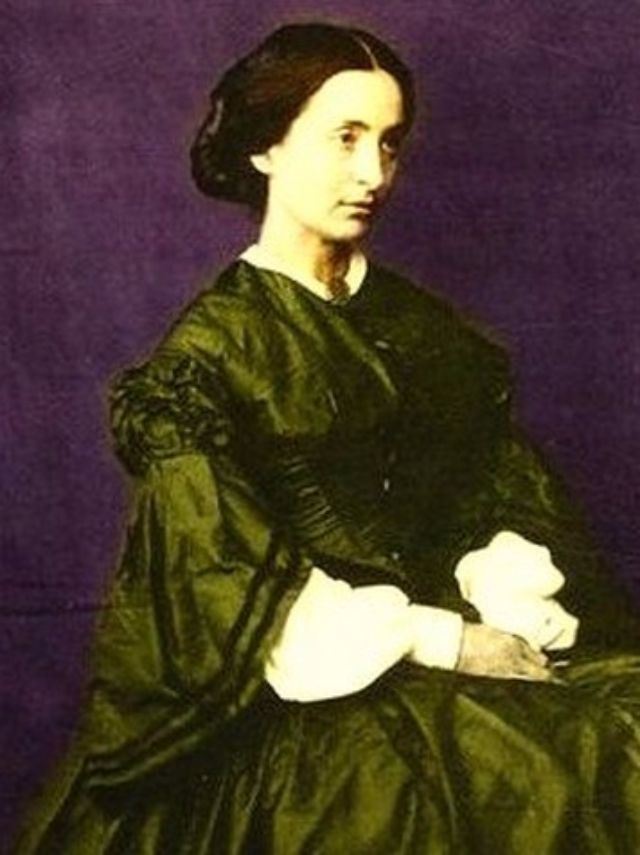
Adèle Hugo was born on 24 August 1830 in Paris, the fifth and youngest child of the poet and novelist Victor Hugo and his wife, Adèle Foucher, for whom she was named. The family was financially stable and in time would prosper.
Victor Hugo’s reputation grew steadily through the 1830s, anchored by the success of The Hunchback of Notre-Dame in 1831 and later secured permanently by Les Misérables.
His children grew up surrounded by the leading cultural figures of the age, attending concerts and absorbing the intellectual atmosphere of a household that received writers, artists, and philosophers as a matter of course.
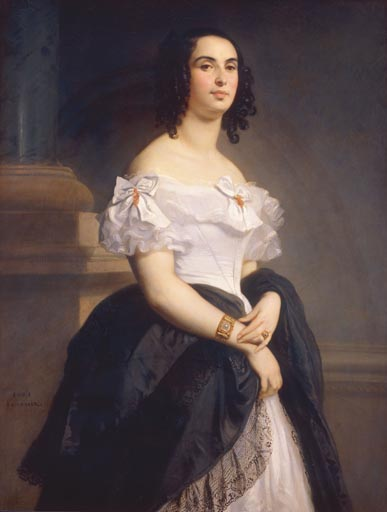
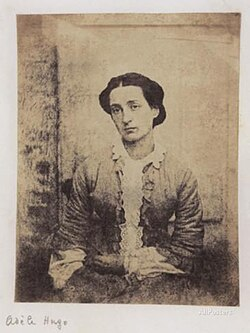
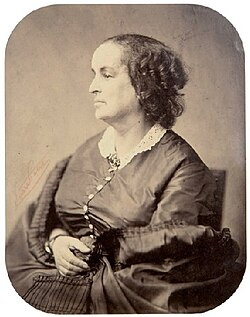
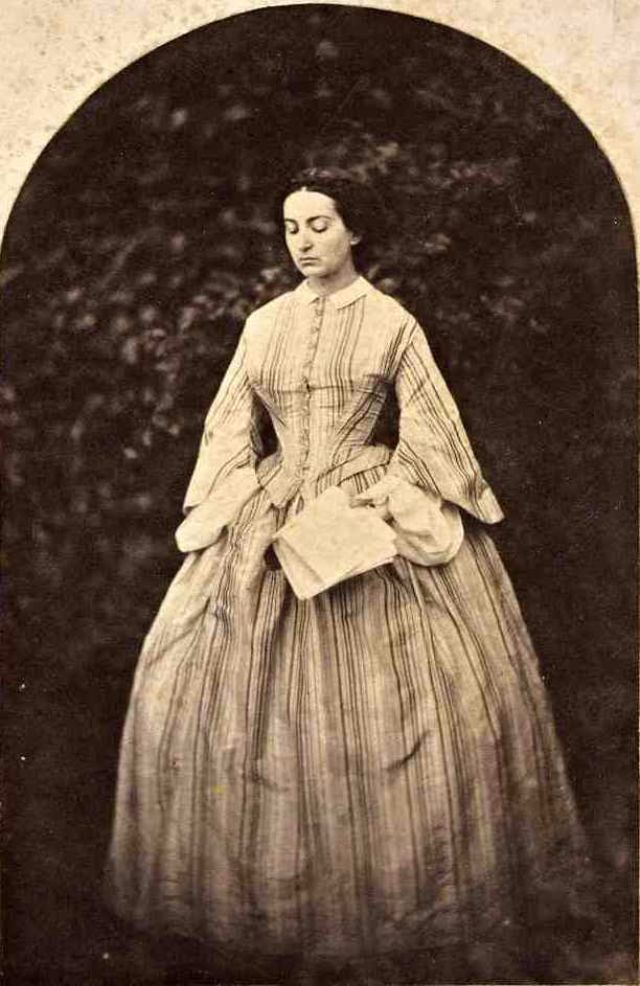
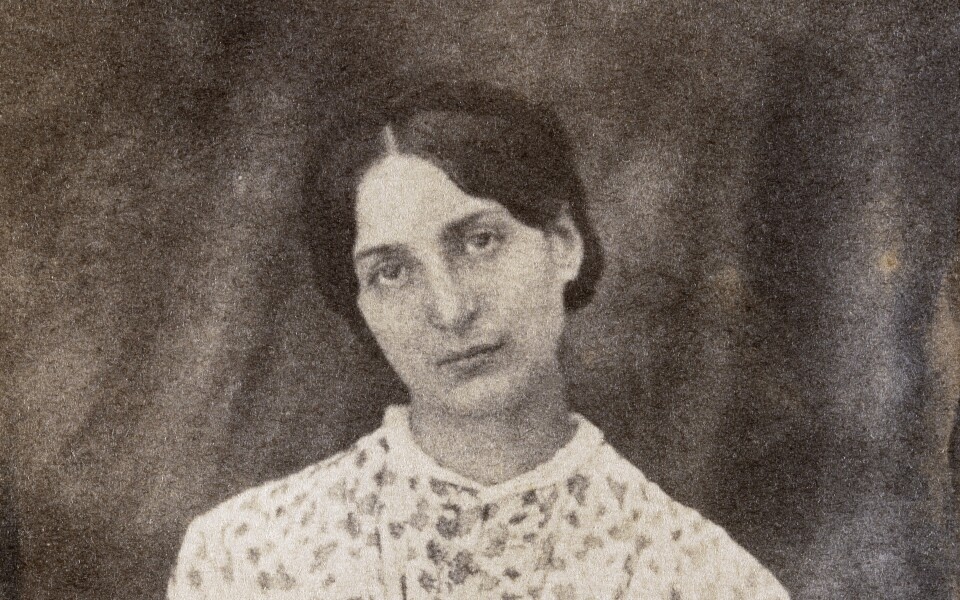
Adèle received a liberal education substantial by the standards available to women in nineteenth-century France. She played the piano with considerable skill, read in French, Latin, and Greek, and was known among her father’s circle for her dark hair and beauty. A photograph taken around 1850 survives. The young woman in it has striking eyes and an expression that does not suggest happiness.
The family’s first major rupture came on 4 September 1843, when Adèle was thirteen. Her sister Léopoldine, nineteen years old and recently married to Charles Vacquerie, drowned in the Seine near Villequier in Normandy after their boat overturned. Her heavy skirts pulled her under.
Charles died trying to save her. Victor Hugo was travelling in the south of France when he read the news in a café newspaper. He fell into clinical depression and could not write fiction for several years. The youngest daughter, watching from Paris, left no account of what the loss did to her. The subsequent record of her life suggests it was formative in ways she may not have been able to articulate.
In the years that followed, Adèle became briefly infatuated with Auguste Vacquerie the older brother of Léopoldine’s late husband, and therefore tangentially family by marriage. He was twenty-seven to her sixteen. Nothing came of it. She turned her attention briefly to the sculptor Jean-Baptiste Clesinger.
Nothing came of that either. These early attachments foreshadowed a pattern: intensity without resolution, and a tendency to pursue men who remained unmoved.
Exile to Jersey Delivered the Lieutenant
The family’s exile from France began in December 1851, when President Louis-Napoleon Bonaparte staged a coup and declared himself Emperor Napoleon III.
Victor Hugo had opposed him publicly and was now at risk of arrest. He fled to Brussels, then in August 1852 settled the family on the island of Jersey, in the Channel Islands.
Three years later, expelled from Jersey after Victor supported a local newspaper that had criticised Queen Victoria, the Hugos relocated to Guernsey. It was in this second island exile that Adèle met the man who would consume the next decade and a half of her life.
Albert Andrew Pinson known to his circle as Bertie was a junior officer in the British army. He and Adèle became acquainted around 1854, when she was nearly twenty-four and he was approximately two years her junior. In 1855, he proposed marriage. She declined.
That refusal appears to have been the hinge on which everything else turned. By 1856, signs of mental illness had become visible in Adèle’s behaviour. She reconsidered, sought to reconcile with Pinson, and found that his interest had gone. He moved on.
She did not. What followed was not grief or wounded pride but something more consuming: a conviction, apparently unshakeable, that Pinson loved her and would eventually prove it.
Historians have since identified this as erotomania: a condition in which the person affected becomes convinced that someone who has rejected them is, in truth, secretly in love with them.
Adèle’s erotomania is now understood as a symptom of schizophrenia, a vulnerability that ran in the Hugo family. Her paternal uncle, Eugène Hugo Victor’s brother had reportedly developed schizophrenia himself, after losing his secret love to his younger brother. That younger brother was Victor. The woman was Adèle’s mother.
Erotomania Drove Her Across the Atlantic
Pinson did not remain on Guernsey. His postings moved him to Bedfordshire, England, then to Ireland, then in 1863 to Halifax, Nova Scotia, in what was still a British colonial territory in Canada. Adèle followed him to each location. The pursuit would eventually span nearly fifteen years.
In Halifax, her behaviour became visibly disturbed. She appeared repeatedly at his barracks. She sent letters and gifts. She offered him money; he reportedly accepted it and continued to ask for more, while continuing to reject her. She consulted a hypnotist, reportedly intending to place Pinson in a trance that would compel him to propose.
In 1863, Adèle wrote to her parents in Guernsey with news: she and Pinson had married. Victor Hugo announced it in a local paper. The announcement was false.
The marriage had not occurred. Pinson remained entirely uninterested, and continued to be so.Her family begged her to come home. Her mother’s health was failing. Adèle did not come home.
Barbados Reduced Her to Ruin
In 1866, Pinson’s regiment was posted to Barbados. Adèle followed. She referred to herself there as “Madame Pinson,” a title she had no right to use. She had largely stopped writing in the diary she had maintained since the early exile years, the meticulous journal she called Journal de l’Exil.
She wrote to her parents rarely. The record of her Barbados years comes primarily from later accounts given by those who encountered her on the island.
What those accounts describe is a woman in collapse. Adèle was seen wandering the streets, talking to herself, detached from her surroundings. She neglected food and her own physical condition. It was a Barbadian woman of African descent, Madame Céline Alvarez Baa, who reportedly took Adèle in, gave her shelter, and eventually arranged for her return to France.
Victor Hugo later reimbursed Madame Baa for her expenses.
In 1869, Pinson’s regiment departed Barbados for Dublin. There he met and married Catherine Edith Roxburgh, the daughter of British Lieutenant-Colonel James Roxburgh. Their marriage produced a child. Adèle remained in Barbados. In 1872, aged forty-one, she finally returned to France.
Paris Received a Different Woman
Victor Hugo had returned to Paris in 1870, after Napoleon III was removed from power following the French defeat at the Battle of Sedan in the Franco-Prussian War. He had lost his wife Adèle’s mother in August 1868, while his daughter was still in Barbados; banished from France, he had been unable to attend the funeral. When his daughter arrived back in Paris in 1872, the father who had not seen her in nearly a decade found a woman he no longer recognised as the one who had left.
He had her committed.
She spent the remaining four decades of her life in private asylums in the Paris suburbs of Saint-Mandé and Suresnes. She hallucinated. She regularly failed to recognise visitors. Victor Hugo continued to provide financially for her care until his death in May 1885. She outlived him by thirty years, the only one of his five children still living at the time of his death Léopoldine had drowned in 1843, and both brothers died in the 1870s.
In later years, the French journalist Gustave Simon visited Adèle at the convalescent home in Saint-Mandé. He found her relatively lucid, willing to speak about her early life with warmth. She described her father and the Parisian cultural world of her youth with apparent affection and clarity.
She still played piano. She was reading in French, Latin, and Greek. Within the narrowed world of the asylum, she had retained a kind of interior life that her circumstances had not entirely extinguished.
Adèle Hugo died on 21 April 1915, aged eighty-four. She was buried at Villequier, in Normandy, in the same churchyard where Léopoldine had been interred over seventy years before.
Albert Pinson died a few months later.
Her Story Outlasted Her Silence
Adèle’s coded diaries, discovered in the 1950s by the Canadian scholar Frances Guille, form the primary record of her inner life during the Halifax years. They remained the most direct evidence available of what she actually believed was happening between herself and Albert Pinson two accounts of the same interaction, utterly irreconcilable.
François Truffaut’s 1975 film The Story of Adèle H. brought her pursuit of Pinson to international attention.
Isabelle Adjani, twenty years old at the time of the film’s Academy Award nomination, became the youngest nominee in the Best Actress category in the award’s history at that time.
The performance is widely considered one of the most precise depictions of erotomania in twentieth-century cinema.
The most recent account is Mark Bostridge’s In Pursuit of Love, published by Bloomsbury in 2024. Bostridge, the biographer of Vera Brittain and Florence Nightingale, spent years tracing the history.
He eventually located Pinson’s descendants and obtained the first known photograph of the lieutenant. The man in the image has a neutral expression. He does not look like someone worth crossing an ocean for.
That, of course, was never the point.
Leave a Reply