
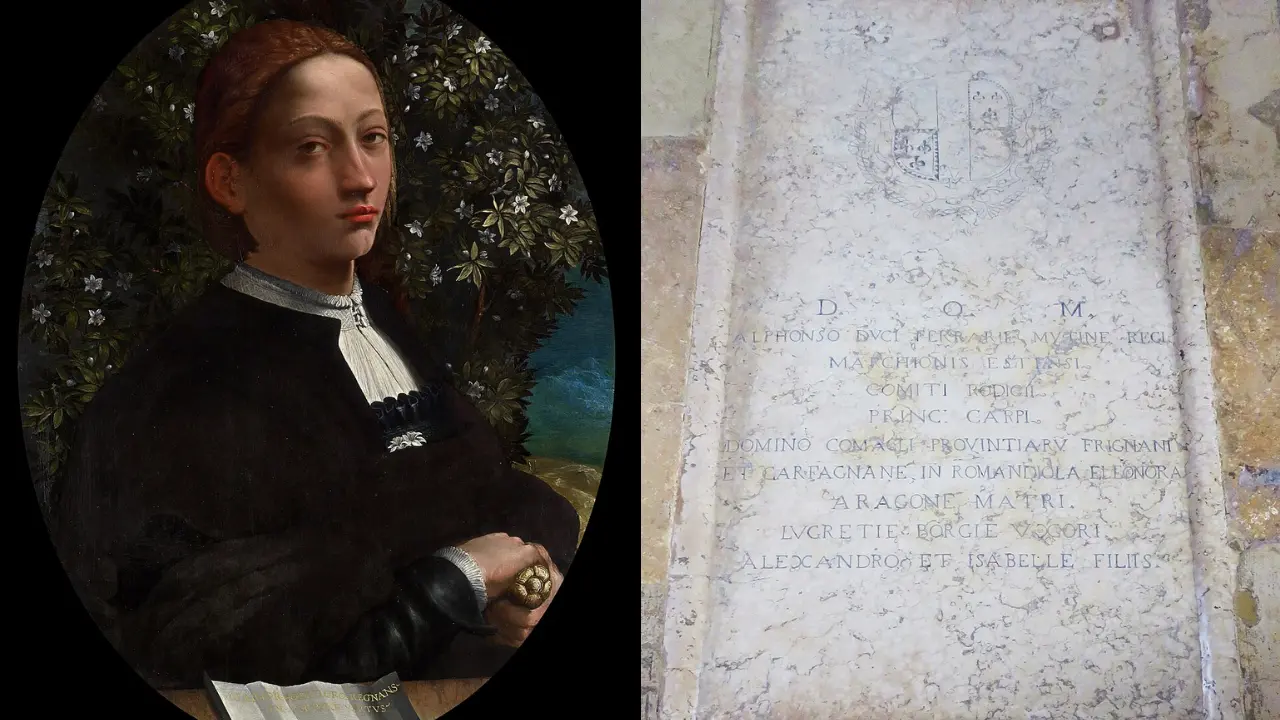
Married three times before the age of 22 and used as a political instrument by her father, Pope Alexander VI, Lucrezia Borgia became history’s most infamous femme fatale despite no documented evidence she ever poisoned anyone.
On the night of July 15, 1500, three armed men fell upon Alfonso of Aragon at the steps of St. Peter’s Basilica in Rome. He was stabbed in the head, right arm, and leg before anyone could reach him. Upstairs, behind locked doors, his wife refused to leave his bedside.
She prepared his food herself, tasting everything before it reached him. She slept in his chamber. She understood that if she turned her back for a single moment, someone would finish what the assassins had started.
Her name was Lucrezia Borgia. In the history that followed, she would be remembered not as the woman guarding her wounded husband but as the woman who poisoned men for sport.
Born on April 18, 1480, in Subiaco, a town outside Rome, Lucrezia was the only daughter of Cardinal Rodrigo Borgia and his mistress Vannozza dei Cattanei. Her father was one of the most formidable political operators in Italy, a Valencian nobleman who had accumulated influence over decades of ecclesiastical maneuvering. Her three full brothers, Cesare, Giovanni, and Gioffre, were raised alongside her. But it was Lucrezia who proved most useful to the family machine.
The Borgia lineage stretched back to the Kingdom of Valencia, where Rodrigo’s uncle, Alfonso de Borgia, had risen to the papacy as Calixtus III in 1455. When Rodrigo himself was elected Pope Alexander VI in 1492, the family commanded the summit of Renaissance Italian power: wealthy, connected, and feared. Into this world, Lucrezia arrived as an asset rather than a person. Her education confirmed this. Tutored by humanists and overseen by Adriana Orsini de Mila, a cousin of her father’s, she became fluent in Spanish, Valenciano, Italian, and French, and literate in both Latin and Greek. She could play the lute and zither, dance, embroider, and recite poetry. Every skill was inventory. Every grace was diplomatic capital.
Alexander VI Used Marriage as Currency
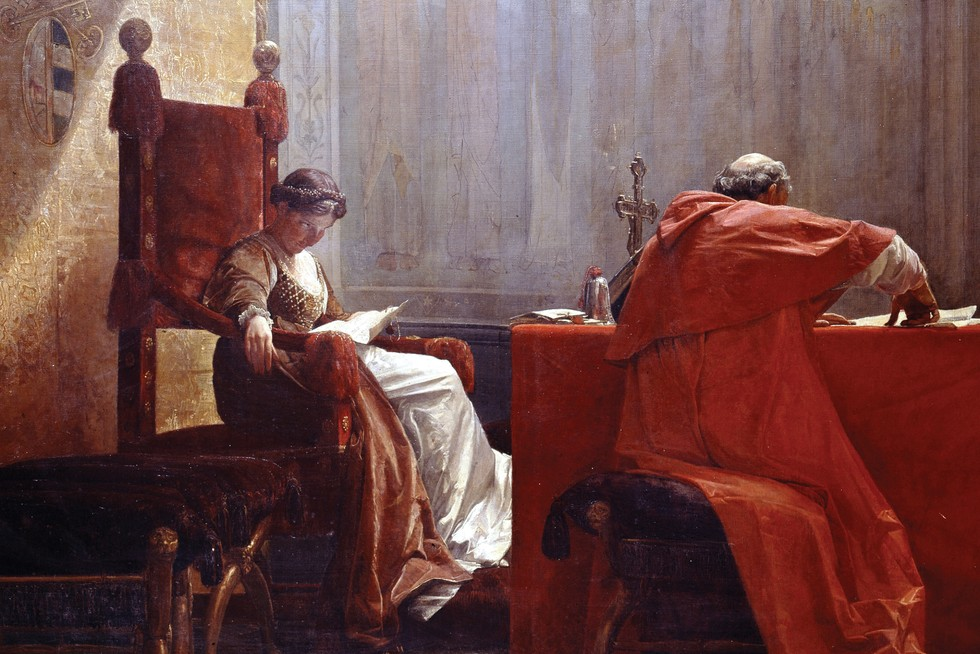
When Lucrezia was still a child, her father had already begun negotiating her hand. The Sforza family, which controlled the Duchy of Milan, offered the most useful alliance in 1493. On June 12, 1493, Lucrezia, aged thirteen, married Giovanni Sforza, Lord of Pesaro, by proxy in Rome, outfitted in brocade and jewels for the ceremony.
She moved to Pesaro, where local poets welcomed her with madrigals. The domestic arrangement appeared stable. Then Alexander’s political calculations shifted.
By the mid-1490s, the Sforza alliance had become inconvenient. Ludovico Sforza’s influence was waning, and the pope wanted his daughter returned. Giovanni was warned by Lucrezia herself, reportedly acting on information passed through Cesare, that his life was in danger. He fled. The annulment proceedings that followed demanded that he confess impotence before witnesses, despite the fact that his first wife had died in childbirth. It was deliberate humiliation. Giovanni signed the documents, then reportedly declared from the safety of his own territory that the pope wanted no other man to have what he wished to keep for himself. This accusation of incest became one of the most durable smears ever attached to Lucrezia’s name.
No credible evidence supports it. What is documented is this: a thirteen-year-old had been married to a political ally, discarded when that alliance expired, and returned to her father’s custody through a coerced annulment, left to carry the stain of accusations her family had no incentive to disprove.
A Second Husband Was Murdered in His Bed
The second marriage was different. On July 21, 1498, Lucrezia married Alfonso of Aragon, the illegitimate son of Alfonso II, King of Naples, in a private ceremony in the Vatican apartments. Contemporary accounts suggest the match was genuinely happy. Alfonso was young, cultured, and handsome. Lucrezia, by all contemporary descriptions, fell in love with him.
Their happiness had an expiration date her family had written before the vows were spoken. Alfonso’s value depended on the Neapolitan alliance. When Cesare Borgia aligned himself with France, then at war with Spain, Alfonso became a political liability overnight. He fled Rome when threats became explicit. Lucrezia was pregnant. He returned at her request.
On the night of July 15, 1500, he was attacked at the steps of St. Peter’s Basilica by three hired men armed with halberds and swords. He survived the initial assault and was carried inside, tended by Neapolitan physicians, his half-sister Sancha of Aragon, and Lucrezia, who posted herself at his bedside and refused to leave. During his convalescence, she prepared and tasted everything he consumed. Her instinct was correct. The killers had not finished their work.
While Lucrezia was briefly drawn away by her father on some pretext, Alfonso was strangled in his bed. The likely agent was Micheletto Corella, a man in Cesare Borgia’s direct service. Alfonso was buried quickly. It was put about that he had been conspiring against Cesare. He had been married to Lucrezia for two years. Their son, Rodrigo of Aragon, was less than a year old.
Lucrezia retreated to Nepi Castle. She wore black, returned her jewels and dresses and cutlery to the Vatican, and signed her letters as “the unhappiest of women.” Her father corresponded with her at length and eventually coaxed her back to Rome. She had no realistic alternative.
Ferrara Revealed What She Was Capable Of
The third marriage was the last and the longest. Alexander VI had targeted the Este family of Ferrara, one of the oldest dynasties in Italy, as an alliance of prestige. Ercole I d’Este, Duke of Ferrara, was resistant. Before agreeing, he sent agents to learn what Lucrezia was actually like.
Their reports did not match her reputation. She has perfect gracefulness in all things, they told him, with modesty, gentleness, and decency. Her qualities make us think nothing sinister can be thought about her. Ercole agreed, extracting a substantial dowry and other concessions in return.
On December 30, 1501, Lucrezia married Alfonso I d’Este by proxy in Rome. She made the journey to Ferrara through the Apennine Mountains on horseback and by sedan chair, arriving in person on February 2, 1502. She was twenty-one years old, had been married three times, widowed once, and publicly slandered throughout. What came next was the longest period of her life in which she exercised any real control.
Alfonso d’Este was not a devoted husband. His extramarital affairs were publicly known and unremarked upon. Lucrezia conducted affairs of her own, including a long passionate correspondence with the scholar Pietro Bembo that the Romantic poet Lord Byron, encountering the letters in Milan’s Ambrosian Library in 1816, described as the finest love letters in the world. But the private life does not contain the full picture of what she built at Ferrara.
When Alexander VI died in 1503 and Cesare was killed in 1507, Lucrezia was free of the family machinery that had governed her since childhood. What she constructed without it is the portion of her story history has most consistently erased.
She administered the Ferrara court with documented competence. She served as regent twice during Alfonso’s military campaigns, meeting with envoys, managing correspondence, and governing in his absence. Records indicate she prohibited discrimination against Ferrara’s Jewish population and imposed penalties on those who violated public order. She managed her own finances with sophistication, investing in land reclamation and short-term rental agreements that nearly doubled her annual income over time. When Pope Julius II excommunicated Alfonso in 1510 and placed Ferrara under interdict, Lucrezia pawned her personal jewelry to fund the city’s defense.
Pierre Terrail, seigneur de Bayard, the most celebrated French knight of his generation, wrote to King Louis XII after visiting Ferrara. The Duchess was a pearl in this world, he said, who had given a wonderful welcome to the Embassy of France. He declared he had never encountered a more triumphant princess, beautiful, benevolent, and kind to all.

History Preferred the Poisoner to the Duchess
Lucrezia Borgia died on June 24, 1519, at Belriguardo Castle, aged thirty-nine. She had given birth ten days earlier to a daughter, Isabella Maria, who did not survive her first day. Puerperal fever claimed Lucrezia before the month was out. The people of Ferrara mourned her publicly. She was buried in the Convent of Corpus Domini, where she had asked to be interred, shrouded in the habit of a Franciscan tertiary.
Nine days before she died, she had written to Pope Leo X asking for his blessing.
The legend that replaced her was built by political enemies during her lifetime and elaborated by nineteenth-century writers who found a poisoner far more useful than a survivor. Victor Hugo gave her a play in 1833. Donizetti gave her an opera. The hollow ring she allegedly used to poison drinks has no foundation in any historical record. The incest accusations carry no documentary evidence beyond the words of men who despised her family. The murder charges have never been traced to a single confirmed victim.
What the historical record does document is a woman sold into marriage at thirteen, widowed by political assassination at twenty, and coerced into a third arrangement before she turned twenty-two. A woman who governed a Renaissance court, protected a persecuted minority, doubled her own income through shrewd investment, and earned the admiration of the finest knight in Europe. A woman whose family needed a symbol and whose enemies needed a villain.
She has served both purposes ever since. Lucrezia Borgia, Duchess of Ferrara, died before she turned forty. The woman history invented died much later, and refuses to die still.
Leave a Reply