
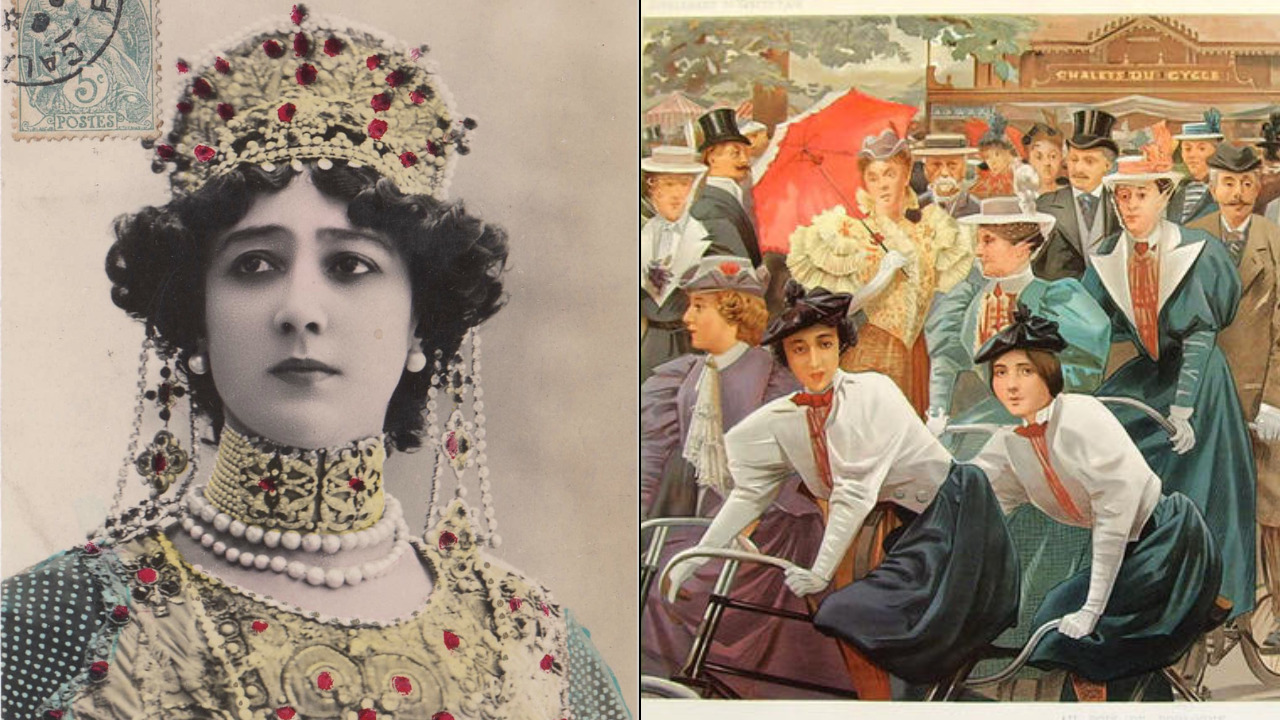
Born into desperate poverty in Galicia in 1868 and raped at ten years old, Carolina Otero became the most sought-after courtesan in Europe, collected lovers who included Kaiser Wilhelm II and the future King Edward VII, amassed a fortune worth millions and died in 1965 in a one-room apartment, having lost nearly all of it at the tables of Monte Carlo.
On a night in 1909, police raided an illegal gambling club in Paris. Inside, they found fifty women and ten men. One woman was discovered hiding in a cupboard. She gave her name as Carolina Otero the same Carolina Otero who, for the better part of two decades, had been the most celebrated courtesan in Europe, mistress to kings, kaisers, and grand dukes.By then, the gambling was no longer incidental to her fame. It would eventually consume it entirely.
A Childhood Built on Poverty and Violence
Agustina del Carmen Otero Iglesias was born on November 4, 1868, in the village of Valga, in Spain’s Pontevedra province. Her mother, Carmen Otero Iglesias, worked as a flamenco dancer and raised her daughter alone. The identity of Otero’s father was never confirmed; she later claimed he was a Greek army officer, though no independent record verifies who he was, or how he died.
The poverty was severe enough that Otero was sent away to work as a maid in Santiago de Compostela while still a child. At around ten years old, she was raped an assault so violent, according to multiple biographical accounts, that it left her unable to have children for the rest of her life.
She did not stay a maid for long. At thirteen or fourteen, she left with a young man named Paco, who found her work dancing in a café. The relationship did not last: while the pair were still working their way through Lisbon, Paco left her. Otero did not slow down to grieve it. She danced wherever the work appeared cafés, taverns, small theaters moving through southern Spain and Portugal, discarding admirers as readily as she collected them, taking what she needed from each arrangement and moving to the next.
Barcelona, a Vanished Marriage, and a Sponsor Who Made Her a Star
By her mid-teens, the record grows harder to pin down. Otero herself later claimed that at fourteen she married an Italian nobleman in her memoirs, a man “as handsome as Bizet’s Toreador.” No documentation supports the marriage, and biographers treat it as one of the many self-authored embellishments Otero added to her own legend over the years.
Whatever the truth, she abandoned the arrangement to chase a dancing career in Marseille.By nineteen, Otero was living in Barcelona, working as both a singer and, by her own account, a prostitute. It was there that she attracted her first long-term patron a wealthy backer, likely drawn in after one of her performances, who took her to Marseille to showcase her talents properly. It was during this stretch, while performing in the south of France, that Otero also visited the casinos of Monte Carlo for the first time and won.
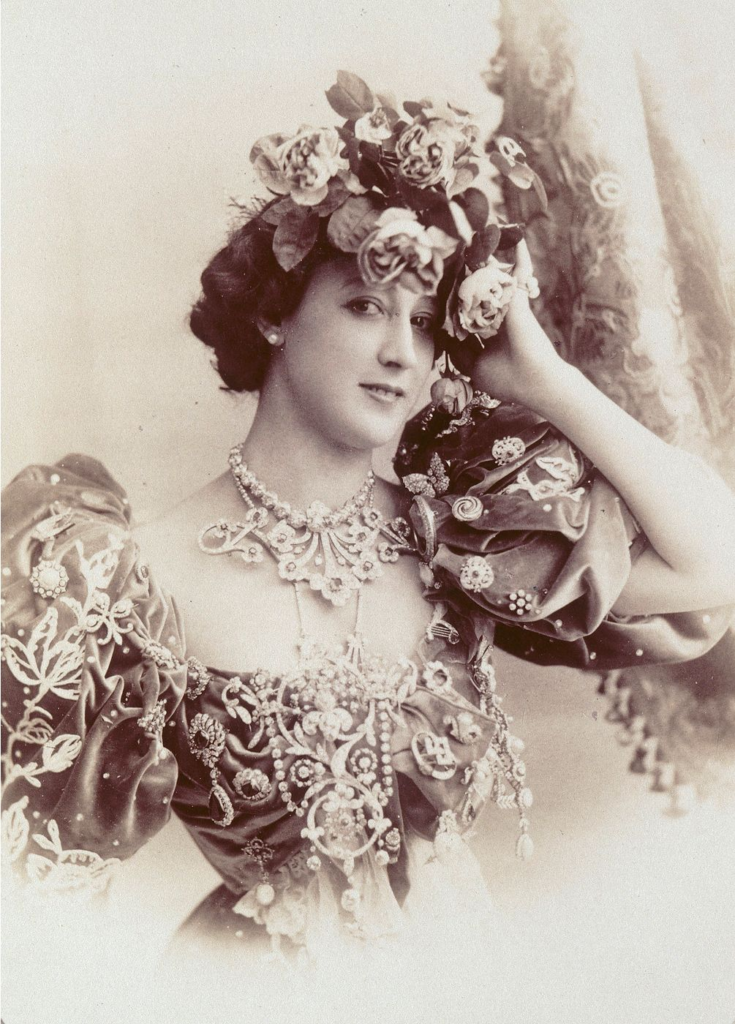
The win is the detail every account of her later ruin traces back to: it was this early taste of gambling money, arriving easily and dramatically, that appears to have fixed the habit that would eventually undo everything else she built.She cut the Marseille patron loose once she no longer needed him and pushed on to Paris. There, in 1888, she came under the wing of a businessman named Ernest Jurgens, who helped position her for the stage that would make her famous. She left him too, not long after. What she carried out of both arrangements was a stage name and a persona: Carolina Otero became La Belle Otero, an invented Andalusian gypsy, dark-eyed and untouchable.
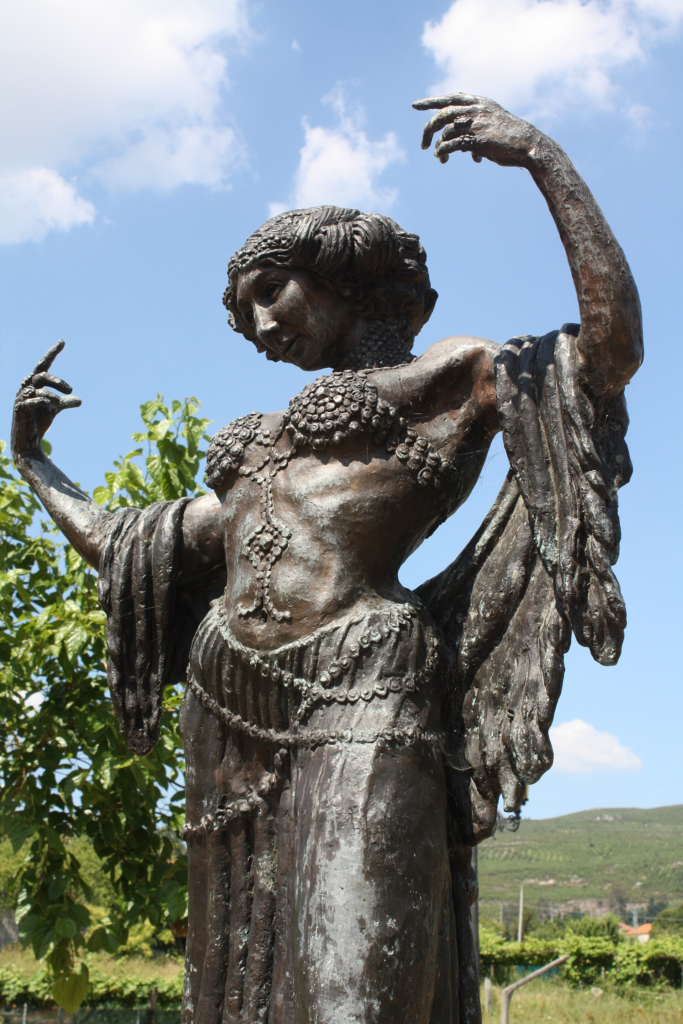
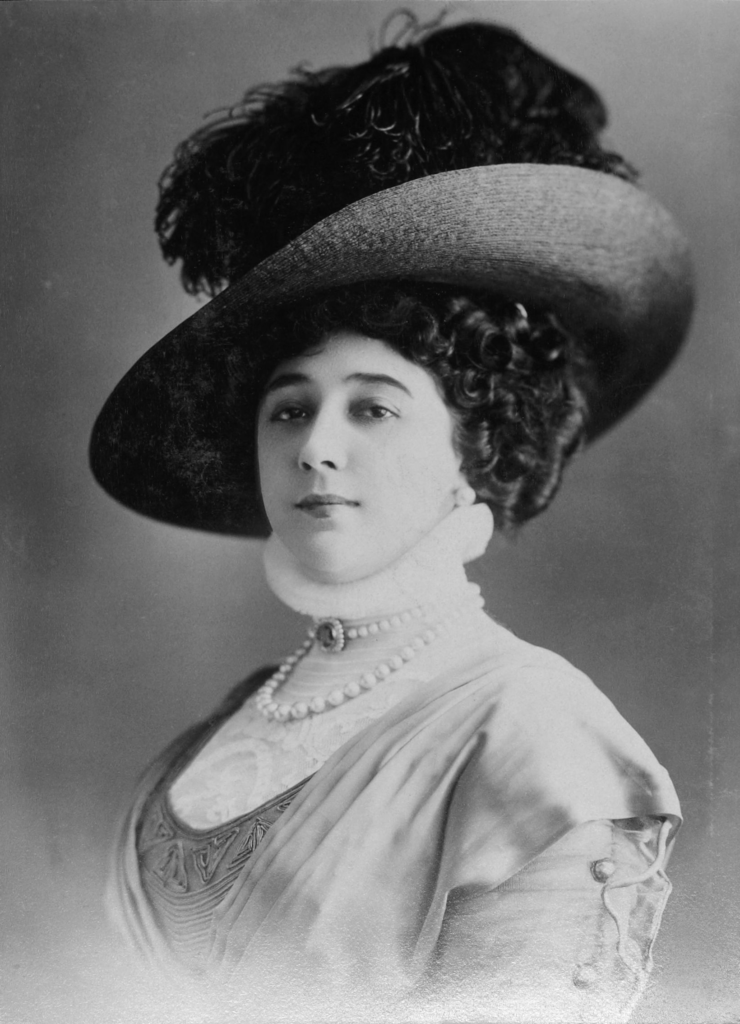
The Folies Bergère made her a star in the early 1890s. Contemporary accounts described her dark eyes as having an intensity that made it “impossible not to be detained before them.” She danced a wild, sensual fandango on at least one occasion reportedly leaping onto a table at Maxim’s to perform it and Paris could not get enough.By 1895, Otero was widely considered the most desired courtesan in Europe.
A List of Lovers That Reads Like a Court Registry
The men who pursued her were not minor figures. Otero’s confirmed and reported lovers included the future King Edward VII of the United Kingdom, then Prince of Wales; Kaiser Wilhelm II of Germany; Prince Albert I of Monaco; King Alfonso XIII of Spain; Nicholas I of Montenegro; and Hugh Grosvenor, the 1st Duke of Westminster, then among the wealthiest men alive.
Her Russian romances were murkier, and sources disagree on the details. Otero is variously reported to have been involved with Grand Duke Nicholas Nikolaevich, his brother Grand Duke Peter Nikolaevich, or both at different times.One frequently repeated story holds that a Russian Grand Duke once locked her in a room and took the key and her coat with him and that Otero, furious, jumped from the window into the snow below, where a passing peasant found her and carried her to safety. She reportedly contracted pneumonia and took three months to recover.
No primary source confirms which Grand Duke was responsible, or whether the episode happened as described.What is better documented is the price of failing to hold her interest. According to period accounts, at least six men are reported to have taken their own lives after Otero ended relationships with them a figure repeated across multiple retellings of her life, though it comes from contemporary rumor rather than any official record.
In 1898, Otero appeared in a short film dancing to Chopin’s “La Valse Brillante” one of the earliest surviving motion picture performances by a stage celebrity, and one of the reasons she is sometimes described as among the first movie stars in history.
A Fortune Measured in the Millions and a Habit That Would Outlast Every Lover
By the time her career carried her through Germany, America, and Russia, Otero had accumulated a genuine fortune period estimates place it anywhere from roughly $15 million to $25 million, figures that vary depending on the source and are difficult to verify precisely, but which agree on the scale: she was, for a time, one of the wealthiest self-made women in Europe.The habit formed years earlier at the tables of Monte Carlo never left her. Every gift, every jewel, every property signed over by a besotted king or duke eventually found its way to the same casinos that had given her that first winning night in her late teens.
Otero retired from performing around the end of the First World War, settling into a mansion in Nice on the French Riviera. She spent time on charitable work. But the casinos of Monte Carlo, Nice, and Cannes drew her back, night after night, dressed in the same impeccable style that had once made her the toast of Paris only now the stakes were her own dwindling capital rather than the gifts of kings.Over roughly thirty years, she lost nearly all of it. The mansion gave way to smaller and smaller lodgings until Otero was living in a single room at the Hôtel Novelty in Nice, dependent on a small pension from the city council.
The Empress of the Folies Bergère Dies Alone
In April 1965 sources place the date between the 10th and the 12th Carolina Otero died of a heart attack in that one-room apartment. She was 96 years old. Her funeral drew only a small gathering: a handful of acquaintances, and several directors of the casinos where she had spent decades of her fortune.
The newspapers that covered her death wrote about the Folies Bergère, about the kings and kaisers, about the woman once so famous that a hotel in Cannes is still popularly said to have modeled its twin cupolas on her figure.In her tiny room, she had kept photographs of her glory days on display until the end.She is reported to have once said that women have only one mission in life to be beautiful and that when a woman grows old, she must learn how to break mirrors. Whether or not the line is exactly hers, it is the one she left behind.
Leave a Reply