
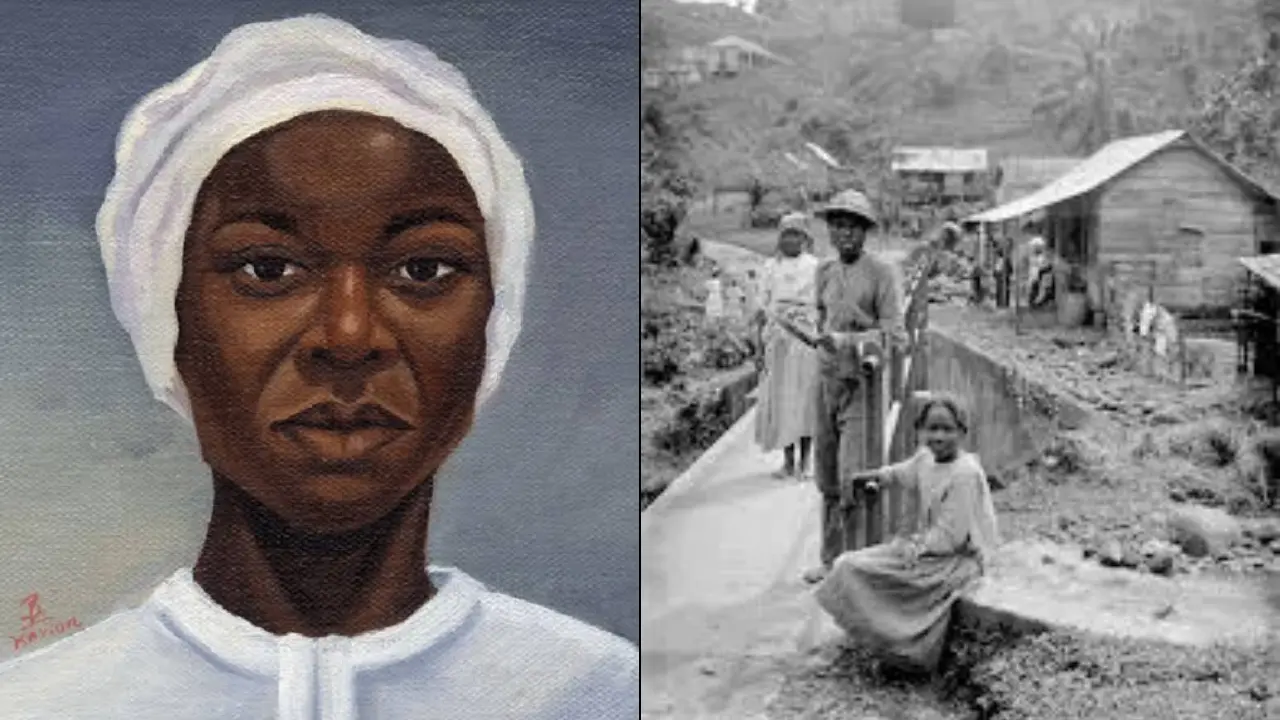
Born into legend and buried in disputed accounts, Nanny of the Maroons led the Windward Maroons through three decades of guerrilla warfare, freed more than 1,000 enslaved people, and signed a land treaty with the British Crown in 1740 despite an official colonial record declaring her dead seven years earlier.
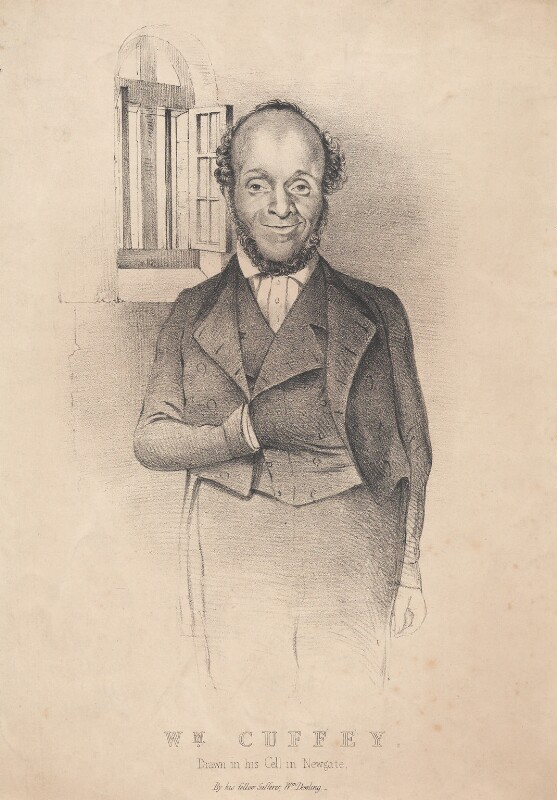
In March 1733, the Journal of the Assembly of Jamaica issued a formal citation. A hired soldier named William Cuffee was commended for “resolution, bravery and fidelity.” His specific achievement was recorded plainly: Cuffee had killed “Nanny, the rebels old obeah woman.”
She was officially dead. The colonial record said so.
In 1740, Nanny signed a land treaty with the British Crown, securing 500 acres in the parish of Portland for the Windward Maroon people.
The woman the colonial archive buried in 1733 had outlasted, outfought, and finally outlasted the British entirely. Moore Town, built on that land grant, still stands today.
Many Accounts Compete to Claim the Same Woman
The difficulty with understanding Nanny begins at the beginning. Multiple origin stories exist, almost all of them shaped by the purposes of whoever recorded or transmitted them.
The most widely cited account, supported by Maroon oral tradition, holds that Nanny was born around 1686 into the Asante people of what is now Ghana. According to the Maroons of Accompong Town, her mother’s name was Nyankopong, a figure possibly connected to the founding of the Oyoko clan, placing Nanny’s lineage among the Asante ruling class. In one version, she was brought to Jamaica as an enslaved person and jumped from a slave ship while it was still offshore, swimming to freedom while her sister Sekesu remained enslaved. Maroon legend holds that Nanny became the mother of all Maroons, while Sekesu became the mother of all those who remained enslaved.
Other accounts complicate this picture. One version holds she arrived in Jamaica as a free woman, perhaps with enslaved people of her own. Another describes her as a figure of African royal blood who came freely and may have married a Maroon man named Adou. Whether these versions describe the same woman, different women, or a composite of both is impossible to confirm.
As poet and historian Kamau Brathwaite has noted, Nanny appears only four times in the official written record, each time in fragmentary and contradictory terms. Almost everything else comes from oral traditions that function, as with most African ancestral figures, to transmit values and cultural identity alongside biographical fact. The result is a woman who is many things at once and definitively few of them.
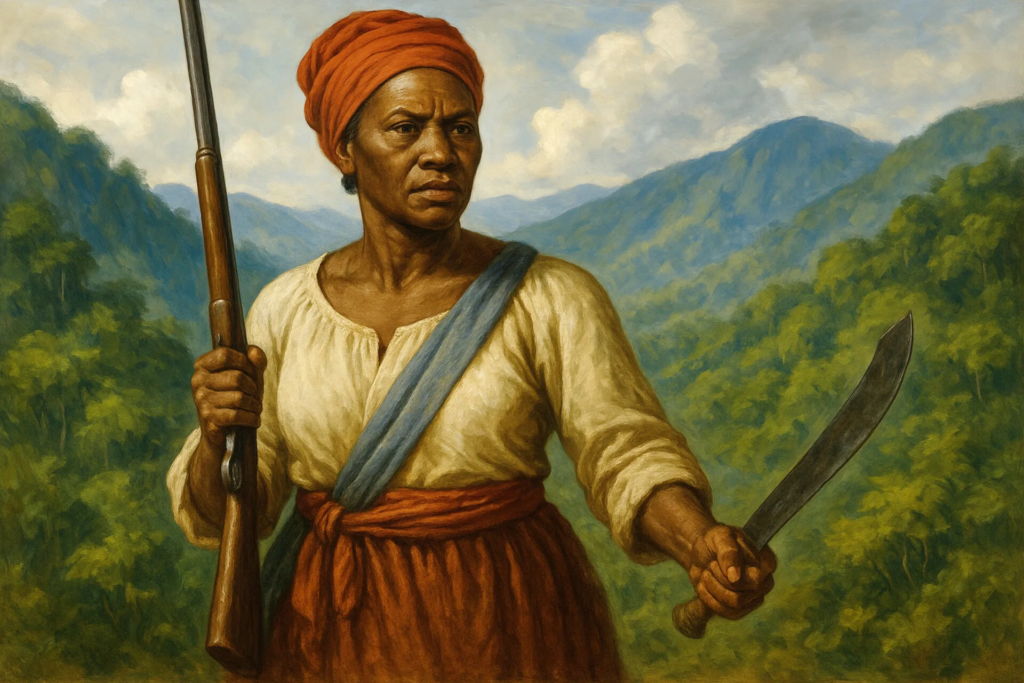
The Windward Maroons Build a Free Nation Inside a Colonial One
The community Nanny led was itself the product of decades of resistance before she arrived. When the English captured Jamaica from Spain in 1655, the Spanish freed their enslaved people before departing. Those formerly enslaved joined communities already living in the island’s mountainous interior, and from this population grew the Windward Maroons of the east and the Leeward Maroons of the west.
By the early 18th century, Nanny led the Windward Maroons alongside Quao, sometimes identified in oral tradition as her brother, while Cudjoe and Accompong commanded the Leeward communities. These were not refugee encampments. The Maroon settlements raised animals, cultivated crops, and maintained active trade networks with nearby towns, exchanging food for weapons and cloth. Historians have noted the settlements functioned along lines recognizable to anyone familiar with Asante social structure.
From 1655 until the peace treaties of 1739 and 1740, these Maroon communities led the majority of slave rebellions in Jamaica. They raided plantations, freed enslaved people, and brought them into mountain settlements. During three decades under her leadership, Nanny is credited with freeing more than 1,000 enslaved people.
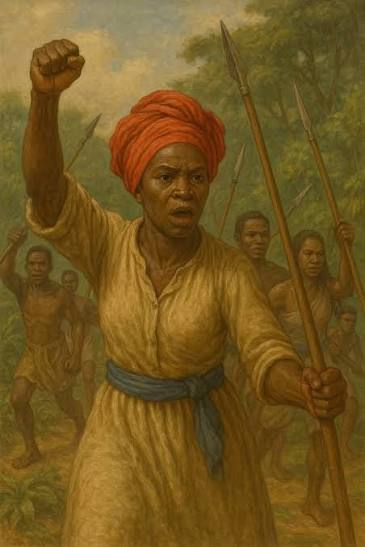
Nanny Turns the Blue Mountains Into a Fortress No Army Could Hold
By 1720, Nanny and Quao had established a settlement in the Blue Mountains that would be named Nanny Town. The site was chosen with the precision of an experienced military planner. Positioned on a 900-foot ridge overlooking Stony River, the village had a single approach path so steep and narrow it could not accommodate two people walking side by side. Any attacking force was forced into single file before it came within range of the village.
The terrain was an advantage. Nanny did not rely on it alone.
The Windward Maroons were among the first to systematically deploy the abeng, a cow horn with a hole drilled in one end, as a long-range communication system. Maroon lookouts could transmit signals across distances the British could neither replicate nor decode. Nanny’s soldiers were trained in camouflage so effective that British accounts described trees in the forest “becoming alive.” They developed techniques for slowing their breathing to remain undetected at close range, and methods for maintaining fires that produced minimal visible smoke.
To these advantages, Nanny added a psychological one. Her forces never killed every soldier in an attacking party. A remnant was always allowed to survive and return to base, to relay what they had encountered. The stories those survivors brought back operated as a weapon against every subsequent officer who considered mounting an assault.
It worked. The British captured Nanny Town more than once. They could never hold it.
In 1734, a Captain Stoddart led a force along the single available path and found it, in his own documented account, “steep, rocky, and difficult, and not wide enough to admit the passage of two persons abreast.” His forces destroyed the settlement after taking it. According to planter Bryan Edwards, who recorded his account nearly half a century after the events, Stoddart found the inhabitants in their huts and fired while they slept. More recent evidence suggests that fewer than ten Maroons died in that attack.
Nanny’s community rebuilt.
The British Declare Her Dead, Then Run Out of Options
The March 1733 Assembly citation awarding William Cuffee a bounty for killing “Nanny, the rebels old obeah woman” is one of the most frequently cited documents in her historical record. It is also almost certainly wrong, or it describes a different woman.
“Nanny” was not only a personal name. It was an honorific applied to senior women within Maroon communities, and more than one woman carried it. Whether Cuffee killed this Nanny or another cannot be confirmed. What is clear is that the leader of Nanny Town survived to negotiate a land agreement seven years after her recorded death.
The circumstances of that agreement were complicated. In 1739, the British signed a peace treaty with Cudjoe and the Leeward Maroons, ending the western theater of the war. This gave the British a stronger negotiating position with the Windward Maroons, who now faced the British alone. By most accounts, Nanny was initially opposed to signing any agreement. She had fought the colonial forces for years without yielding. But in 1740, a separate land patent was signed, granting “Nanny and the people now residing with her and their heirs… a certain parcel of Land containing five hundred acres in the parish of Portland.”
The agreement carried a cost the Maroon community would reckon with for generations. Like the Leeward Maroons under Cudjoe, the Windward Maroons agreed not to harbor newly escaped enslaved people and to help return them to plantation owners in exchange for bounties. Some accounts suggest Nanny did not comply with this clause and continued sheltering those who reached her. Others dispute this. What is not disputed is that the British, having spent decades attempting to defeat her on the battlefield, had agreed to give her land.
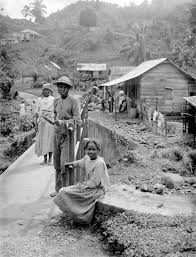
Moore Town Stands Where Nanny Town Fell
The rebuilt settlement became Moore Town, renamed around 1760 after the governor Sir Henry Moore during Tacky’s War, a slave rebellion the Maroons helped the British suppress. By that point, Nanny may already have been dead.
She is believed to have died around 1760, most likely in her early to mid-seventies, of natural causes. According to Maroon oral history, her remains rest at a site called Bump Grave in Moore Town, a location her descendants still regard as sacred ground.
In 1975, the Jamaican government declared Nanny of the Maroons the country’s only female national hero, a designation formalized further on March 31, 1982, when she was conferred the Order of the National Hero, Jamaica’s highest recognition. Her portrait was placed on the $500 note, a bill Jamaicans call simply a Nanny.
The colonial Journal of the Assembly of Jamaica recorded her death in 1733. Moore Town has been continuously occupied ever since, and each year on April 20, the anniversary of the 1740 treaty, its residents mark what the British signed and what Nanny refused to lose.
Leave a Reply