
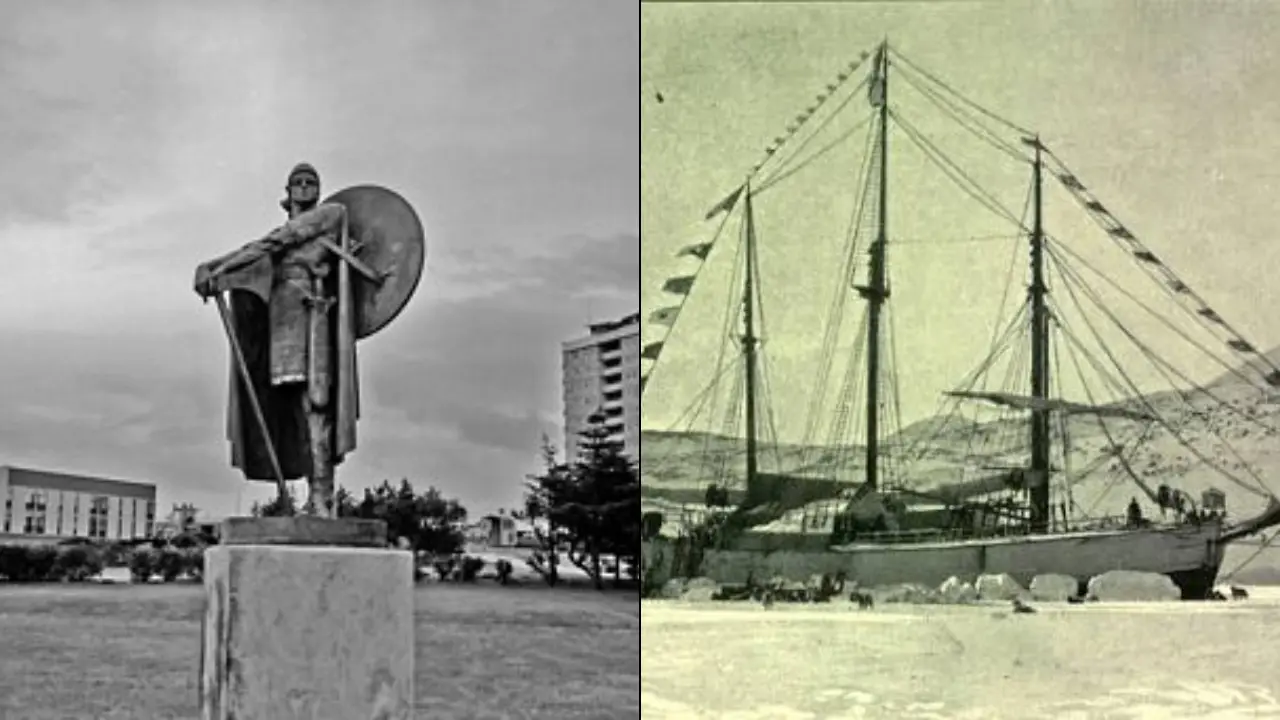
Around 1010 CE, Icelandic merchant Thorfinn Karlsefni led as many as 140 men to the shores of North America, coming closer to establishing a permanent European colony than anyone else would for the next five centuries.
Around 1010 CE, on a stretch of North American coastline the Norse had named Hóp, a lookout spotted movement on the water. Strange craft were approaching. Hide-covered boats, many of them, crewed by figures unlike anyone the settlers had encountered on any previous voyage. Both groups fell still. Then, as quietly as they had appeared, the strangers turned and left.
They would return. And when they did, the first serious attempt to colonize North America would be finished.
The man who had brought those settlers there was Thorfinn Karlsefni Thórðarson, an Icelandic merchant whose name has been largely surrendered to the same historical record that handed all the recognition to Leif Eriksson. Karlsefni did not merely reach what the Norse called Vinland. He sailed there with livestock, built a base of operations, attempted to hold a settlement through two winters, and fathered the first child of European descent known to have been born in the Americas. He came closer to permanently establishing a European colony in the New World than anyone else would for the next five centuries.
His story survives in two Old Norse sagas. They do not always agree on what happened.
Karlsefni Built His Fortune Before He Sailed Into the Unknown
Thorfinn Karlsefni was born around 980 CE, most likely at the family estate at Reynistaður in the Skagafjord region of northern Iceland. His full name was Thorfinn Karlsefni Thórðarson. “Karlsefni” was a byname: Magnusson and Pálsson translate it as “makings of a man,” while the Cleasby-Vigfusson Old Norse dictionary offers the crisper gloss “a thorough man” or “a sterling man.” His father was Thord Horsehead, known in Old Norse as Þórðr hesthöfði. Through his father’s lineage, as recorded in the Landnámabók, Karlsefni could trace descent through several generations of prominent Norse figures, among them the matriarch Aud the Deep-Minded and King Kjarval of Ireland.
Little survives of his early years. What the sagas make clear is that by adulthood he had established himself as a successful merchant, sailing trade routes between Iceland, Norway, and Greenland. He was a man of standing before he became a man of legend.
On one of his trading voyages, Eiríks saga rauða records, Karlsefni arrived at Brattahlíð, the Greenland estate established by the Norse explorer Erik the Red, with a crew of 40 men and a ship loaded with goods. He wintered there as a guest. During those months he met Gudrid Thorbjarnardóttir, a widow of considerable reputation who was staying with her brother-in-law Leif Eriksson. Karlsefni married Gudrid that winter.
At Brattahlíð, he also absorbed the account that had been circulating across the Norse settlements for roughly a decade: Leif Eriksson had sailed west and reached a land of extraordinary natural abundance. Leif had called it Vinland, a name traditionally understood to mean Land of Wine for the grapevines he reportedly found there. He had explored what is now believed to be the northeastern coast of Canada, described its timber, fish, and fertile ground, and come home. He had not stayed. What Leif had built in Vinland he was willing to lend but not give away. According to the Grœnlendinga saga, when Karlsefni proposed following Leif’s route, Leif agreed to loan the houses he had constructed there. The property remained Leif’s.
Three Ships Left Greenland for a Continent No Norse Had Settled
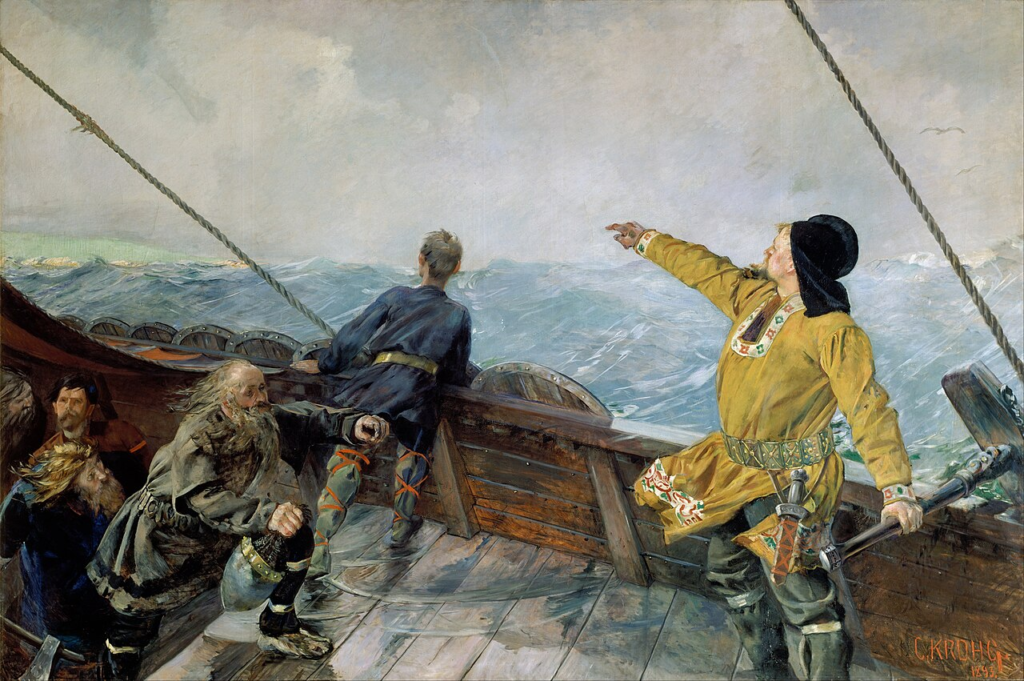
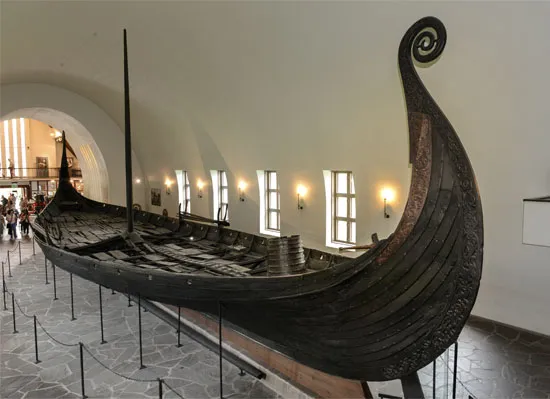
The two primary sources for Karlsefni’s story, the Grœnlendinga saga and Eiríks saga rauða, diverge significantly on the size of the expedition. The Grœnlendinga saga records 60 men and 5 women; Eiríks saga rauða describes three ships and 140 men. Scholars have noted that Eiríks saga rauða may have been shaped by the interests of a later editor, Haukr Erlendsson, who was himself a descendant of Thorfinn and inserted additional genealogical material into the text to elevate his ancestor’s standing. Both sagas agree that the settlers brought livestock. This was not a scouting mission. Karlsefni was attempting to plant a colony.
The expedition followed Leif’s route and located the camp he had built on his earlier voyage. They wintered there. When the cold months passed, Karlsefni moved the settlement further, building a new base he called Straumfjord, meaning Stream Fjord or Current Fjord, named for the powerful waters surrounding it. The exact location of Straumfjord remains unknown. The only confirmed Norse archaeological site in North America is L’Anse aux Meadows in Newfoundland, which some scholars associate with the settlement. Excavations of Thorfinn’s home in Greenland, conducted in 1930, revealed a deposit of anthracite coal identified as having originated in the vicinity of Rhode Island, suggesting the Norse may have reached considerably further south than any confirmed site currently records.
The first winter in Straumfjord was severe. Food was scarce and the settlers struggled to survive it. The small number of women in the party relative to the men created additional tensions within the settlement from the outset, and the expedition’s internal cohesion, strained from the beginning, would prove as damaging as anything the settlers encountered from outside.
The Norse Found Vinland and Fathered the New World’s First European Child
When summer returned, the expedition split and pushed further south in search of the land Leif had described. Karlsefni’s group reached a location the sagas name Hóp. The description is precise: fields of wild wheat, grapevines on every slope, streams dense with fish. Scholars have proposed various locations for Hóp, including areas of what is now Nova Scotia or northern New England, though no consensus exists.
The settlers built shelters and prepared for a longer stay. The land supplied more than enough to keep them.
It was here that Gudrid gave birth to a son. The boy was named Snorri. He was, by every available historical reckoning, the first person of European descent known to have been born in the Americas. The sagas record the fact without ceremony. Many Icelanders today reportedly trace their ancestry to him.
The Norse had been at Hóp for some time when they noticed canoes crossing the water toward them. The sagas describe hide-covered boats and figures staring at the settlement from a careful distance. Both groups held still. Then the visitors turned and departed.
When they returned, they came to trade. The settlers offered milk and red cloth. The indigenous people, whom the Norse called Skraelings, a term whose precise meaning in Old Norse remains disputed by scholars, brought furs of considerable quality. The arrangement held for a time. It was fragile.
A Bull Broke Free and Ended the First European Colony in North America
Then a bull from the Norse camp broke loose.
The animal’s sudden noise sent the Skraelings retreating in alarm. The peace did not survive the incident. When the Skraelings returned again, they came with weapons. Fighting broke out. Several Norse settlers were killed, and many Skraelings fell in the battle. The settlers held their ground, and Eiríks saga rauða records that Freydís Eiríksdóttir, Leif’s half-sister, played a decisive role in driving the attackers back.
Karlsefni surveyed what remained. The Skraelings outnumbered his people by a margin no available force could overcome. To stay was to invite an assault the settlement could not survive. After approximately two months at Hóp, he abandoned Vinland and retreated north to Straumfjord.
The internal fractures that had developed over the winter did not heal during the retreat. The settlement’s inability to hold together under pressure had compounded the threat from outside. When the ships finally loaded for Greenland, what departed was not a colony driven out by force alone, but one that had already begun to come apart from within.
Karlsefni Returned to Iceland With Proof of America and Nobody Remembered Him for It
The expedition wintered once more at Straumfjord before loading the ships with timber, grapes, and furs and making for Greenland. Passing through waters near Markland on the return journey, the crew reportedly encountered a small group of Skraelings. According to Eiríks saga rauða, two children from the group were taken aboard, taught to speak Norse, and baptized. The voyage home was not without further loss. According to later accounts, many of the settlers drowned when a ship was wrecked in the Irish Sea during the return passage. Thorfinn reached Greenland safely.
The total time Karlsefni spent attempting to colonize North America was approximately three years.
He and Gudrid eventually returned to Iceland, settling at the family estate in Skagafjord. The sagas record that he later traveled to Norway and sold timber sourced from Vinland at a substantial price. He died at some point after 1020 CE. The estate passed to Snorri and to Gudrid, who, according to tradition, eventually made a pilgrimage to Rome.
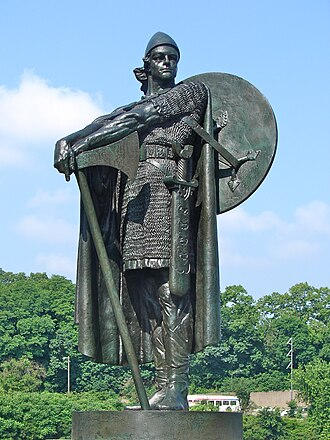
The legacy of the expedition has accumulated slowly and unevenly. In the early twentieth century, a statue of Karlsefni by the Icelandic sculptor Einar Jónsson was installed along Kelly Drive in Philadelphia, unveiled on November 20, 1920, as part of a commission designed to produce sculptures emblematic of American history. By the twenty-first century, the statue had become a regular rallying point for local white supremacist groups, drawing counter-protests and repeated vandalism. On October 2, 2018, it was found toppled from its stone base and dragged into the Schuylkill River. As of 2020, the City of Philadelphia had not reinstalled it and was weighing the statue’s future in light of its appropriation by hate groups. A second casting stands in Reykjavík. The manga series Vinland Saga, published from 2005 and adapted into an anime in 2019, made a fictionalized version of Karlsefni its protagonist, giving him a cultural afterlife the sagas alone had not managed to secure.
None of this places him where he arguably belongs: alongside Leif Eriksson, not in his shadow. Karlsefni reached the same shore Leif had described. He built something there. He brought back timber, furs, and the proof that the land was real and habitable. He brought back Snorri, born on a continent that would not bear a European settlement for another five centuries. What he could not bring back was a solution to the problem that ended him.
What happened to the Skraelings of Hóp after the Norse departed, and what they made of the strangers who appeared on their shore and then vanished without explanation, is not recorded anywhere in the sources that survived.
Leave a Reply