
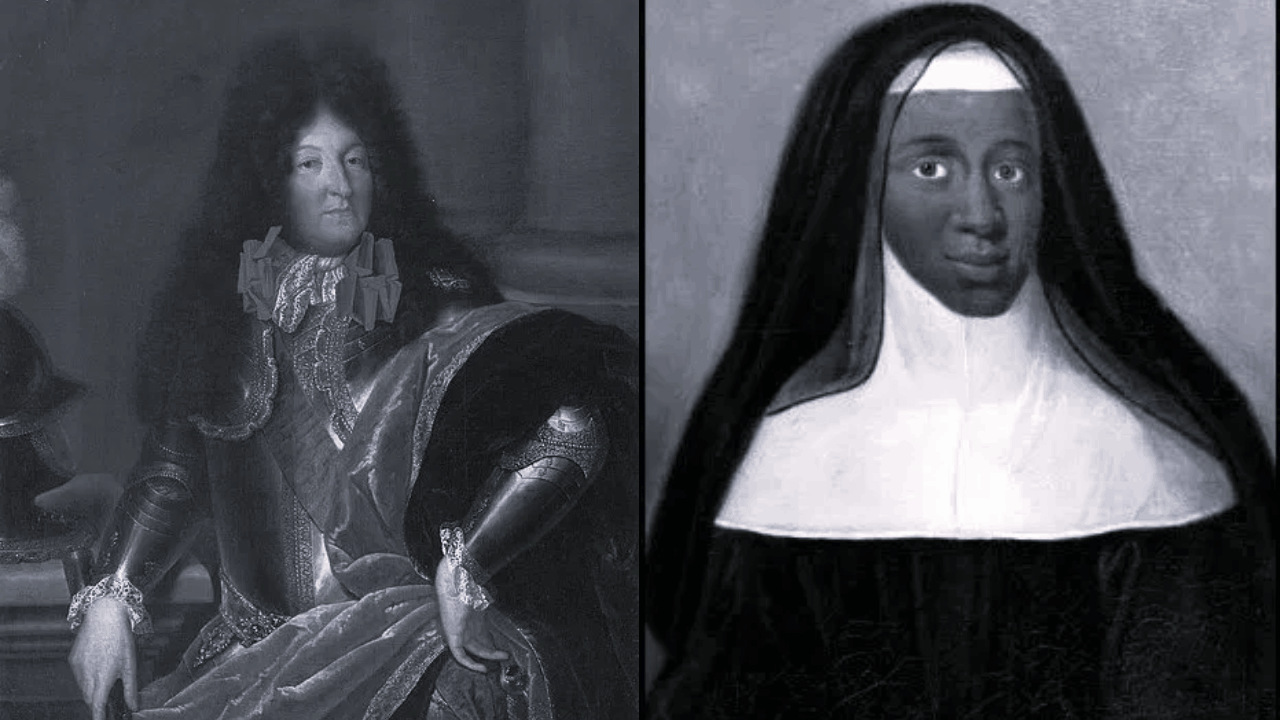
She was placed behind convent walls before she could walk, given a name that belonged to a king and queen, and watched over in secret for the better part of fifty years. No explanation was ever offered. No parentage was ever confirmed. When Louis XIV settled a royal pension on her in October 1695, the paperwork offered nothing beyond the barest instruction: it was to be paid to her for life, wherever she was.
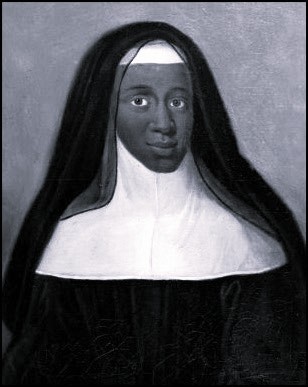
That is all the court was prepared to say in writing about Louise Marie-Thérèse, known to posterity as the Black Nun of Moret.Her portrait hangs today in the Bibliothèque Sainte-Geneviève, the great library beside the Panthéon in Paris. It is a pastel, painted around 1680, by the same hand that produced a series of twenty-two portraits of the Kings of France.
It shows a dark-skinned woman in a Benedictine habit, composed, watchful, giving nothing away. There are now known to be three portraits of her in total. A second, attributed to the painter Pierre Gobert, was discovered in the municipal museum at Remiremont, in the Vosges, where it had lain behind a handwritten inscription reading simply: La princesse noire religieuse de Moret.
The black princess, nun of Moret.Both images raise the same question that occupied the court of Louis XIV and has refused to release its grip on historians ever since: who was this woman, and why did the most powerful monarch in Europe care what became of her?
Her World
Louise Marie-Thérèse spent her life at the Benedictine Abbey of Notre-Dame of the Nativity at Moret-sur-Loing, a small convent in north-central France close to the Château de Fontainebleau, one of the principal residences of the French court. The royal family used Fontainebleau each autumn for the hunting season, which meant that Louise lived within a short distance of the king’s world without ever quite belonging to it.
She was known within those walls as La Mauresse: the Mooress. It was a term in common use in early modern Europe to describe dark-skinned men and women, and it set her apart from every other woman in the building.Her date of birth is disputed. Some sources place it around 1664; others suggest the late 1650s. The uncertainty is itself telling. Births at court were public events, conducted before witnesses, recorded in detail. Louise’s birth was recorded nowhere.
She enters the historical record properly only in the 1690s and early 1700s, when several prominent figures at the court of Louis XIV began writing about her. Their accounts agree on the broad outline: a black woman, well educated, supported by the crown, visited by people of significant rank, and carefully protected from scrutiny.
She could read and write with facility, which surviving letters confirm. She was not, in other words, merely tolerated. She was maintained. The royal pension of 300 livres granted to her on 15 October 1695 carried explicit instructions: it was to follow her wherever she went, for the rest of her life, paid from the royal treasury.
The Court and the Secret
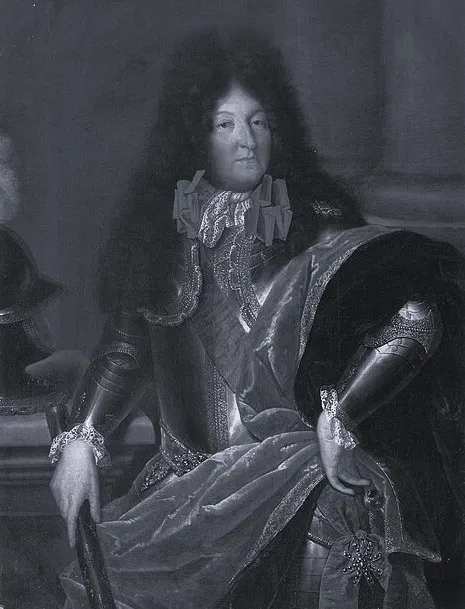
To understand why any of this constitutes a scandal, it is necessary to understand who was sitting on the French throne.Louis XIV came to power in 1643, aged four. He would reign for seventy-two years, the longest confirmed reign of any monarch in European history. By the time Louise Marie-Thérèse became a matter of documented record, he had ruled France for the better part of half a century.
He had also taken a staggering number of mistresses, several of whom bore him children he acknowledged. He was not a man unacquainted with the problem of what to do with inconvenient offspring.His wife was Maria Theresa of Spain, daughter of Philip IV, who married Louis in 1660 as part of the peace settlement that ended the Franco-Spanish war.
She was deeply pious, frequently neglected, and publicly humiliated by her husband’s serial infidelities. She died at Versailles on 30 July 1683, aged forty-four, from complications following an abscess on her arm. After her death, Louis contracted a secret morganatic marriage with Françoise d’Aubigné, Madame de Maintenon, who had served as governess to his illegitimate children.
The marriage, which took place in October 1683, was never publicly announced, though the court quickly understood its nature.Louis, in short, was a man who knew how to keep secrets. Madame de Maintenon herself appears in surviving accounts as one of the figures who visited Moret to check on Louise, though the visits were irregular and the nun was not always produced for inspection.
Three Theories
The first theory holds that Louise was the illegitimate daughter of Louis XIV. By the mid-seventeenth century, France was a colonial power with growing connections to West Africa and the Caribbean, and a small number of Black people had found their way into French court circles as servants, musicians, and attendants. It is not implausible that Louis fathered a child with a Black woman in his orbit and arranged for the infant to disappear into a convent under royal protection.
He had done comparable things before and would do so again. A brief reference to another dark-skinned child named Dorothée appears in the archives of the period, suggesting a possible pattern, though the evidence for her is even thinner.The second theory is the one most historians have found compulsive, and it is the more unsettling of the two. This version holds that the child was the queen’s.
Among the figures kept at the French court in the seventeenth century was a young African dwarf named Nabo, brought from Dahomey as a gift and installed as one of the queen’s favourites. Royal courts of the period routinely kept dwarves and exotic figures as entertainers; Nabo was not remarkable in that context. What was remarkable, according to this theory, was that Maria Theresa entered into a liaison with him and conceived a child.
The case rests on a specific event. On 16 November 1664, the queen gave birth to her third child, a daughter officially named Marie-Anne de France. The birth took place in public, as was the custom, at the Louvre, attended by courtiers and foreign ambassadors. Barely six weeks later, on 26 December, the child was declared dead, her body displayed before burial at Saint-Denis. The theory insists the infant did not die.
What happened, according to its proponents, is that Alexandre Bontemps, Louis XIV’s first valet de chambre and the keeper of his most intimate secrets, removed the child from court and placed her in a series of religious houses before she settled at the Benedictine convent at Moret-sur-Loing, possibly as early as the spring of 1665.
The argument in favour of this version is partly circumstantial and partly nominal. Louise Marie-Thérèse’s name joins the feminine form of Louis with the queen’s own name, Maria Theresa. If she was the product of a royal affair, or even a royal orphan given royal patronage, the choice of name was significant either way.
The argument against it is considerable. Royal births were closely observed. Historians have noted that the attending physicians recorded Marie-Anne’s sickness and premature state without remarking on anything unusual about her appearance. The darkening of the infant’s skin may have resulted from oxygen deprivation during a difficult labour rather than from African parentage.
The idea that a black princess was produced at a public birth without anyone of the dozens present reporting it to any of the foreign courts eager for such intelligence stretches credibility severely.The third theory is the most prosaic: Louise was a Black orphan of no royal connection who was placed under royal patronage as an act of practical charity, given the names of her benefactors, and supported for the rest of her life by a court that had taken responsibility for her welfare. Louis XIV’s government did exactly this with other orphaned children.
Hundreds of young women were sent to New France in the second half of the seventeenth century under royal patronage to help populate the French colony. Millions of Canadians today are descended from these women, known as the Filles du Roi.
The Voice of Saint-Simon
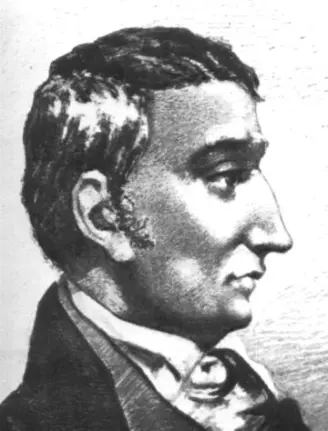
The fullest surviving account of Louise Marie-Thérèse comes from Louis de Rouvroy, Duke of Saint-Simon, the great memoirist of the French court. Saint-Simon was a meticulous and often acerbic observer with access to the king’s most senior servants, and his account of the nun at Moret is the most credible primary source available.
He wrote: “It seems that in this convent there is a woman of colour, a Moorish woman who had been placed there very young by Bontemps, valet of the king. She received the utmost care and attention, but was never shown to anybody. When the late queen or Madame de Maintenon went, they did not always see her, but always watched over her welfare.
She was treated with more consideration than people the most distinguished, and herself made much of the care that was taken of her, and the mystery by which she was surrounded. Although she lived regularly, it was easy to see that she was not contented with her position.
Hearing Monseigneur hunt in the forest one day, she forgot herself so far as to exclaim, ‘My brother is hunting.’ It was pretended that she was a daughter of the king and queen, but that she had been hidden away on account of her colour, and the report was spread that the queen had had a miscarriage. Many people believe this story, but whether it was true or not has remained an enigma.”
The woman who burst out in that moment was not performing a calculated claim. She was reacting to a sound through a convent wall. And the man she identified as her brother was not an abstraction: Monseigneur was Louis de France, the Grand Dauphin, heir to the French throne. The exclamation, if Saint-Simon’s account is accurate, places Louise in direct kinship with the line of succession.
Saint-Simon himself could not determine the truth of it. A man who had spoken with dozens of people who would have known the intimate details of the king’s household, he remained uncertain. The mystery, he concluded, had been well kept.
Voltaire, who met Louise Marie-Thérèse in person when he visited the Moret convent in 1719, noted in his Le Siècle de Louis XIV (1751) that she bore a striking physical resemblance to Louis XIV. He recorded that the king had given her twenty thousand écus as a convent dowry. He believed she was almost certainly one of the king’s illegitimate children.
Later Years and the Iron Mask
Louise’s later life offers little more than the occasional signed document to confirm she was still alive. After Louis XIV’s death in 1715, the flow of high-ranking visitors dried up. There was no longer any political reason to maintain the connection. She continued her existence at Moret: prayer, reading, the routine of convent life.
A document she signed in April 1725 confirms her continued presence there, in what would have been her early to mid-sixties. The last document bearing her signature is dated 10 January 1730. She is believed to have died in 1732, aged somewhere between her early and mid-seventies, though even this cannot be established with certainty.
In 1978, the French writer Pierre-Marie Dijol published Nabo ou le Masque de Fer, in which he attempted to solve two of the great mysteries of Louis XIV’s reign at once. His argument was that Nabo, the African dwarf at the queen’s court, had been the father of Louise Marie-Thérèse, had been discovered and imprisoned by the king, and was in fact the Man in the Iron Mask, the enigmatic prisoner held in secrecy during Louis XIV’s reign and later mythologised by Alexandre Dumas in the nineteenth century.
It was an elaborate theory with considerable narrative appeal and almost no evidential basis.The book nonetheless sparked renewed interest in Louise’s story. Her portrait was the subject of fresh scholarly attention. The Versailles television series, which ran on Canal+ from 2015 to 2018, dramatised her birth as a central plot point of its first season, following the theory that she was the queen’s secret child.
The 2019 exhibition at the Musée Charles de Bruyères in Remiremont, which brought together all three known portraits of the Mauresse for the first time, drew researchers from across France and introduced her story to a new generation of visitors.The portrait at the Bibliothèque Sainte-Geneviève still hangs where it has long been kept, near the Panthéon, within walking distance of the old royal heartland of Paris.
She looks out from it with an expression that yields nothing. The convent is gone. The pension records survive. The exclamation in the forest is there in Saint-Simon’s memoirs, and it will not go away.Three and a half centuries of inquiry have not settled what the French court of the Sun King was at pains to conceal. They are unlikely to now.
Leave a Reply