
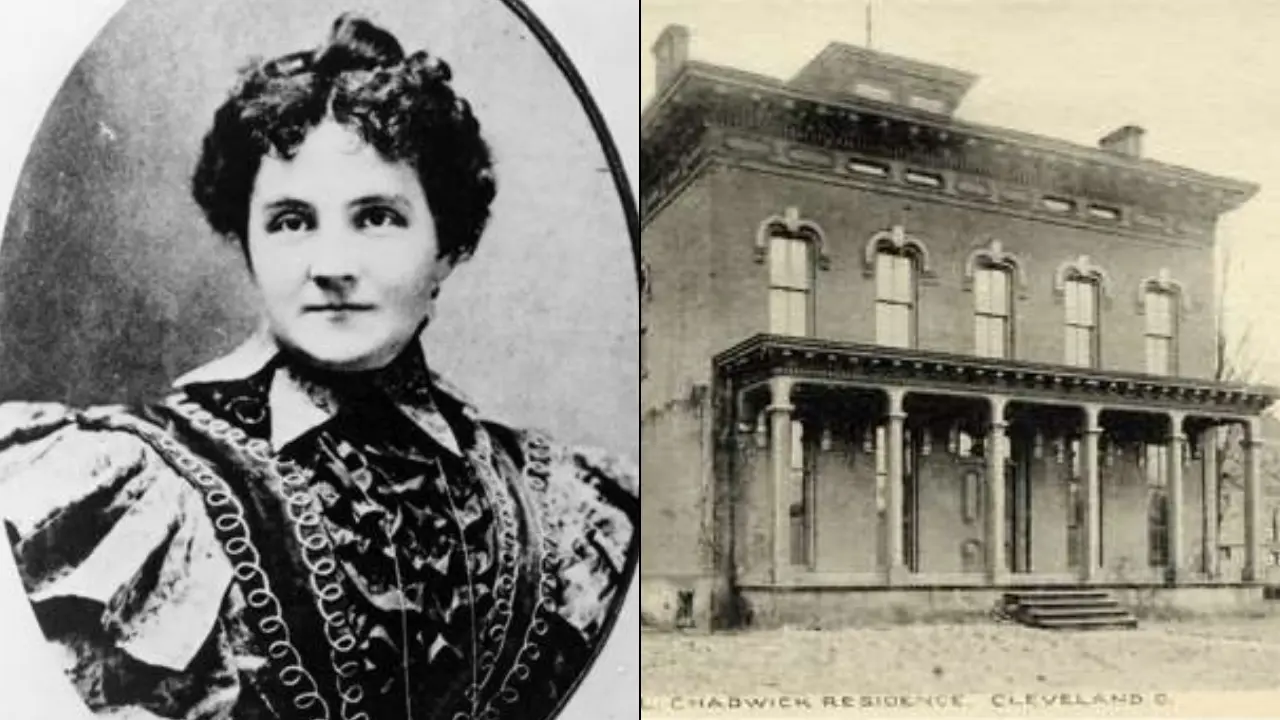
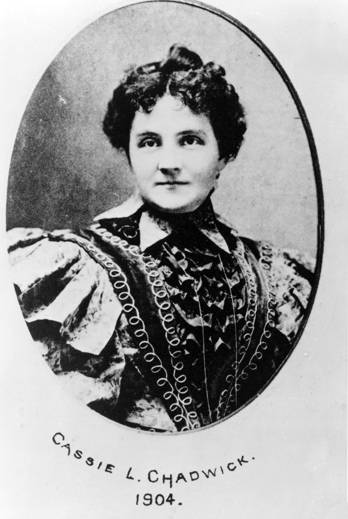
For eight years, Canadian-born grifter Cassie Chadwick convinced America’s bankers she was Andrew Carnegie’s illegitimate daughter, obtaining loans totaling roughly $2 million before the scheme collapsed in November 1904.
On March 10, 1905, Andrew Carnegie took his seat in a Cleveland courtroom. The 69-year-old steel magnate had not come to testify. According to contemporary accounts, he had come to see for himself: the woman who had convinced a nation’s bankers that she was his heir.
Her name was Cassie Chadwick. She had never met Andrew Carnegie in her life.
Betsy Bigley Learns That Forgery Pays
Cassie Chadwick was born Elizabeth Bigley on October 10, 1857, in Appin, Canada West, the third daughter in a family of two boys and six girls. Her father, Daniel Bigley, worked as a railroad section hand. The family later relocated to a small farm near Eastwood, Ontario, where she was known simply as Betsy. The ambitions forming behind that name were not suited to farm life.
At sixteen, Betsy ran away from home. Police found her attempting to extract a $250 promissory note from a prosperous local farmer and returned her to her family. She did not stay long. In 1878, she was arrested in Woodstock for attempting to borrow money on a stolen pocket watch; her father settled the matter with the victim. Within the year, she had traveled to Toronto and reinvented herself as Elizabeth Cunard, heiress to the wealthy shipping family of the same name, presenting forged letters of introduction and acquiring approximately $10,000 in goods on credit before the scheme fell apart and she fled the city.
Back in Woodstock in March 1879, she was arrested for passing forged promissory notes, supplementing the documents with a calling card that read “Miss Bigley, Heiress to $15,000.” She stood trial on March 22, 1879. Her lawyers employed an insanity defense, bolstered by deliberately erratic behavior throughout the proceedings. The jury found her not guilty.
Her family sent her to Cleveland to live with her married sister, Alice York, whose husband worked as a machinist. She arrived and immediately established herself as Madame Lydia DeVere, a widowed clairvoyant, funding the venture with a bank loan secured against her sister’s furniture. In November 1882, as Lydia DeVere, she married Dr. Wallace Scott Springsteen, a Civil War veteran. The Plain Dealer published a photograph of the wedding. The photograph brought creditors, and Alice York herself, to Springsteen’s door. He threw her out, filed for divorce, and settled her debts. They had been married twelve days.
As Madame Marie LaRose, she married John R. Scott, a farmer from Trumbull County, Ohio. She persuaded him to sign a prenuptial agreement beforehand, citing mistreatment from her first husband; the agreement guaranteed her a claim on his assets in the event of a separation. After four years of farm life she had not chosen, she went to a Youngstown attorney, gave a sworn statement alleging adultery, and directed him to file for divorce on those grounds. The marriage ended. She moved on.
A third husband followed: a Cleveland businessman named C.L. Hoover. He died in 1888 and reportedly left her approximately $50,000 in his will. It was the first inheritance she had ever legitimately received. It was not enough, and it did not last.
In 1889, she was convicted of forgery and sentenced to nine and a half years in a Toledo penitentiary. Paroled after four years for good behavior, she returned to Cleveland in 1893 under a new name: Mrs. Cassie Hoover. With what remained of her savings, she opened a brothel on the city’s west side.
She had five aliases, three divorces, one legitimate inheritance, and a felony conviction. She was 35 years old.
The Brothel Keeper Becomes Mrs. Chadwick
It was at her own establishment that Cassie Hoover met Dr. Leroy S. Chadwick, a wealthy widower whose wife had recently died. She introduced herself as a respectable widow running a boarding house for women. When Chadwick gently observed that the building was a well-known brothel, she fainted.
Once revived, she assured him she would never operate such an establishment and begged him to remove her from the premises before anyone could associate her with its operations.
He married her in 1897.
Whether Leroy Chadwick ever knew about Emil, Cassie’s son born in the mid-1880s and left in the care of one of the women at the brothel, remains unclear. She had identified herself in earlier court records as single with no children. In the 1900 United States census, filed three years into her marriage under the name Cassie Chadwick, she listed herself as born February 3, 1862, in Pennsylvania. Her actual birthdate was October 10, 1857. Her actual birthplace was Canada. She was still falsifying official government documents six years before her arrest.
As Mrs. Cassie Chadwick, she moved into a house on Euclid Avenue, then known as Millionaires’ Row, where the Rockefellers, the Hannas, the Hays, and the Mathers kept their residences. She spent at a pace that drew notice even among these neighbors. She was invited to social events only out of obligation to her husband. She was not otherwise welcomed into the circle, and no amount of spending changed that. The women of Millionaires’ Row saw through what money could not disguise.
The gap between her life and the life she intended to have became the blueprint for the largest fraud she would ever attempt.
Chadwick Plants the Forged Carnegie Note
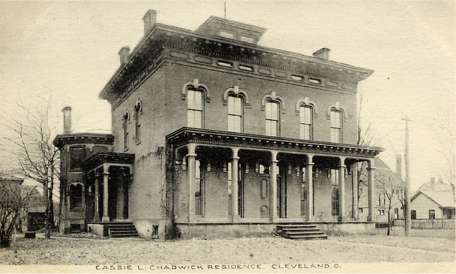
Sometime after the 1897 marriage, Chadwick traveled to New York City and asked Dillon, a lawyer and acquaintance of her husband’s, to accompany her to Andrew Carnegie’s Fifth Avenue mansion. She went inside. She spoke, in reality, only with Carnegie’s housekeeper. On her way back to the carriage, she appeared to drop a piece of paper.
Dillon picked it up. It was a promissory note for $2 million, bearing Carnegie’s signature.
She swore him to secrecy. Then, with the secrecy sworn, she told him everything: she was Carnegie’s illegitimate daughter. The steel magnate, consumed by guilt over the circumstances of her birth, had been quietly providing for her for years. At her Cleveland home, she claimed, she held additional promissory notes totaling $7 million. Upon Carnegie’s death, she would inherit $400 million.
Dillon arranged a safe deposit box to hold the note. He apparently found secrecy harder to maintain.
Word reached the financial markets of northern Ohio, and banks began calling on Cassie Chadwick with unusual enthusiasm. The scheme worked on a single, precise social calculation: no banker in America would risk humiliating Andrew Carnegie by demanding his illegitimate daughter prove her identity. Beyond that, any banker who admitted to extending such a loan would also be admitting he had charged Carnegie’s own heir usurious interest rates, which was its own kind of ruin.
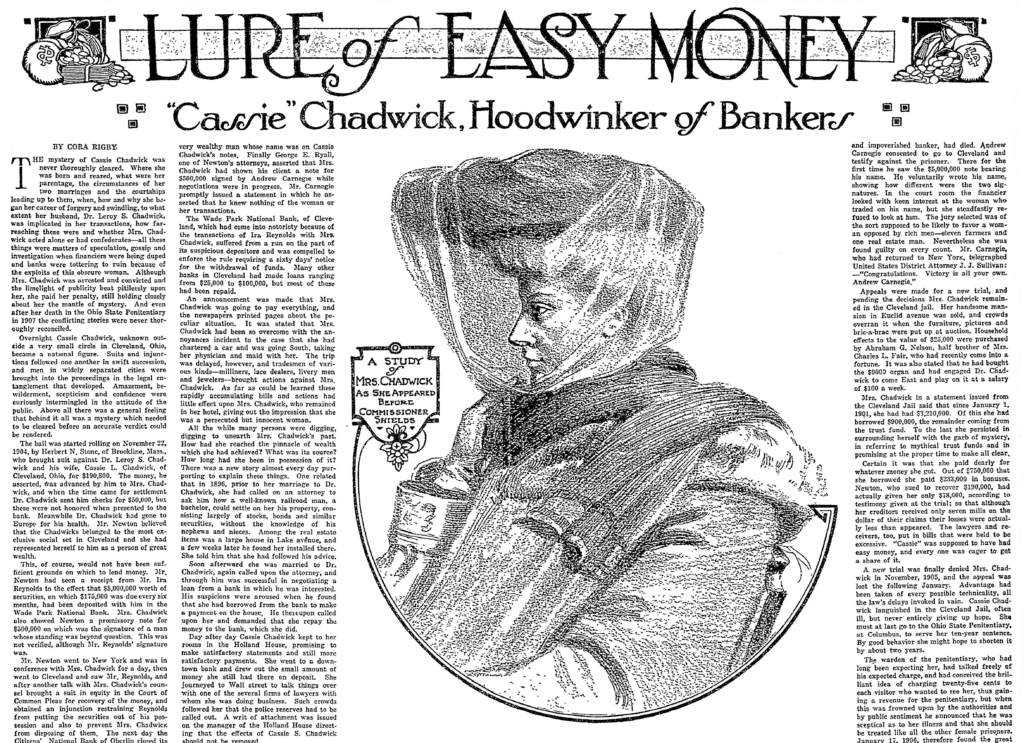
The arrangement locked every participant into silence from both directions. Carnegie’s embarrassment protected Chadwick from scrutiny; the bankers’ greed protected her from exposure.For the next eight years, the loans accumulated to roughly $2 million, equivalent to approximately $72 million today. Beyond the promissory notes, Chadwick also forged securities in Carnegie’s name and deposited them across multiple banks as further collateral, deepening the web of false documentation that sustained the con.
She spent accordingly. Diamond necklaces. Enough gowns to fill 30 closets. A gold organ. She reportedly gave money to suffrage causes and to the poor. Cleveland called her the Queen of Ohio. She shopped, donated, and entertained with the confidence of a woman who had already decided the inheritance was hers.
Not one banker contacted Andrew Carnegie to confirm he had a daughter.
Newton Calls His Loan and Banks Fall
In November 1904, a Brookline, Massachusetts banker named Herbert B. Newton extended Chadwick a loan of $190,000. Newton then learned of the scale of her existing debt. He called his loan in. She could not pay. Newton sued.
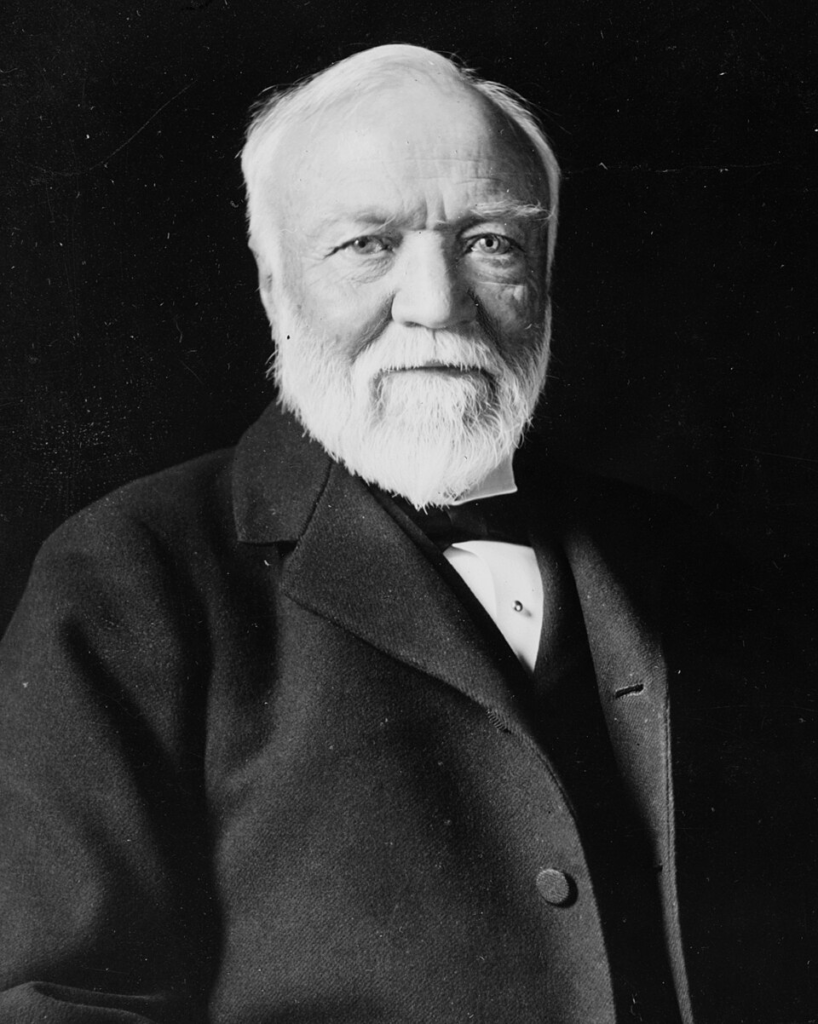
Carnegie’s response came through a spokesman. He had no knowledge of Cassie Chadwick. He had not, he stated, signed a promissory note of any kind in more than 30 years.
The securities held in her name across multiple banks were worthless. The $7 million had never existed. Citizen’s National Bank of Oberlin, which had loaned her $800,000, suffered a catastrophic bank run within days and collapsed into bankruptcy. Losses spread across the Cleveland banking community. Leroy Chadwick filed for divorce and left immediately for Europe with his adult daughter.
Chadwick fled to New York and checked into her apartment at the Hotel Breslin. Officers arrested her there within weeks and returned her to Cleveland. When they detained her, she was wearing a money belt containing over $100,000.
The trial was a media spectacle. Members of the Millionaires’ Row families came to watch, the same neighbors who had refused her entry into their world for nearly a decade. Carnegie himself attended, wishing to see the woman who had used his name to empty the region’s banks. On March 10, 1905, the court sentenced Chadwick to 14 years in federal prison and fined her $70,000 for conspiracy to bankrupt Citizen’s National Bank and conspiracy against the United States government.
Carnegie had by then seen enough. He left.
The Queen of Ohio Dies in Prison
On January 1, 1906, Chadwick was transported to the Ohio State Penitentiary in Columbus. She brought trunks containing clothing, photographs, and furniture for her cell. The prison warden permitted it on account of her celebrity status.
Her health deteriorated within eighteen months. She began writing explicit instructions for her funeral and directed Emil to purchase a tombstone for the Bigley family plot in Woodstock, Ontario, using whatever funds she had hidden from her creditors. On September 17, 1907, she suffered a nervous collapse that left her blind. Heart and stomach problems followed. On October 10, 1907, her 50th birthday, Cassie Chadwick died in the Columbus penitentiary.
Andrew Carnegie, distressed by the sustained misuse of his name, donated funds toward construction of the Oberlin Carnegie Building, now used by Oberlin College Library, in a gesture toward the institution whose bank her frauds had helped destroy. The Chadwick mansion on Euclid Avenue became a tourist attraction before it was demolished in the early 1920s.
Elizabeth Bigley, who became Lydia DeVere, who became Marie LaRose, who became Cassie Chadwick, was buried in Woodstock Anglican Cemetery in Woodstock, Ontario. The tombstone was purchased with money her creditors never found. It was in Woodstock, decades earlier, that a sixteen-year-old girl with a forged calling card had first been arrested for passing bad notes.
The stone is still there. The money never was.
Leave a Reply