
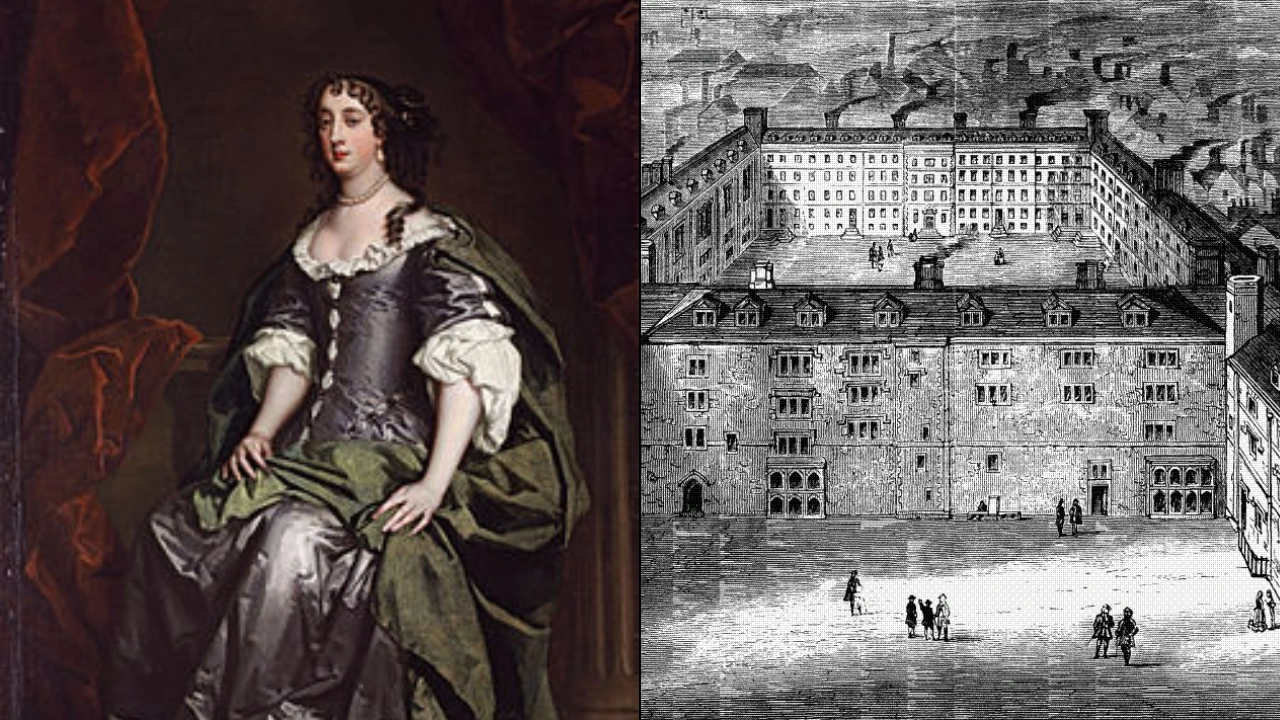
For nearly two decades, the most powerful madam in Restoration London counted King Charles II among her clients, survived one imprisonment, outlasted a Puritan riot, and was ultimately brought down not by the crown she served but by the politician she loved.
Rioters Destroyed What Courts Never Could
Easter week, 1668. A crowd of Puritan Dissenters tore through the streets of Moorfields and came to a stop outside one of the most notorious addresses in London. They had a complaint that was, in its way, entirely logical: the government had just banned them from worshipping in their own homes, while the woman inside this building conducted her trade with the full knowledge of the king. They broke in.
They ripped the bedding from every room, smashed the furniture, and looted what remained. The women who worked there were attacked. By the time the rioters moved on, the property was too damaged to use.
The woman who owned it was Elizabeth Cresswell, and she did not even bother fleeing. She had more powerful friends than the rioters could hope to threaten. King Charles II was among her clients.
Senior aristocrats passed through her establishments in Clerkenwell, Cripplegate, and Lincoln’s Inn Fields. Within weeks, she had co-authored a petition to the Countess of Castlemaine demanding government compensation for the damage.
She expected to win. For the better part of a decade, she had always won.
War Left Cresswell’s Class in Ruins
Elizabeth Cresswell was born in 1625 in the village of Knockholt in Kent, the same year King Charles I acceded to the thrones of England, Scotland, and Ireland. The Cresswells were not a poor family.
They were gentry, Protestant in their convictions, with connections to the Percival family, whose branches held estates in Kent and, later, carved out large landholdings in Ireland, providing a thread, however slender, that linked the Cresswells to the Royal Court.
The stability did not last. From the late 1630s, the kingdoms of Charles I were torn by war, culminating in a civil conflict that consumed England through most of the 1640s. The execution of the King by Parliament in January 1649 brought the fighting to an end, but the peace extracted a brutal toll.
Across England, gentry families who had supported the losing Royalist cause emerged from the wars missing fathers, brothers, and the wealth that had sustained them. Women were left with nothing actionable in law and few options in practice.
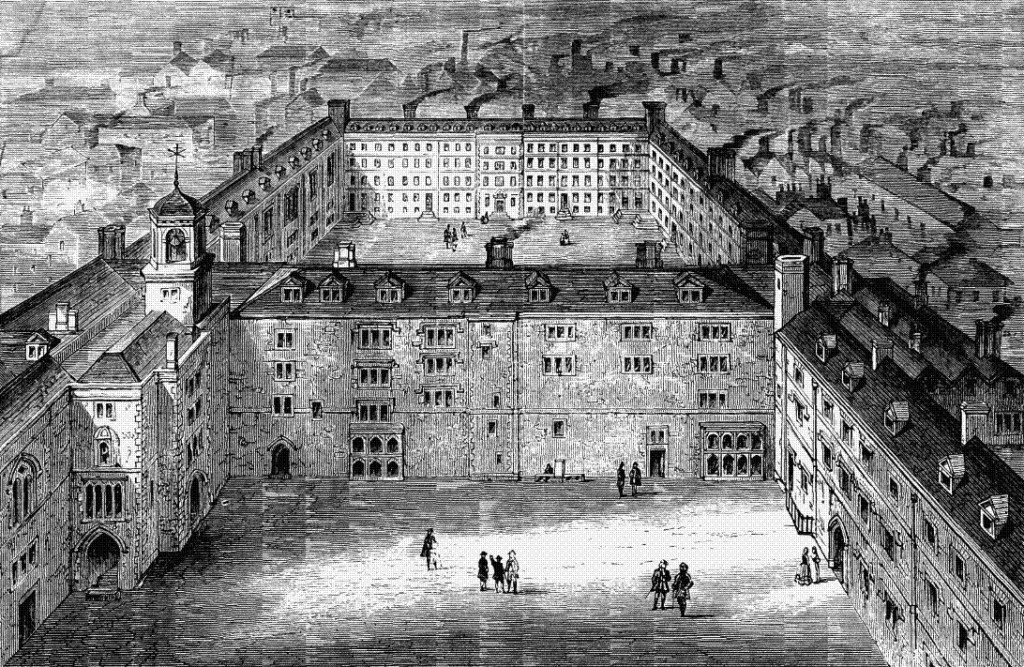
Exactly what Cresswell did in the 1640s is not recorded. By the 1650s, she had moved to Shoreditch in London and had begun operating a brothel on Bartholomew Close, a narrow side street in the Little Britain neighbourhood. In 1658 she was arrested for it, and the resulting trial became one of the scandals of the Commonwealth period.
Residents of Little Britain testified to the scale of what she had been running. Men and women arrived through the day and through the night. Wine was drunk by the dozen bottles. Women stripped to their bodice and petticoat and were seen entering rooms whose doors were then locked.
The court record states that neighbours described a back gate through which visitors would “surreptitiously slip in,” bringing, in the words of those neighbours, “much infamy” upon the entire district.
Despite Cresswell’s reported attempts to bribe officials into keeping the case out of the pamphlets sold at St Paul’s Cathedral, the trial became the talk of the city. She was convicted and sentenced to hard labour in Bridewell prison.
She was imprisoned by a government committed to moral order. The next government had entirely different priorities.
The Restoration Made Cresswell Untouchable
In 1660, the exiled son of the executed king was invited back to England by a cohort of nobles who had concluded that the experiment of republican government had failed. Charles II returned from the Continent, was received in London to enormous public celebration, and was crowned at Westminster Abbey in April 1661.
The era that followed, known as the Restoration, was a conscious and sustained repudiation of Puritan austerity. It was, in short, the ideal political environment for Elizabeth Cresswell.
She was released from Bridewell and moved with speed. By the mid-1660s she had expanded her operations to a scale that was, by any measure of the seventeenth century, remarkable. She ran establishments near Lincoln’s Inn Fields, at Cripplegate, and out of a mansion in Clerkenwell. She maintained an administrative office at Millbank to oversee the network and employed agents who travelled across England to recruit women to work in her establishments.
Many of those women came, reportedly, from precisely the class of family Cresswell herself had been born into: gentry households impoverished by the wars, whose daughters now had no dowry and no prospects.
The network had a name. Her women were known as “The Countesses of the Exchange,” because they worked on Gresham Street near the Royal Exchange, the commercial heart of seventeenth-century London.
The clientele made prosecution effectively impossible. Charles II, a serial philanderer who fathered an estimated fourteen illegitimate children by various mistresses over the course of his reign, was among those who frequented Cresswell’s establishments. Senior aristocrats and the city’s most powerful merchants followed.
For an official to move against Cresswell in this period was to risk moving against men whose influence far outweighed any public interest in moral enforcement.
She was, in the fullest sense, protected by the appetites of the powerful.
The Bawdy House Riots of Easter 1668 interrupted this arrangement without ending it. The rioters, Puritan Dissenters furious at a government decree that forbade them from worshipping outside the established church while tolerating the brothel trade, targeted Cresswell’s establishments specifically because of her ties to the king. The brothel in Moorfields was the most severely damaged. The bedding was destroyed outright, a significant financial loss in an era when quality beds were costly goods.
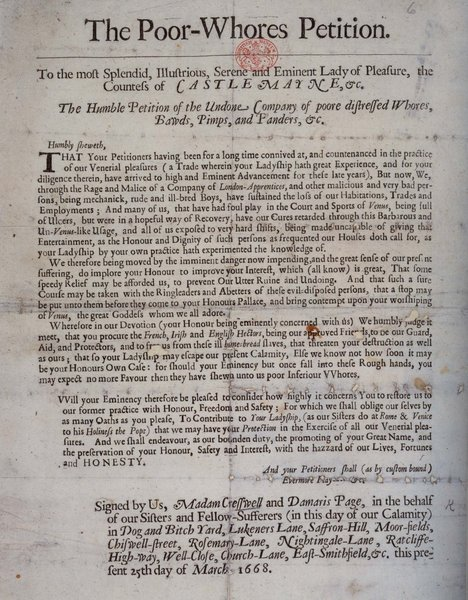
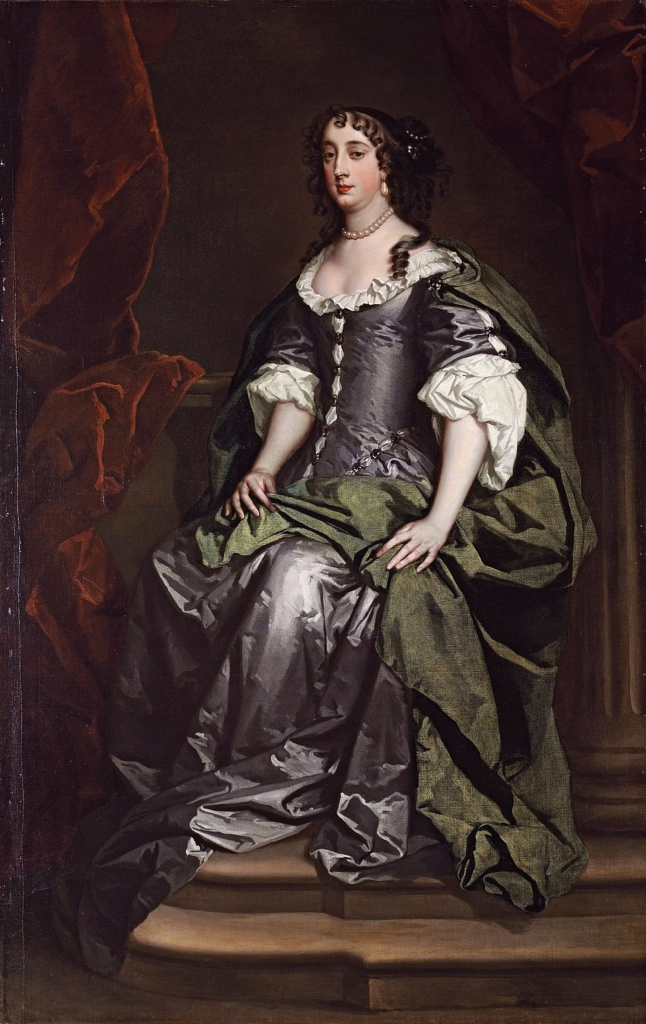
Cresswell’s response was characteristically audacious. She partnered with Damaris Page, a prominent London madam who operated several establishments near the Tower of London and in Stepney, catering largely to the mariners who worked the docks. Together they commissioned a pamphlet, likely written by an unidentified professional writer, addressed directly to Barbara Villiers, Countess of Castlemaine, Charles II’s most powerful and longest-serving mistress, with whom he had by that point fathered five illegitimate children.
The pamphlet, published under the title The Whore’s Petition, called on the Countess to use her influence over the king to secure government funding for the restoration of London’s brothels. It framed Castlemaine as a sister to the petitioners, one whose position was not, in kind, entirely different from their own.
Most historians today read The Whore’s Petition as a satirical provocation aimed at the Dissenters rather than a genuine political appeal. The likelihood that Charles II would publicly divert Crown funds to the rebuilding of brothels was, at best, remote. The pamphlet seems to have been designed to embarrass the rioters by pointing out the inconsistency of their position. Whatever its intent, the document survives as one of the more extraordinary publications of Restoration London.
Player’s Politics Ended Her Royal Immunity
By the 1670s, Elizabeth Cresswell had survived a Puritan republic, a Bridewell sentence, and a mob. What she could not survive was the man she chose to love.
Sir Thomas Player came from a family of drapers and merchants in Kent who may, given the overlapping geography of their respective families, have been known to the Cresswells in childhood.
His father had been a firm Parliamentary supporter during the civil wars and was rewarded with the post of Chamberlain of the City of London in 1651, a position Thomas inherited upon his father’s death.
By the late 1660s, Player had established himself as one of the most combative critics of Charles II in Parliament, fixating on the king’s indifference to Protestant orthodoxy and on the persistent rumour, well-founded as it turned out, that Charles was sympathetic to Catholicism.
Player and Cresswell became publicly associated in the 1670s. Their home in Camberwell, south of London, was the subject of considerable gossip, with reports of orgies circulating through the city, though these accounts almost certainly reflected the hostile imagination of their political enemies rather than fact.
What is documented is that Cresswell and Player hosted gatherings at Camberwell for Player’s parliamentary allies, and that these gatherings were understood by the king’s advisors as precisely what they were: meetings of men who opposed the monarchy.
Player became so closely identified with Cresswell’s money and her household that contemporaries mockingly referred to him as Sir Thomas Cresswell. She had reportedly funded him through the mid-1670s, after a series of poor investments had stripped away much of his own fortune.
Player then involved himself in two of the most dangerous political manoeuvres of the late Restoration period. The first was the Exclusion Crisis: the sustained parliamentary effort in the late 1670s to bar Charles’s brother, James, Duke of York, a Catholic, from inheriting the throne. Charles had fathered approximately fourteen children, but none in wedlock, and none were therefore eligible to succeed him.
Player was a central figure in the Exclusion movement. The second was the Popish Plot, a fabricated Catholic conspiracy constructed in 1678 by the informer Titus Oates and promoted by hard-line Protestants including Player, designed to inflame anti-Catholic opinion and destabilise the king’s position.
The retribution came in 1681. Weeks after Player had publicly called for a parliamentary investigation into the Popish Plot, Cresswell was hauled before the courts in London and charged with, in the language of the indictment, “over thirty years of bawdry.”
The timing was not coincidental. Numerous women who had worked in her establishments over the years testified against her. The brothel in Moorfields was closed and its property transferred to the Crown. The rest of her network was left largely intact.
Charles was not destroying her. He was reminding her of what he could do.
The message was clear enough. Cresswell withdrew from political association with Player, and the prosecution stopped where it had started.
Literature Preserved What Bridewell Finally Claimed
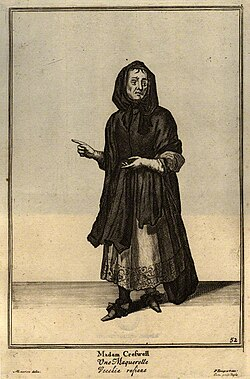
By 1681, Cresswell was already in her mid-fifties, an advanced age by the reckoning of the seventeenth century. A portrait engraved by Marcellus Laroon, an artist of French descent born in The Hague, for his publication The Cryes of London in the mid-1680s shows a woman visibly diminished, already suffering from tuberculosis.
She never left her profession. A new Protestant austerity followed the accession of William III and Mary II, and Cresswell was arrested again in the early 1690s. The date of her death is uncertain. Some sources place it around 1698. What is clear is that she died in Bridewell prison, the same institution that had held her forty years earlier, at the beginning of everything.
The literary trace she left behind is notable. John Wilmot, second Earl of Rochester, one of the defining libertines of the Restoration, referenced her in his satirical verse. A succession of pamphlets and broadsides named her explicitly through the 1670s and 1680s. Most enduringly, Daniel Defoe drew on Cresswell’s life when he created the title character of his 1722 novel Moll Flanders, a woman of ambition and adaptability who navigates a world that offers her no safe footing.
She operated for over three decades in an industry that destroyed most of the women inside it, survived a king’s displeasure, and died where she had begun.
The question that remains is not how she fell. It is how, for so long, she did not.
Now that you’ve read about Elizabeth Cresswell, discover the story of Barbara Villiers, Countess of Castlemaine, the mistress whose influence over Charles II made her one of the most powerful women in Restoration England. Or explore the case of Titus Oates, the man whose fabricated Popish Plot of 1678 sent innocent men to the scaffold and brought the monarchy to the edge of crisis.
Leave a Reply