
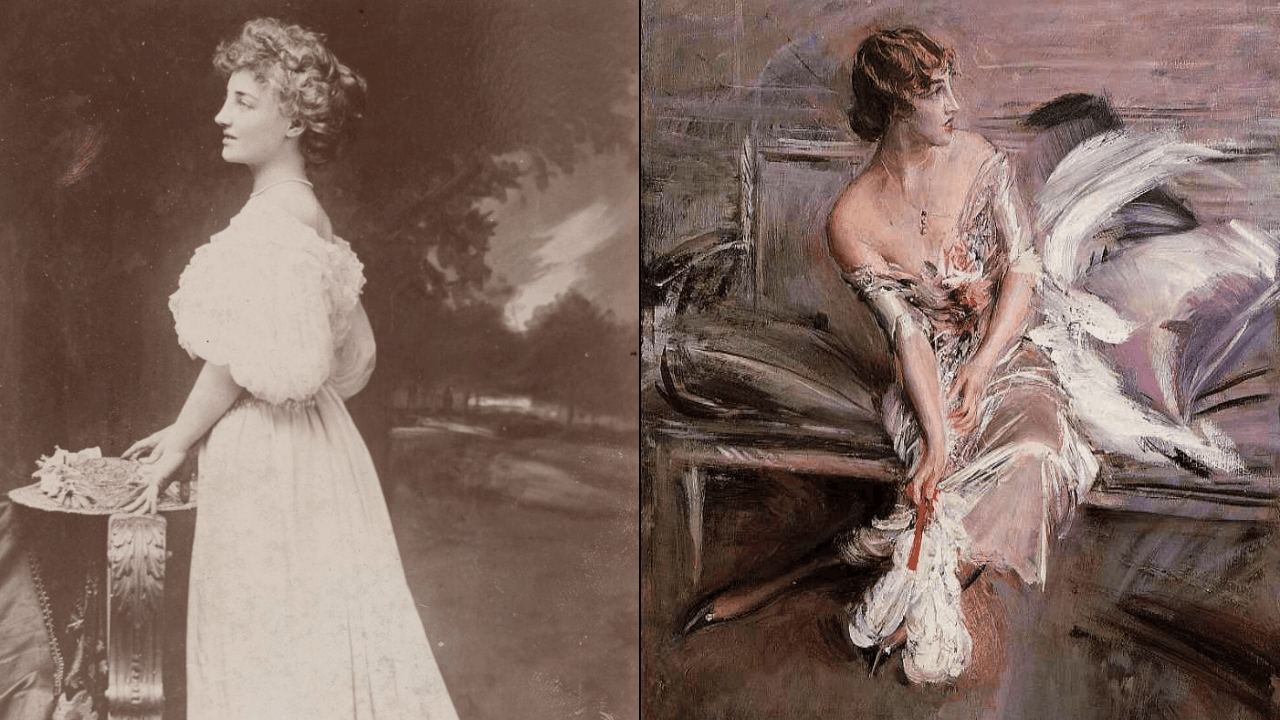
She was the most desired woman in Europe. She traded decades of her life for a marriage that didn’t want her. And when it was over, there was almost nothing left.
A dinner party at Blenheim Palace, sometime in the late 1920s. The Duchess of Marlborough descends to the table, takes her seat among her husband’s assembled guests, and sets a revolver on the white cloth beside her plate.
A guest, presumably brave or simply bewildered, asks what she intends to do with it. “Oh I don’t know,” Gladys replies, without particular emphasis. “I might just shoot Marlborough.”Nobody laughed. Nobody quite knew whether to.
That moment, small and chilling in equal measure, is the distillation of everything Gladys Marie Deacon became. She had been called the most beautiful woman in the world. Marcel Proust had declared he had never seen “a girl with such beauty, such magnificent intelligence, such goodness and charm.” She had sat for Boldini. She had been pursued by the Crown Prince of Prussia.
She had spent twenty years as the secret obsession of one of England’s great dukes, waiting for his marriage to collapse so she could take her rightful place inside it.The place, when she finally got there, destroyed her.
The Shooting in Cannes
Gladys was born on 7 February 1881, at the Hôtel Brighton in Paris, the eldest child of Edward Parker Deacon and his wife Florence, the daughter of Rear Admiral Charles Henry Baldwin, a distinguished naval officer who had served in both the Mexican-American War and the Civil War.
Edward’s family were Boston Americans, long established and once formidably regarded. Florence was beautiful, socially relentless, and largely absent as a mother. The marriage was unhappy from early on.
On 18 February 1892, when Gladys was eleven years old, her father tracked his wife and her French lover, Emile Abeille, to their rooms at the Hotel Splendide in Cannes. Edward forced open the door, found Abeille cowering behind the sofa, and shot him three times.
Abeille died the following morning. Edward gave himself up and was convicted of the killing, sentenced to twelve months’ imprisonment. Gladys was sent to the Convent de l’Assomption at Auteuil. When Edward was released and arrived to collect his daughter, he found she had already been removed by her mother.
The couple divorced in 1893. Custody of the three eldest children, including Gladys, was awarded to Edward. He took them to America. It was an unstable arrangement and a miserable one. Edward’s mental health was already fraying.
By 1899 he was committed to the McLean Hospital in Massachusetts, where he died in 1901, leaving his estate divided equally between his four surviving children. Gladys was twenty.She and her sisters returned to France. Europe suited her. She was already remarkable.
A Face That Stopped the Century
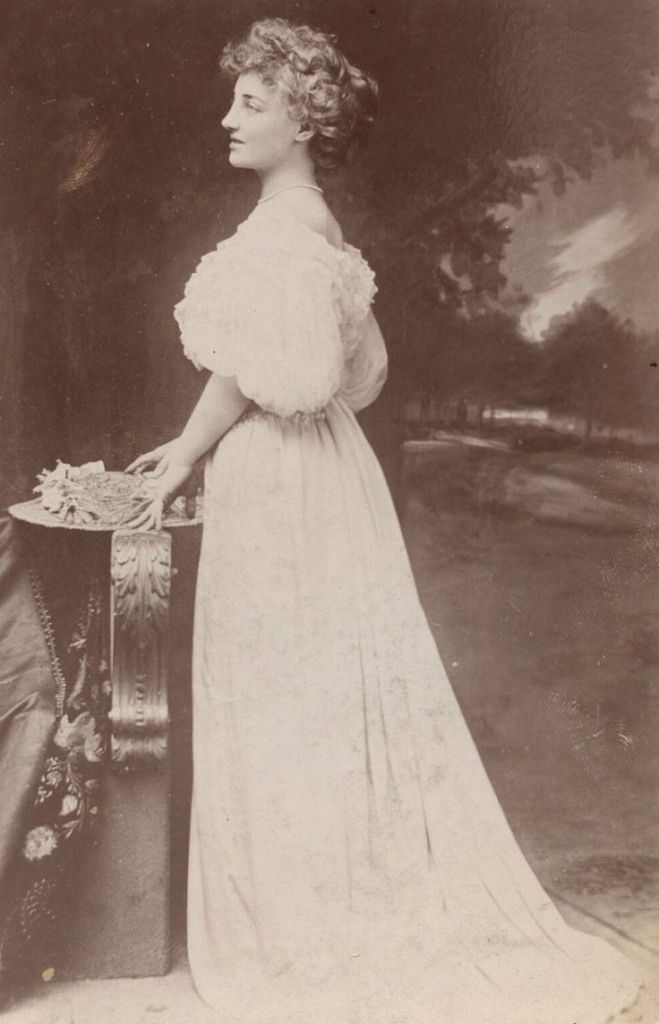
Through the late 1890s and into the new century, Gladys Deacon moved through the salons and palaces of the Belle Époque like something that had been put there specifically to provoke. She was fluent in seven languages. She spoke on equal terms with philosophers, artists, and heads of state.
She had copper hair, ice-pale skin, and eyes described variously as blue, green, or impossible to categorise. Proust pursued her friendship with an intensity that bordered on devotion. Rodin sculpted her. Claude Monet befriended her. Bernard Berenson, the art historian and connoisseur of everything beautiful, reportedly considered proposing marriage.She was also, from at least 1897, acquainted with the Duke of Marlborough.
Charles Spencer-Churchill, ninth Duke of Marlborough, had married the American heiress Consuelo Vanderbilt in 1895, a union that rescued the Spencer-Churchills from severe financial difficulty by exchanging Consuelo’s railroad fortune for the prestige of her new title.
The marriage was not a love match. It was, by most accounts, barely a marriage at all.When Gladys began visiting Blenheim Palace and the Duke began to notice her, the consequences were predictable.Their affair ran, semi-clandestinely, for over two decades.
Paraffin and Consequence
In 1903, at the age of twenty-two, Gladys Deacon made the decision that would overshadow the rest of her life. Despite possessing a beauty that had stopped some of the greatest minds in Europe cold, she was troubled by a slight natural depression between the bridge of her nose and her forehead. She wanted a classical Grecian profile. A surgeon injected paraffin wax into the depression to correct it.
The wax did not stay where it was put. Over time it migrated, sagging down beneath the skin to collect in hard, lumpen formations at her chin and jaw. By the time the damage became fully apparent she was disfigured in a way that no further procedure could correct, and that no amount of money could conceal.She reportedly ordered the removal of every mirror from her rooms at Blenheim. She began wearing veils.
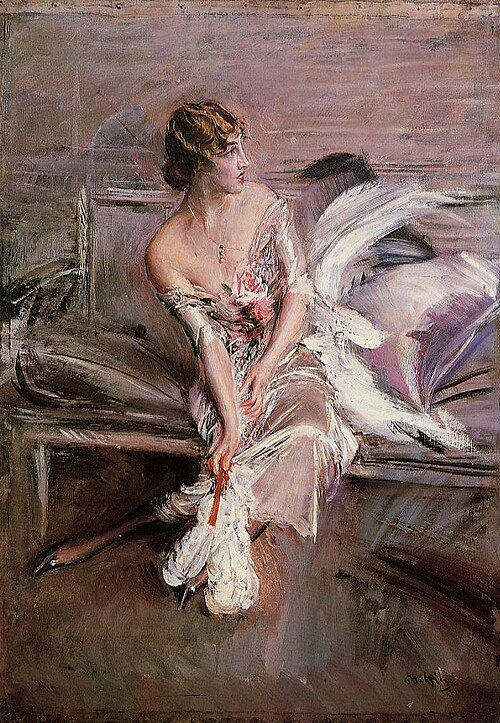
Despite this, the Duke’s interest did not wane. Neither did that of much of European society. The Italian master Giovanni Boldini painted her portrait, a process thought to have taken place between 1905 and 1908, and the resulting canvas captures something of the strange, self-aware quality that made Gladys so unsettling to those who met her.
There was also believed to be a portrait by the American expatriate John Singer Sargent, which some accounts suggest showed her partially veiled, though the attribution remains less firmly documented.Twenty Years to the Altar
The Duke and Duchess of Marlborough formally separated in 1907. Consuelo had conducted her own relationship with the French aviator Jacques Balsan for some years, and by 1921 both parties were prepared to proceed with a divorce. Consuelo married Balsan on 4 July 1921. The Duke married Gladys Deacon in Paris on 25 June of the same year.Gladys was forty years old. She had waited twenty-four years for this.The marriage was a catastrophe almost immediately.
Blenheim Did Not Suit Her
The new Duchess of Marlborough arrived at Blenheim with ideas. She commissioned enormous painted eyes, modelled on her own famously unusual irises, to be fixed to the ceiling of the main portico at Blenheim, where they still stare down at visitors today.
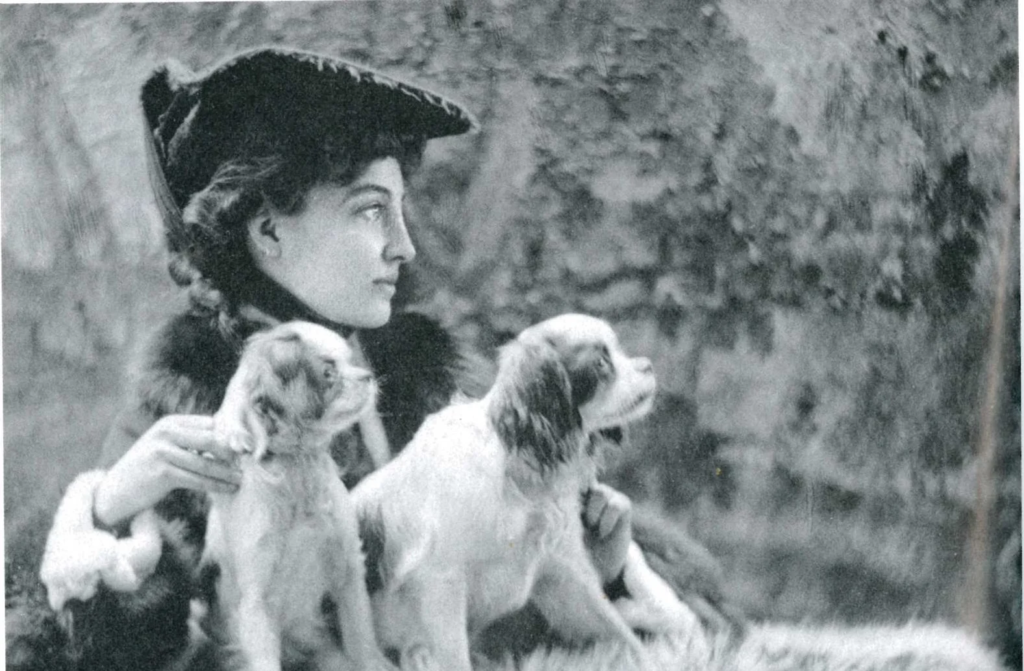
She also ordered a pair of stone sphinxes to mark her arrival as duchess, which remain on the west terraces. These were not small gestures. They were acts of possession.She also arrived with dogs. Many dogs. The breeding and rearing of Blenheim Spaniels became an obsession that the Duke found insufferable.
Gladys was in her forties when she took up residence, and already carrying the beginnings of what would become a serious mental deterioration. Her father had begun fragmenting psychologically at roughly the same age. His mother had suffered similarly. The pattern was not lost on those who knew the family history, though Gladys herself seems to have ignored it for as long as she could.
Her behaviour at Blenheim grew increasingly erratic through the 1920s. She slept with the revolver beside her not merely as theatre but in earnest: she did not want the Duke in her bedroom. The dinner party incident was not an isolated outburst.
She spoke disparagingly of her husband in company, remarking that she had married a house rather than a man. The Duke’s conversion to Roman Catholicism in the late 1920s introduced a further point of friction into an arrangement that had become openly hostile.
By 1931 the Duke had moved out of the palace, and spent the following two years manoeuvring Gladys out of it. In 1933 he dismissed her staff and instructed her to leave. She did. Divorce proceedings were initiated but never completed. Charles Spencer-Churchill, ninth Duke of Marlborough, died in the summer of 1934.
The Long Retreat
Gladys left Blenheim with her dogs and went first to a house in north Oxfordshire, then to Grange Farm at Chacombe, in Northamptonshire. She was not destitute. She had money, and she used it to buy herself the solitude she appeared now to want above all things.
The solitude thickened into something else. By the mid-1930s she was rarely seen. Biographers and those who knew her from this period described a woman who had built an interior world from the memories of another life, one spent in conversation with Proust and Monet and Rodin and the great ornamental figures of early twentieth-century Europe. The present, by comparison, had very little to offer.
Her conduct became concerning to others. She rang strangers in the middle of the night. She threatened to shoot local children who tried to take apples from her orchard. Whether or not she was capable of acting on these statements, enough people believed she might be.In 1962, she was committed to St Andrew’s Hospital in Northampton.
At St Andrew’s she presented a curious and confounding picture. She was almost entirely lucid on political and cultural matters, maintained a diary, and retained a sharp intelligence that had not significantly diminished. But her behaviour could tip without warning. She was difficult, unpredictable, and capable of considerable hostility.
Hugo Vickers, then in his early twenties, obtained permission to visit her in 1975 and spent two years in her company before her death. His biography, first published in 1979 and reissued in a substantially revised edition as The Sphinx: The Life of Gladys Deacon in 2020, remains the definitive account of her life.
On one of his visits, Vickers asked her: “Where is Gladys Deacon?” She considered the question. “Gladys Deacon?” she said finally. “She never existed.”Gladys Marie Spencer-Churchill, Duchess of Marlborough, died at St Andrew’s Hospital on 13 October 1977.
She was ninety-six years old. She was buried in the churchyard at Chacombe, Northamptonshire.The painted eyes remain at Blenheim. The sphinxes remain on the west terraces. The mirrors, if she ever let them be put back, have gone undocumented.
Leave a Reply