
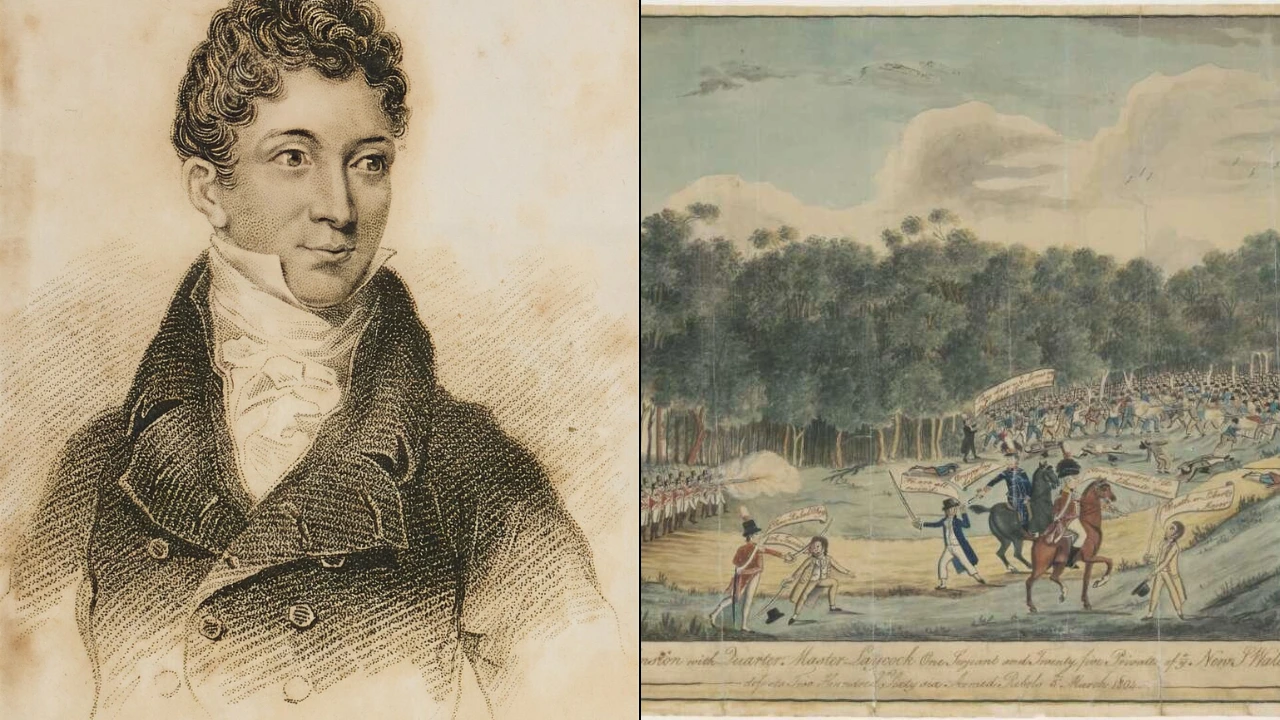
Born the son of a servant in Surrey around 1782, James Hardy Vaux was transported to Australia three times across four decades, and wrote the first full-length autobiography and first dictionary ever produced on the continent while serving a life sentence in a penal settlement.
In May 1831, the convict ship Waterloo docked in Sydney Harbour. Prison officials moved along the line of disembarking men, inspecting faces. One official stopped.
James Hardy Vaux was standing in front of him.
Vaux had broken the terms of his conditional pardon and fled New South Wales two years earlier. He had sailed to Ireland, assumed a false name, and been convicted of a new crime on the far side of the world. Now he had been transported back again.
Officials reinstated his life sentence on the dock.
It was the third time James Hardy Vaux had arrived in Australia in chains.
Vaux Ruined Every Chance Given to Him
James Hardy Vaux was born in Surrey, England, around 1782. His father, Hardy Vaux, served as butler and house steward to George Holme Sumner of Hatchlands Park, a substantial country estate in Surrey. His mother Sophia was the daughter of an attorney. The family occupied a stable position in the servant class, and Vaux spent most of his childhood with his maternal grandparents in Shropshire, receiving an education at a boarding school.
At 14, restless and bored, he asked to be apprenticed to a trade. Within months he was working for a linen draper in Liverpool. He arrived punctual and obedient. The change came quickly. He began staying out until dawn, disappearing to cock fights during working hours, and running up gambling debts he had no means of repaying. To cover them, he started stealing small amounts from his employer’s till. The thefts were never discovered. His employer dismissed him anyway, having disapproved of his habits and deteriorating attitude.
He moved to London and found work as a clerk. The position did not interest him. He was more drawn to the taverns and the red-light district around Covent Garden, a dense urban quarter of London that had long functioned as the city’s center of street prostitution and nocturnal commerce. He changed employers repeatedly, staying long enough to earn a degree of trust before stealing and disappearing. In 1798, apparently looking for the structure his life lacked, he enlisted in the Royal Navy and served aboard HMS Astraea. He lasted a year. He deserted the ship and returned to London.
By 1800, Vaux was working as a professional criminal.
His method was systematic and patient. He ordered clothing and goods from tradesmen on credit, never intending to pay, and vacated his lodgings in the middle of the night to avoid both the bill and the landlord. He cultivated trust with employers, waited until it was sufficiently established, then stole from them and fled. He worked schemes involving persuading people to donate small sums of money to him. In April 1800 he was arrested for defrauding an employer. He escaped conviction. The evidence could not be made to hold.
Months later he was arrested again, this time for pickpocketing a handkerchief alongside a fellow thief named Alexander Bromley, whom he had met in Newgate Prison while awaiting proceedings on the earlier charge. Newgate was London’s most notorious jail, overcrowded and brutal, a holding facility for criminals awaiting trial or transportation. Vaux and Bromley were tried together at the Old Bailey, London’s central criminal court. Both were found guilty. Both were sentenced to seven years’ transportation.
Transportation Sent Vaux to the End of the World
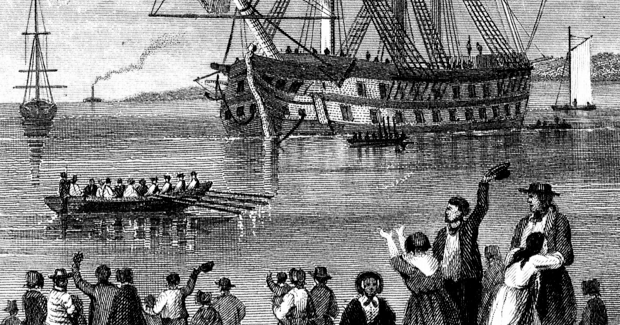
The sentence of transportation, by the early nineteenth century, meant removal to the penal colonies of New South Wales on the eastern coast of Australia, a journey of roughly five months by sea. Before departure, convicts were washed, issued clothing and bedding, and divided into groups for the voyage. Conditions aboard the convict ships were cramped, poorly ventilated, and frequently unsanitary. Disease spread easily among convicts who were already weakened before embarkation. Many did not survive the crossing.
Vaux survived. He arrived in Sydney in December 1801 aboard the convict ship Minorca. He found work as a clerk to a storekeeper in Hawkesbury, a settlement northwest of Sydney, and later secured a position at the Colonial Secretary’s Office in Sydney itself. It was a significant step upward for a transported convict. He was entrusted with access to official documents and correspondence.
He forged the initials of Governor King on commissariat orders, official supply documents, attempting to generate paperwork that would secure his early return to England. He was discovered, stripped of his position, and sentenced to hard labor in a convict road gang, one of the most punishing assignments in the colony. Convicts in road gangs worked in irons under close supervision, clearing and building roads in the Australian heat. Vaux spent years slowly recovering his standing in the colony before earning an appointment as clerk to the magistrates at Parramatta in 1806.
The following year, Governor King, preparing to sail home to England, offered Vaux a passage aboard HMS Buffalo in exchange for organizing the Governor’s papers during the voyage. Vaux’s seven-year sentence expired during the crossing. Although compelled to serve as a seaman for the remainder of the journey, he deserted the ship the moment it docked at Portsmouth and disappeared into London.
A Jeweller’s Shop Sealed His Second Transportation
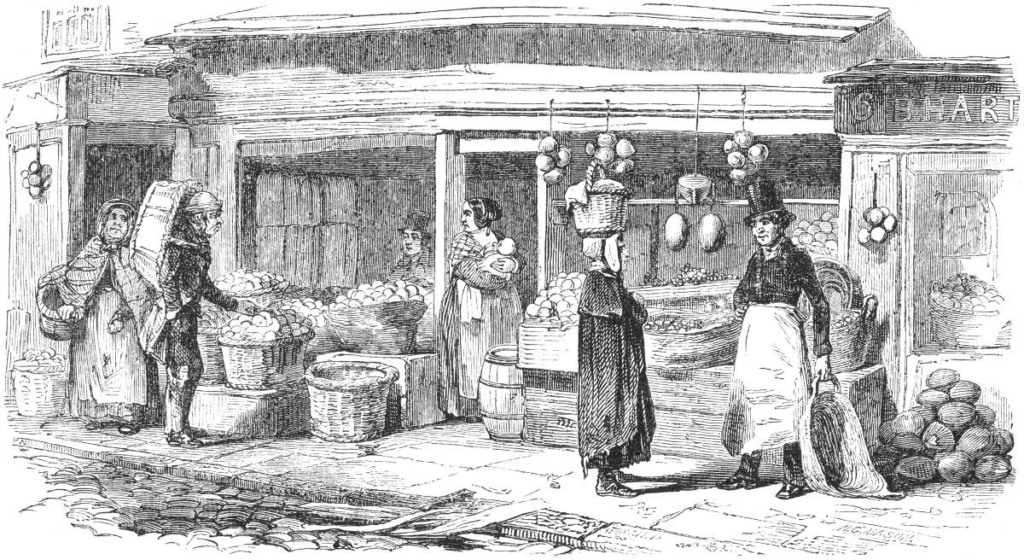
Back in London and without legitimate income, Vaux adopted a new strategy. Dressed and behaving as a gentleman, he moved through jewellers’ shops across the city, pocketing chains, watches, and rings while other customers and staff were occupied elsewhere. The performance was convincing. He operated undetected for months. In November 1808 he was arrested and tried at the Old Bailey for the theft of a silver snuffbox. The evidence was insufficient for conviction. He was released.
His luck ended in February 1809. Tried again at the Old Bailey, this time under the alias James Lowe, Vaux was convicted of stealing three diamond rings and a brooch from a jeweller’s shop on Piccadilly. Under the law as it stood, the theft of goods from a shop was a capital offence. The court sentenced him to death.
The sentence was subsequently commuted to transportation for life.
He spent months imprisoned in wretched conditions aboard the prison hulk Retribution, one of several decommissioned warships moored in the Thames and used to hold convicts awaiting transportation. The hulks were widely considered among the worst conditions in the British penal system, overcrowded and disease-ridden, with convicts put to hard labor during the day and confined below decks at night. From the Retribution, Vaux was transferred to the convict ship Indian and reached Sydney for the second time in December 1810.
He was assigned first to a settler in Hawkesbury and later appointed overseer of a convict gang in Sydney. In 1811 he was caught receiving stolen property and banished to the Newcastle penal settlement, a secondary punishment site established for convicts who had committed further offences in the colony. In 1814 he attempted to escape by boarding a ship leaving the settlement. He was caught, flogged, and returned to Newcastle.
He remained there, under close confinement, for most of the next seven years. It was in Newcastle that he began to write.
A Condemned Man Wrote Australia’s First Books
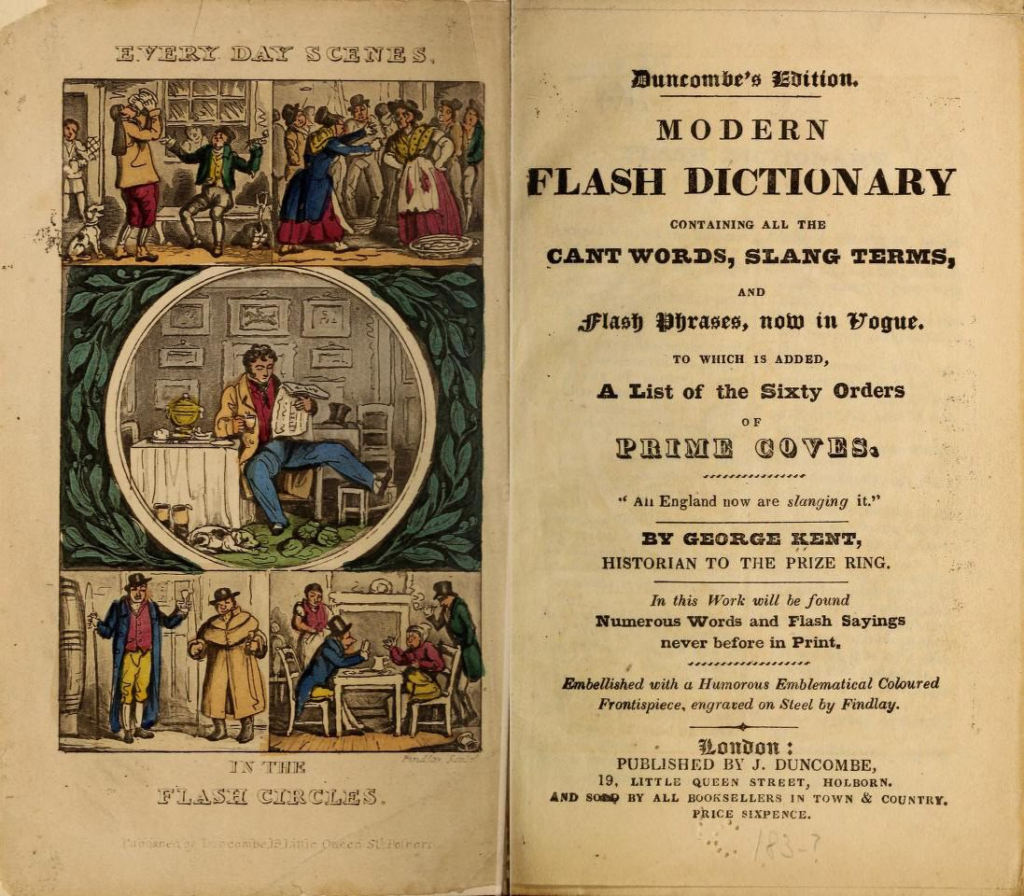
The flash language, or cant, was the coded vocabulary of London’s criminal underworld. Thieves, swindlers, prostitutes, and pickpockets used it to communicate in public without being understood by magistrates, constables, or potential victims. Vaux, who had spent the better part of two decades immersed in that world, knew it thoroughly. The commandant of the Newcastle penal settlement, seeking to better understand the criminals under his jurisdiction, encouraged Vaux to compile a dictionary of flash terms for official use.
The work Vaux produced was remarkably comprehensive. It documented hundreds of slang words and phrases in active use in London at the turn of the nineteenth century, with definitions precise enough to be useful to someone who had never heard them. Terms for different categories of theft, for different grades of criminal, for the tools and techniques of pickpocketing and fraud were recorded in detail. The dictionary functioned both as a practical reference and as an inadvertent archive of a subculture that would otherwise have left almost no written trace.
The commandant then encouraged Vaux to write his memoirs. He titled the work Memoirs of the First Thirty-Two Years of the Life of James Hardy Vaux, a Swindler and Pickpocket; Now Transported for the Second Time, and For Life, to New South Wales. The full title was itself a kind of confession, and an unusually honest one. Vaux documented his apprenticeship, his criminal methods in London, the conditions of transportation, the workings of the colonial penal system, and the social world of the convict settlements. He did not romanticize any of it.
In 1819 both manuscripts were published in London by John Murray, the same publisher who had brought out Byron. The memoirs were republished in 1827 and reprinted in 1829 and 1830. The London Magazine, reviewing the work in 1827, described it as one of the most singular that had ever issued from the press.
Both works now hold their place in Australian literary history. Vaux’s memoirs are recognized as the first full-length autobiography written in Australia. His flash dictionary was the first dictionary compiled on the continent. Neither was intended as a literary achievement. Both were written by a man serving a life sentence at a penal settlement at the far edge of the world, with no expectation of release.
Freedom Came, and Vaux Destroyed It
In 1820, Vaux received a conditional pardon. The condition was straightforward: he was released from the penal settlement but required to remain within New South Wales. He could not leave the colony. He complied. For the next six years he worked without incident as a clerk at the Colonial Secretary’s Office in Sydney, the same department he had once tried to defraud with forged initials seventeen years earlier.
In 1826 he was dismissed without notice and without any allegation of misconduct. Officials had determined that his convict history made his continued presence in a government office discreditable to the department, regardless of his nine years of honest conduct. The decision was, by any measure, an act of institutional bad faith. Vaux complained bitterly that the dismissal was unjust. He found other employment, but nothing of equivalent standing or responsibility. For three more years he worked, increasingly marginal to the colonial economy that his own labor had helped sustain.
In April 1829, he broke the terms of his pardon and fled.
He reached Ireland and made his way to Dublin, operating under the name James Young. He was arrested within months for passing forged banknotes. He pleaded guilty and wrote directly to the bank whose notes he had forged, asking for leniency. The bank supported a reduced sentence. He was convicted and sentenced to seven years’ transportation.
When the convict ship Waterloo arrived in Sydney in May 1831 and officials recognized Vaux among the disembarking prisoners, his previous life sentence was reinstated. He was sent to Port Macquarie penal settlement, a more remote and punishing assignment than Newcastle, and remained there for six years. In 1837 he returned to Sydney and found work as a clerk to a wine merchant. In May 1839 he was convicted of indecently assaulting an eight-year-old girl and sentenced to two years’ imprisonment. He was released in 1841. He was 59 years old.
No reliable record of his life exists after that date. Where he went, how he lived, and when and where he died are unknown. The man who had evaded conviction multiple times, deserted two ships, escaped one colony, and been transported across the world three times simply vanished from the historical record in his late fifties, leaving nothing behind but the books he wrote in chains.
James Hardy Vaux failed at almost everything he attempted across four decades of crime. What he could not help succeeding at was observation. The world he had moved through, the criminal vocabulary of early nineteenth-century London, the realities of the hulks and the convict ships and the penal settlements, survived because he wrote it down. His dictionary and his memoirs remain the primary written record of a world that no one else thought worth preserving.
Leave a Reply