
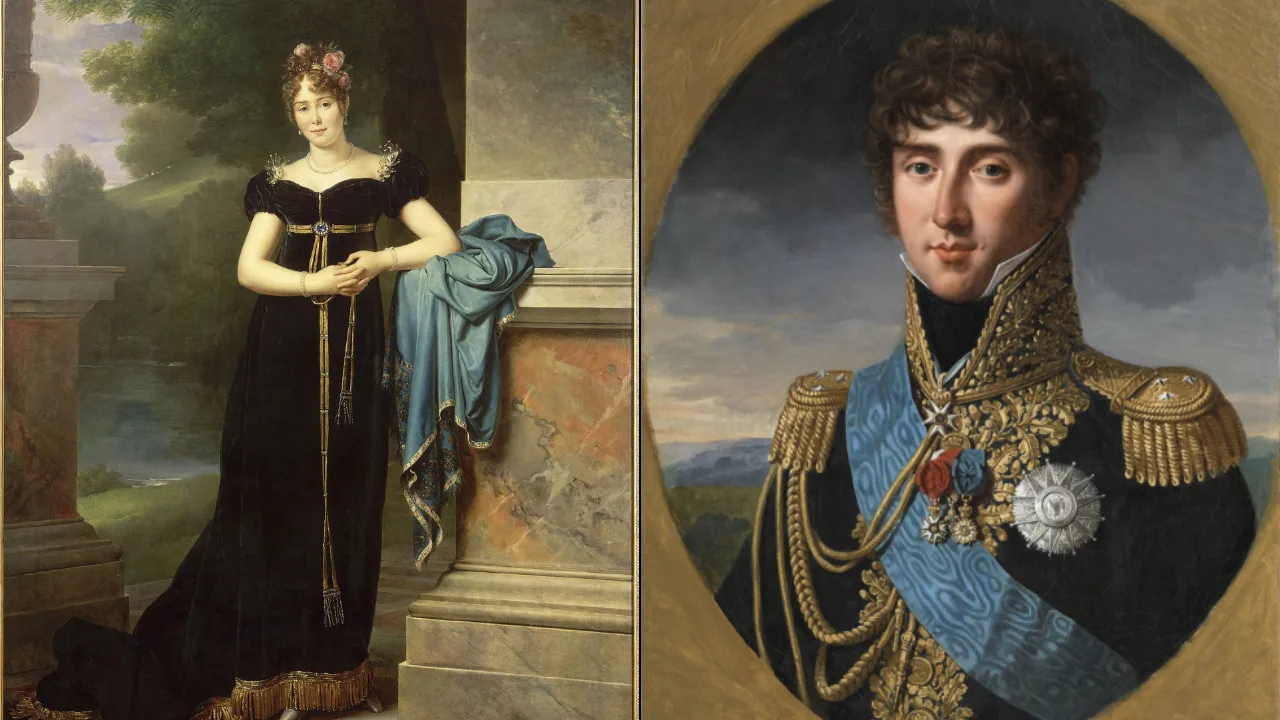
In January 1807, the Polish nobility pressured 20-year-old Marie Walewska into Napoleon’s bed to win back their country; she gave the emperor a son he never publicly acknowledged, and died at 31 with Poland partitioned again.
On the first day of January 1807, a bitter cold had settled over Blonie, a small market town west of Warsaw. Napoleon Bonaparte’s carriage had pulled into a coaching inn to change horses; he was riding into the Polish capital for the first time, master of all Western Europe and pressing east into Prussian-held territory. A young woman pushed through the crowd gathered against his carriage door. She reached him, handed him flowers, and spoke the words: “Welcome, a thousand times welcome to our land.”
Her name was Marie Walewska, Countess Walewski. She was 20 years old, married to a man of 68, and she had not come to the inn by accident. The Polish senator who had arranged her presence was waiting nearby to see whether she would succeed.
Poland Vanishes, Marie’s World Follows
Marie Łączyńska was born on 7 December 1786 in Kiernozia, a village in central Poland, the eldest daughter of Count Mateusz Łączyński, a prominent landowner, and Eva Zaborowska. She was born into a Poland that was already dying.
In 1772, Prussia, Russia, and the Habsburg Empire had taken the first partition of the Polish-Lithuanian Commonwealth, removing roughly a third of its territory between them. This was not an annexation that happened to Poland from a distance: it was a surgical carving of a living state, its borderlands absorbed, its administration replaced, its language subordinated to German and Russian in the regions claimed. Poland’s remaining leadership and nobility spent the next two decades attempting to hold what was left. Two further partitions followed, in 1793 and 1795. After the third, the Commonwealth ceased to exist entirely. Prussia absorbed central and western Poland, including the territory around Kiernozia. Russia claimed the east. The Habsburg Empire took the south. A state that had existed for eight centuries vanished from the map in three transactions spanning 23 years.
Marie’s father did not accept the outcome without resistance. In 1794, Mateusz Łączyński fought in the Kościuszko Uprising, Poland’s last coordinated armed attempt to halt the third partition before it could be completed. In October of that year, at the Battle of Maciejowice, one of the uprising’s decisive defeats, he was mortally wounded. He left behind seven children, a widow, and a dwindling estate. Marie was not yet eight years old.
The family that had once operated from a palatial Kiernozia estate now struggled financially. In those reduced years, one of Marie’s tutors was a young Frenchman named Nicolas Chopin. He had arrived in Poland in his teens, become a devoted Polish patriot, and even joined the same citizen forces as Marie’s father during the Kościuszko Uprising. He taught her French with the linguistic precision of a man who had adopted the Polish cause as his own. He would later father the composer Frédéric Chopin. The language he taught the young countess would prove to be the most consequential skill she ever acquired.
Marie later attended the Convent of Our Lady of the Assumption in Warsaw to complete her education, absorbing herself in the nationalist intellectual circles of the Polish capital. The city still bristled with the memory of partition. France, under Napoleon, was the one power that seemed capable of reversing it.
The Łączyński family’s financial difficulties made the next step straightforward, if not kind. In 1804, at 18 years old, Marie was married to Anastazy, Count Colonna-Walewski. The count was 68 years old, three times widowed, and a former chamberlain to Stanisław August Poniatowski, the last King of Poland. The match stabilised the family’s debts and delivered Marie into the Polish nationalist circles surrounding the old aristocracy. Contemporaries described Marie on her wedding day as “the melancholy little bride, bereft of feeling.” Her husband was described as “the old gentleman, beaming with self-satisfaction.” In 1805, she gave birth to their only child together, a son named Antoni Rudolf. She was 19. Her husband was 70.
Polish Nobles Choose Walewska for Napoleon
Napoleon’s campaigns swept east in a sequence of rapid strategic victories through 1806. He defeated the Prussians at Jena in October, entered Berlin, and pressed further into the territories Prussia had carved from Poland after the third partition. For the Polish nobility, his advance held the possibility of something they had spent a decade believing was gone permanently: a Polish state. French troops were welcomed as liberators in Warsaw. Polish cavalry regiments rode under French command. The political question was whether Napoleon’s sympathy for Polish independence ran deep enough to survive his other strategic interests.
Certain men in Warsaw believed they knew how to deepen it.
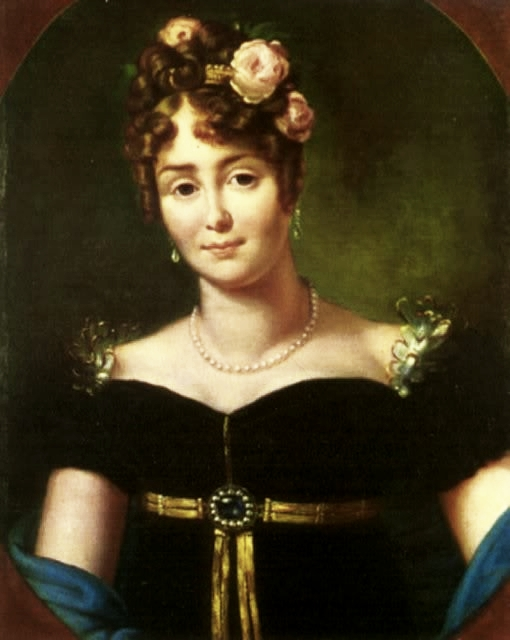
Senator Józef Malachowski, a senior figure in Polish political circles, identified the young Countess Walewska as a suitable candidate to cultivate Napoleon’s goodwill. She was known in Warsaw’s nationalist circles, married into the old aristocracy, and had made a vivid impression at court gatherings. After Marie’s initial encounter with Napoleon at Blonie on 1 January 1807, Napoleon had inquired after her identity and arranged her invitation to a ball in Warsaw. He sent a large bouquet and a sealed letter the following morning. Several more letters followed. All went unanswered.
Malachowski went to Marie’s home personally to make the case. He was not alone. Her brothers, patriots themselves, added their voices to the appeal. The old count, her husband, gave his consent. The argument the men assembled presented was not romantic, and it made no pretence of being so. The French emperor’s attention could be secured, and through that attention, the restoration of a Polish state could be influenced. The sacrifice they were proposing was personal. The benefit they described was national. The entire Polish nationalist establishment, from senator to sibling to husband, arranged itself into a single coherent pressure.
She complied. “A sacrifice was demanded,” she wrote in her memoirs years later. “It was all about achieving this one single equivalence, which could excuse my debased position. This was the thought that possessed me. Ruling over my will, it did not allow me to fall under the weight of my bad conscience and sadness.”
Their affair took hold at Finckenstein Palace in East Prussia, where Napoleon had established his field headquarters for the winter campaign against Russia. Marie was given apartments adjoining his rooms at the castle. She arrived and departed at night to avoid detection, though much of Warsaw’s upper circle was aware of the arrangement. What began as a political transaction did not remain purely transactional. Napoleon’s letters grew warmer and more personal in register. His staff observed a man genuinely attached. Marie’s own emotional evolution is harder to document. Her memoirs, composed in the last months of her life, insist she held to her patriotic purpose and suppressed everything else. Her behavior over the following seven years tells a more complicated story.
Napoleon Rewards Her Country, Conceals Her Son
Napoleon concluded the Treaty of Tilsit with Prussia and Russia in July 1807, imposing some of the most punishing terms he would ever extract from a defeated opponent. Prussia was stripped of more than half its territory. From the eastern Polish lands Prussia surrendered, Napoleon created a new Polish state. On 22 July 1807, the Duchy of Warsaw was formally proclaimed, with a constitution modeled on the Napoleonic legal code, a Polish civil administration, and the Saxon king Frederick Augustus I installed as its ruler. It was not independence: the Duchy was a French vassal state, beholden to Napoleon’s strategic interests. But it was the first Polish political entity with a functioning government and a Polish administration since the final partition of 1795. For a people who had watched their country removed from the map 12 years earlier, this was not a modest development.
Marie’s influence on Napoleon’s decision cannot be precisely measured. What is clear is that she had spent months in closer proximity to him than any ambassador, conveying Polish national aspirations through personal experience rather than diplomatic memoranda. He left Warsaw in the autumn of 1807, returning to Paris after nearly a year away. He sent her books, a portrait of himself, and a note: “My gentle and dear Marie, you who love your country so much, will understand the joy I feel at being back in France, after nearly a year away. This joy would be complete had you been here too, but I carry you in my heart.”
The relationship resumed in 1809, when the War of the Fifth Coalition pulled Napoleon east once more to take Vienna from the Habsburg Empire. Marie traveled from the Duchy of Warsaw to join him at Schönbrunn Palace, the imperial Habsburg residence that Napoleon had claimed as his temporary headquarters while he dictated peace terms to Austria. She settled in a residence beside the palace. She did not leave while the negotiations continued.
On 4 May 1810, back in the Duchy of Warsaw, she gave birth to a son. The boy was named Alexandre Florian Joseph Colonna-Walewski. Under Polish law, he was registered as the legitimate son of Marie’s elderly husband. Napoleon never publicly claimed the child. He took steps, however, to ensure Alexandre’s material security. In 1812, he arranged a grant of 69 farms in the Kingdom of Naples yielding a revenue of 170,000 francs annually, along with the title of count. The arrangement acknowledged paternity in everything but name.
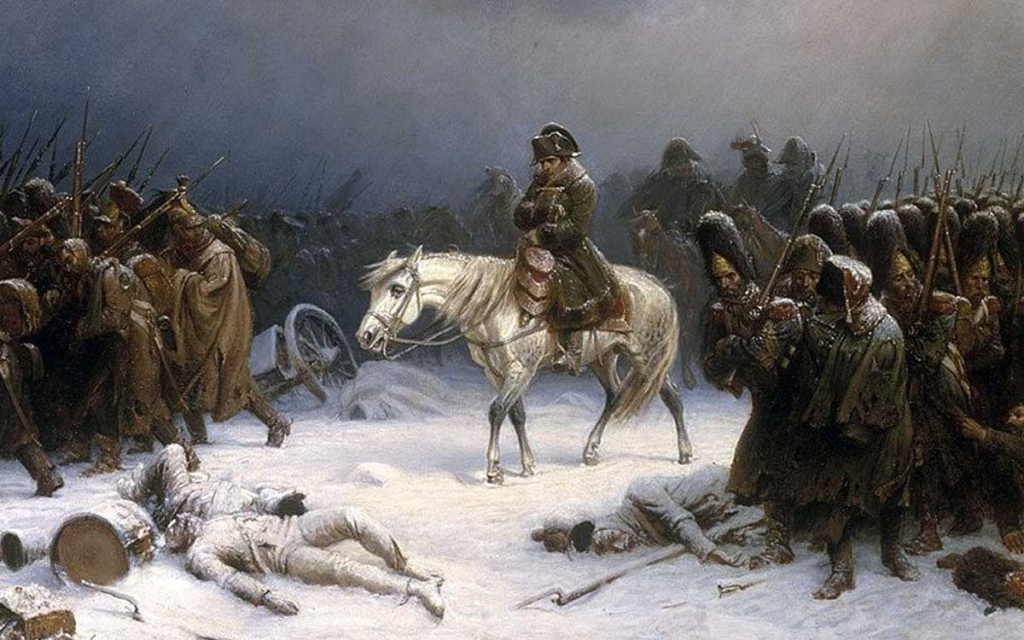
In August 1812, on her brother’s sworn testimony that he had coerced Marie into the marriage, her union with Count Walewski was formally annulled. She received half his considerable estate as settlement. She was 25 years old. Her husband was 76. Months later, Napoleon led his Grand Army into Russia in the largest military campaign of his reign. It destroyed itself in the Russian winter. More than 400,000 soldiers died or were captured. The Duchy of Warsaw, which had depended entirely on Napoleon’s military dominance for its existence, was fatally exposed.
Napoleon Falls, Walewska Follows to Elba
The collapse came in stages. The Russian campaign failure of 1812 opened a coalition that pressed Napoleon from all directions. Prussian, Russian, Austrian, and British forces converged on France through 1813 and into 1814. In April 1814, Napoleon abdicated at Fontainebleau and was exiled to the island of Elba, a small island off the Italian coast, where he was permitted to rule as its nominal sovereign with a reduced ceremonial guard.
Marie rushed to Fontainebleau before his departure. He was receiving no visitors. She sent a letter to Elba, raising among other matters the question of lands Alexandre had been granted in Naples, which the French marshal Joachim Murat had since confiscated. In September 1814, five months into the exile, she arrived on the island with four-year-old Alexandre. The encounter was brief and constrained. Napoleon was simultaneously attempting, without success, to persuade his Austrian wife Marie Louise and their legitimate son to join him. The Habsburg court in Vienna had ensured that Marie Louise was redirected toward other arrangements. His Polish mistress and their unacknowledged son waited in whatever emotional space that left available.
It was the last time they met privately.
Napoleon escaped Elba in February 1815, landed in the south of France, and marched north unopposed as the army he had once commanded deserted the Bourbon king who had replaced him and returned to his side. He entered Paris and resumed power. The Hundred Days ended at Waterloo in June 1815, when Wellington and the Prussian forces under Blücher defeated him decisively. He abdicated for the final time four days later. Before he was transported to Saint Helena, an island in the middle of the South Atlantic chosen for its remoteness, Marie saw him once more at Malmaison, the estate outside Paris that had been his home during his marriage to Josephine. He refused to allow her to accompany him.
That refusal ended their contact permanently. The Congress of Vienna, which had been reordering Europe throughout 1815 and whose work concluded within weeks of Waterloo, redivided the Duchy of Warsaw between Prussia and Russia. The map of 1795 was restored almost exactly. The Polish state that Marie had been pressed to help create had lasted eight years.
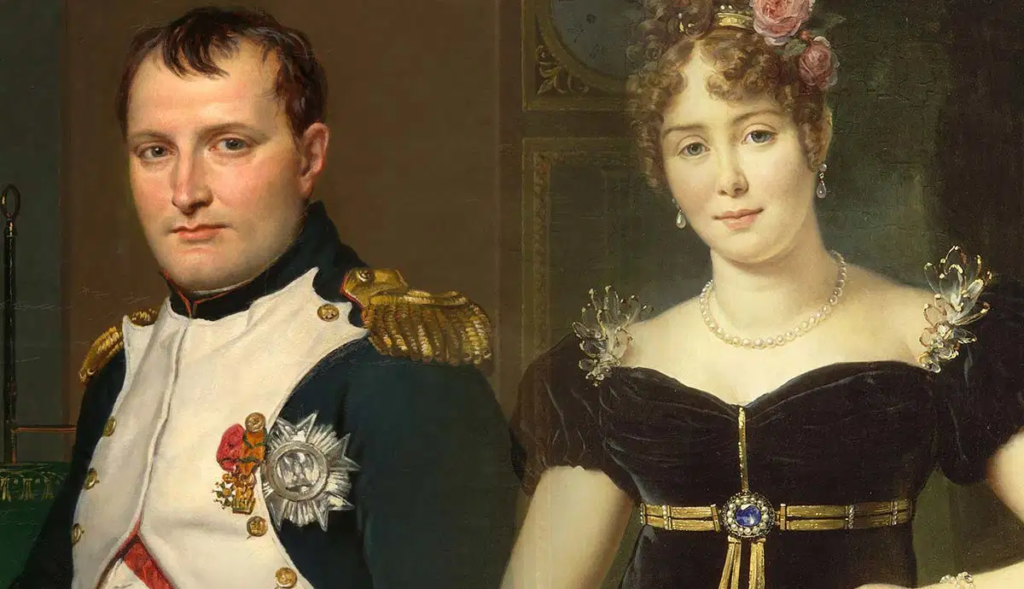
Walewska Dies Four Days After Her Birthday
Marie’s first husband, Count Walewski, died in January 1815. She was 28, a widow by annulment, with a surviving son from her marriage and an unacknowledged son from Napoleon. She had known Philippe Antoine, Count d’Ornano, for several years. He had served Napoleon through the entire arc of the empire, from the early Italian campaigns to the retreat from Moscow and the final defense of Paris in 1814. He was Napoleon’s second cousin through the Bonaparte family’s Corsican branch. He was also, by the accounts of those who observed them, a man who had been genuinely in love with Marie for some time and had waited through her attachment to Napoleon to say so plainly.
On 7 September 1816, Marie married d’Ornano at the Cathedral of Saints Michael and Gudula in Brussels. The couple settled in Liège, then part of the United Kingdom of the Netherlands under the post-Vienna settlement. D’Ornano had no desire to return to Paris, where the restored Bourbon monarchy viewed those who had served Napoleon’s empire with official suspicion and personal coldness.
Marie became pregnant almost immediately. In January 1817, during a visit to Poland, she received a diagnosis of kidney disease. Her doctors advised against continuing the pregnancy. She refused. Through that spring and summer, her condition worsened. On 9 June 1817, the couple’s son was born in Liège. He was named Rodolphe-Auguste. Marie’s health did not recover from the birth. Through the months that followed, as she grew weaker, she dictated her memoirs to a secretary. The memoirs were addressed to her husband. They are among the most closely read primary sources of the Napoleonic period, and in them she insisted, to the last, that she had always acted for Poland.
Marie Walewska died in Paris on 11 December 1817, four days after her thirty-first birthday.
Per her wishes, her heart was placed in the d’Ornano family crypt at Père Lachaise Cemetery in Paris. Her body was returned to Poland and buried in the church at Kiernozia, the village where she was born, where Nicolas Chopin had taught her French, and where her father had left for a battle he would not survive.
The Duchy of Warsaw had already been dissolved for two years. The son who was never officially Napoleon’s outlasted both the state and the emperor himself. Alexandre Colonna-Walewski, serving as French Foreign Minister under Napoleon III, presided over the Congress of Paris in 1856, the negotiations that formally ended the Crimean War and reshaped European international law. He died in Strasbourg in 1868, at 58. In 1937, the film Conquest, starring Greta Garbo as the Countess Walewska, returned her story to the popular imagination as a romance. Senator Malachowski did not appear in it. Neither did her brothers. Neither did the old count, who had given his consent.
Her heart is still in Paris. Her body is in Kiernozia.
Leave a Reply