
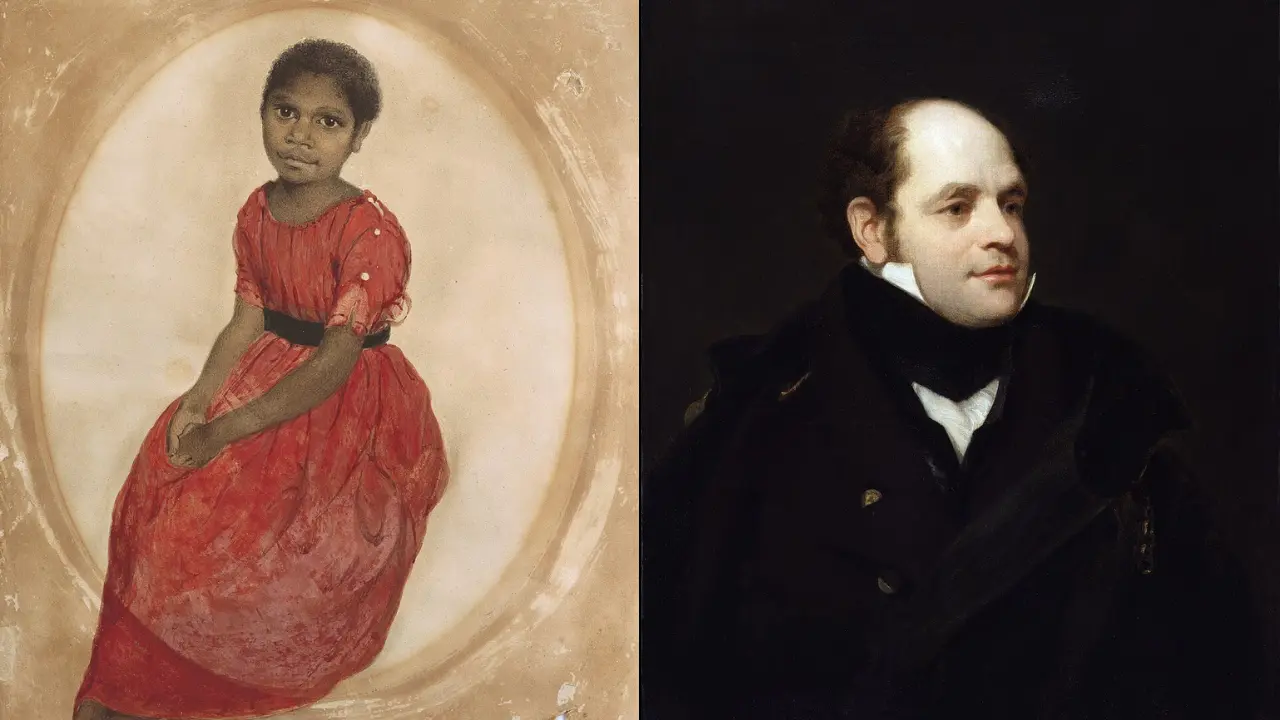
In 1841, a six-year-old Palawa girl named Mathinna arrived at Government House in Hobart inside the Governor’s carriage. She had been brought from Wybalenna, the Aboriginal settlement on Flinders Island where the surviving remnant of Tasmania’s indigenous people had been confined. She carried a kangaroo skin, a rush basket, a string of shell necklaces, and a pet possum. Within two years, the family that had taken her would be gone.
She died in a puddle at the side of a road. She was sixteen.
Britain Consumed the First Peoples of Van Diemen’s Land Within a Generation
The island now called Tasmania was first reached by Europeans in 1642, when Dutch navigator Abel Tasman made landfall and named it Van Diemen’s Land in honor of Anthony van Diemen, governor-general of the Dutch East India Company. Its remoteness delayed sustained European contact for over a century. Captain James Cook visited in 1777, and British colonization began in earnest in 1803, when Van Diemen’s Land became the primary destination for transported convicts as mainland Australia’s use as a penal colony wound down. By the 1820s, at least 20,000 Europeans had settled on the island, drawn by available land and convict labor.
There were people already living there. The Palawa people, Tasmania’s Aboriginal inhabitants, numbered an estimated 4,000 to 10,000 at the time of first sustained European contact. Disease reduced those numbers catastrophically through the early decades of the nineteenth century. Then, between approximately 1824 and 1831, a guerrilla conflict known as the Black War was fought between the settlers and the Aboriginal population. Roughly ten Aboriginal people were killed for every European settler. By the early 1830s, only a few hundred Palawa remained.
What followed was a policy of forced removal. Under the direction of George Augustus Robinson, the Chief Protector of Aborigines, the approximately 400 surviving Palawa were relocated to a settlement called Wybalenna on Flinders Island. The conditions there were severe. Within years, reportedly only 47 remained alive. Mathinna was born at Wybalenna in approximately 1835. Her father was Towterer, an exiled leader of the Ninine tribe originally from south-western Tasmania. Her mother was Wongerneep. She was not an orphan. She was given the European name Mary at birth, suggesting her parents had already been exposed to missionary influence at the settlement.
Lady Jane Franklin Decided to Civilize an Aboriginal Child
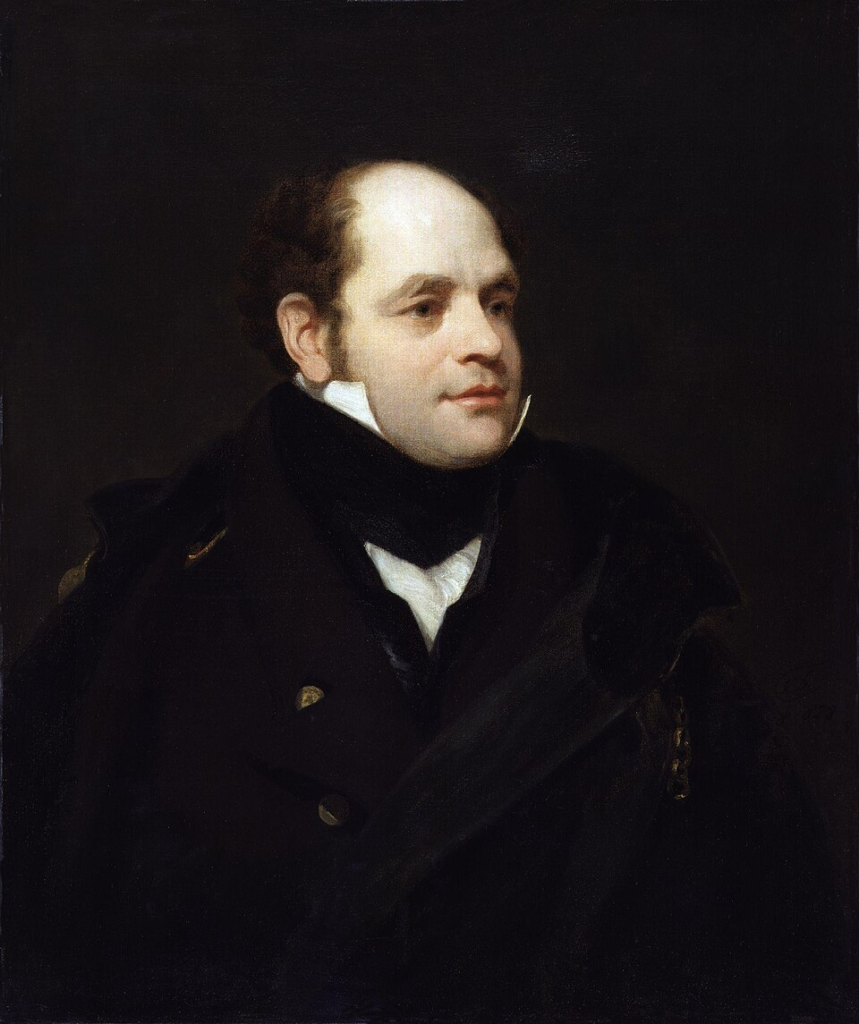
In 1836, Sir John Franklin was appointed Lieutenant Governor of Van Diemen’s Land. Franklin was a significant figure in British polar exploration: he had served in the Napoleonic Wars and led two overland expeditions into the Canadian Arctic in 1819 and 1825, searching unsuccessfully for the Northwest Passage. His wife, Lady Jane Franklin, was by most contemporary accounts the more formidable of the pair. In 1838, a year after the Franklins arrived in Van Diemen’s Land, Lady Jane wrote to Robinson requesting he send her “a black boy” from Wybalenna, along with other curiosities, including snakes.
Robinson sent a nine-year-old boy named Timemendic. Lady Jane renamed him Timeo and placed him in the care of Eleanor Franklin, her step-daughter from Sir John’s first marriage. Timemendic was trained as a household servant, deemed “idle and disobedient,” and ultimately rejected. When Lady Jane attempted to have him admitted to the Hobart Orphan School, he was refused. He was sent to work as a deckhand on a government ship.
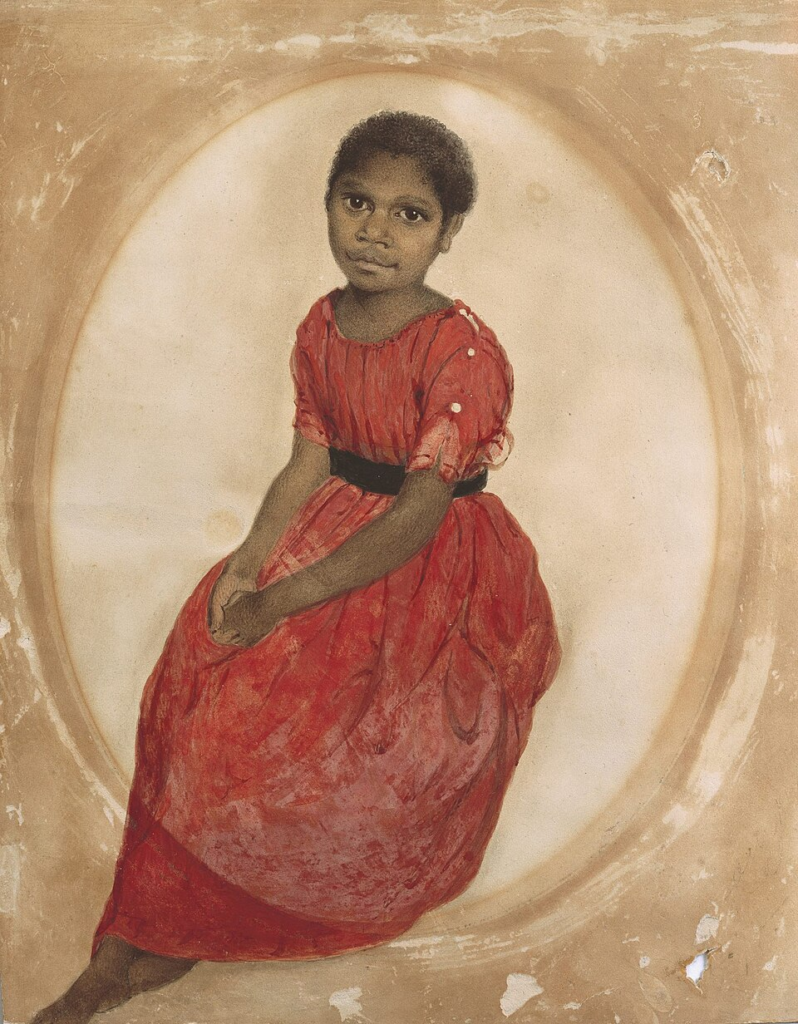
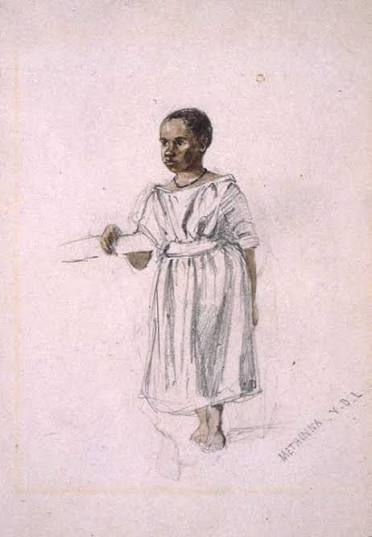
Three years later, in 1841, Lady Jane decided to try again. This time, she requested a girl. Robinson sent a six-year-old named Mary, who was not an orphan; her parents remained alive at Wybalenna. Lady Jane renamed her Mathinna, a word derived from an indigenous Tasmanian language meaning shell necklace. Eleanor was placed in charge of her care. Mathinna was brought to Government House in Hobart and taught to read and write. She was given clothes. Lady Jane particularly liked her in a red dress.
Thomas Bock Painted the Girl Who Would Soon Be Discarded
In 1842, Lady Jane commissioned Thomas Bock, an English-born convict artist transported to Van Diemen’s Land in 1824, to paint Mathinna’s portrait. Bock depicted a seven-year-old girl, barefoot, seated in her scarlet dress and gazing directly at the viewer with composed attention. The painting was sent to Lady Jane’s sister in England, accompanied by a letter describing Mathinna as “one of the remnant people about to disappear from the face of the earth,” who possessed “the unconquerable nature of the savage.”
Around the same time, Mathinna dictated the only piece of correspondence available from her. “I am good little girl,” she wrote, “I have pen and ink cause I am a good little girl…I have a got a red frock like my father. Come here to see my father. I have got sore feet and shoes and stockings and I am very glad.” She missed her father. She asked him to come. There is no record of any response.
Eleanor Franklin’s diary mentioned Mathinna on two occasions. On one, she noted it would be “a long time before she becomes quite civilized.” The Franklins were in Tasmania for less than five more years.
The Franklins Left Tasmania and Left Mathinna Behind
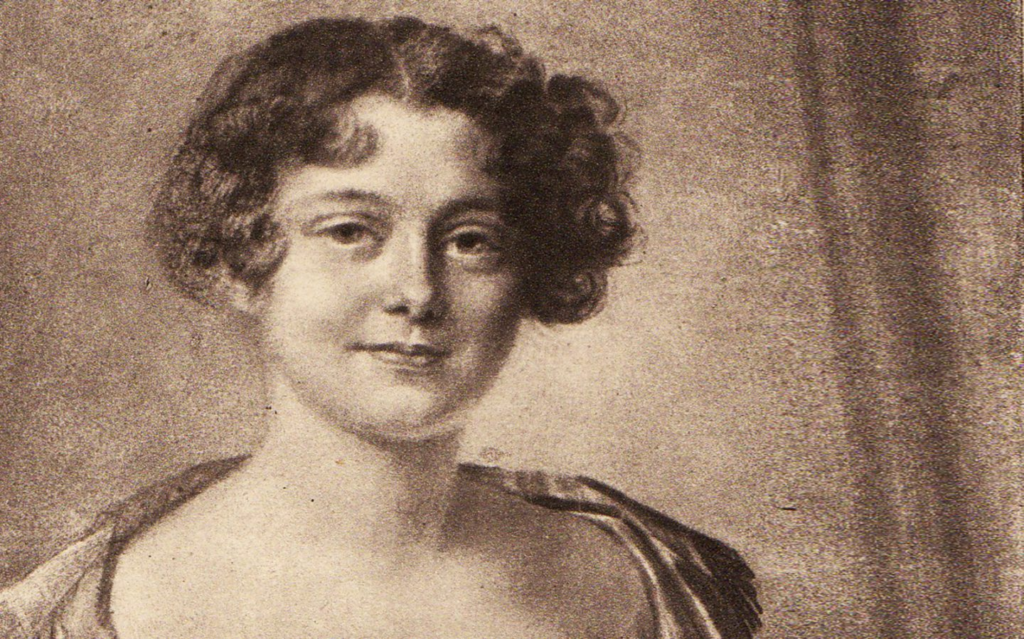
Sir John Franklin was recalled to England in 1843. He, Lady Jane, and Eleanor departed. Mathinna had been in their household for two years. She was eight years old. They left her at the Queen’s Orphan School in Hobart. There is no documented record that Lady Jane Franklin ever inquired after Mathinna again. The portrait remained in England.
In 1844, Mathinna was sent back to Wybalenna on Flinders Island, where the children at the settlement were placed under the authority of the chaplain Robert Clark and his wife. Clark treated the children with documented brutality. During a formal inquiry into his management in 1846, Mathinna gave testimony. “I have been under the care of Mr and Mrs Clark,” she stated. “When I was flogged I was placed across a table and my hands and feet were tied. I was flogged every day. I think I was flogged when I ought not to be flogged. I was once flogged when the blood ran down my head.” She was approximately eleven years old. No record exists of Clark being prosecuted.
In 1847, Mathinna was returned to the Queen’s Orphan School in Hobart. Meanwhile, that same year, Sir John Franklin died in the Canadian Arctic aboard HMS Erebus. The expedition had departed England on May 19, 1845. His entire crew of 129 officers and men perished. The Northwest Passage remained unnavigated.
Mathinna Drowned in a Puddle at Sixteen
In 1851, the colonial authorities determined Mathinna was too old to remain at the Orphan School. She was offered as a domestic servant. No one came forward. She was sent to the Aboriginal settlement at Oyster Cove, west of Hobart, where the final survivors of the Palawa people had gathered following the closure of Wybalenna. She was approximately sixteen. She arrived as someone caught between two worlds: educated at Government House, trained in European manners, she was neither accepted by colonial white society nor comfortably integrated into the Oyster Cove community. Accounts from the period describe her turning to alcohol.
On September 1, 1852, Mathinna drowned. According to one account, she fell while drunk on Old Station Road north of Oyster Cove, and was found with her face in a puddle. She was approximately sixteen or seventeen years old. Thomas Bock’s watercolor of her in the red dress was in England. Lady Jane Franklin was in England. Sir John Franklin had been dead five years in the Arctic ice.
Mathinna was buried at the Oyster Cove Aboriginal Cemetery.
Her story did not end there.
The Girl in the Red Dress Was Not Permitted to Rest
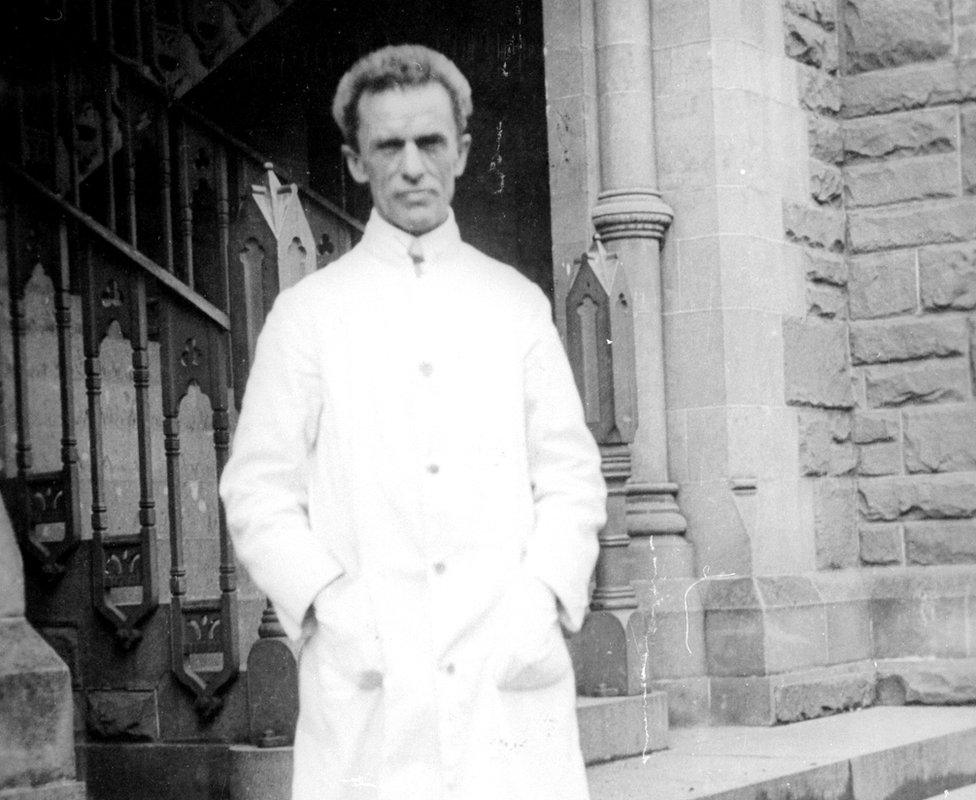
In the summer of 1908 and 1909, Sir William Edward Hamilton Crowther and a companion ransacked the burial ground at Oyster Cove. Mathinna’s skull was among a dozen or more stolen from the cemetery as part of a program organized by Richard Berry, a professor of anatomy at the University of Melbourne and a committed eugenicist, to collect Aboriginal skulls for the university’s anatomy museum. The skull was subsequently donated to the Tasmanian Museum and Art Gallery as part of what became known as the Crowther Collection.
After a campaign by the Tasmanian Aboriginal Centre, all the remains from Oyster Cove were returned and cremated in a four-day ceremony in 1985. A doll and a pincushion Mathinna had sewn during her years at Government House were taken from her in 1843 when the Franklins departed and kept in England for nearly 180 years. In 2022, they were returned to Australia and placed on display at the Tasmanian Museum and Art Gallery.
The town of Mathinna, in the north-east of Tasmania, is named after her. Thomas Bock’s watercolor remains one of the most recognized images of colonial-era Australia. In the portrait she is barefoot. She is looking directly at the painter. Whatever she is thinking, she does not say.
Leave a Reply