
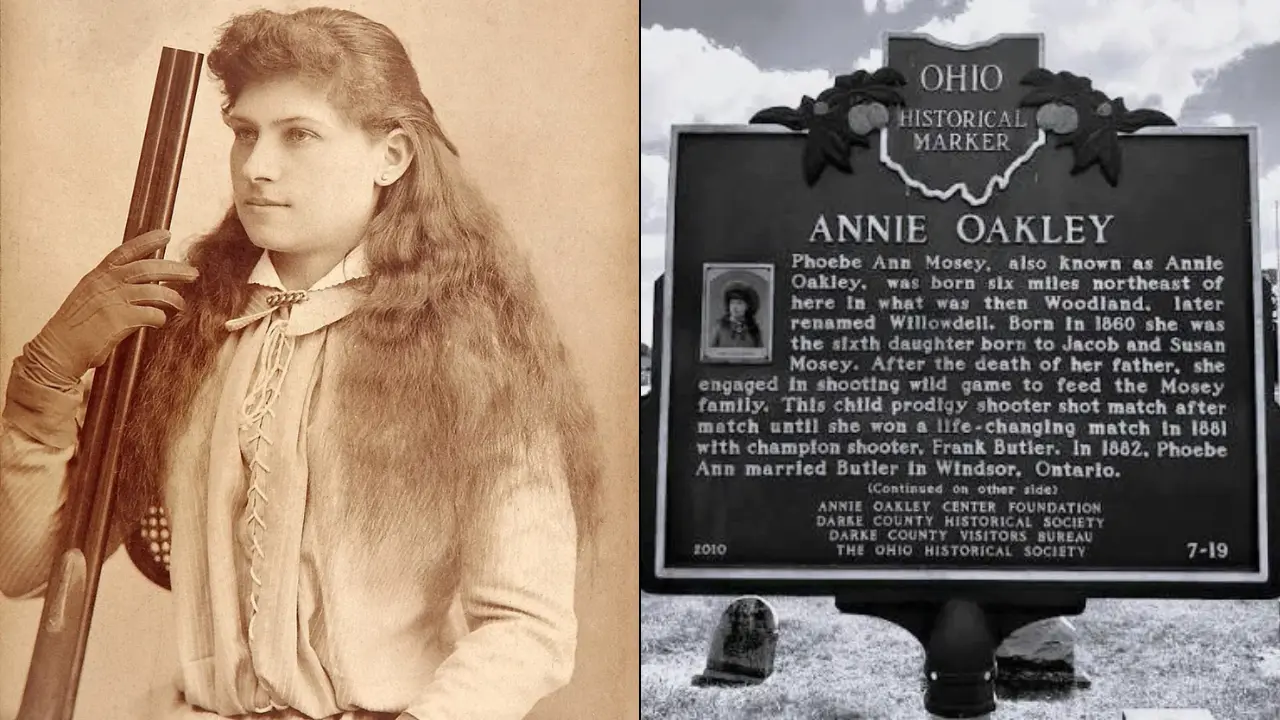
Before Annie Oakley became America’s first female superstar, she prayed on her knees in the snow. Her lips were frozen shut. She had no shoes.
On a winter night sometime around 1871, ten-year-old Phoebe Ann Mosey had fallen asleep over a basket of stockings she was meant to be darning. The woman she worked for struck her on the ear, pinched her arm, and locked her outside as punishment. Within minutes, Phoebe Ann could not feel her feet. She later described how she looked up at the sky and tried to pray. No sound came out.
The woman was one of a couple Phoebe Ann would refer to for the rest of her life only as “the wolves.” They had taken her in on the promise of fifty cents a week and an education. They kept her for almost two years in conditions she described as near-slavery: up at four in the morning, milking cows, feeding livestock, pumping water, digging potatoes, and rocking an infant to sleep, all before she was allowed to go hunting. She was nine years old when she arrived. They wrote letters to her mother saying she was happy and attending school. She was doing neither.
This was the beginning of Annie Oakley’s story. Not the Wild West shows, not the standing ovation from Queen Victoria, not the cigarette held between Kaiser Wilhelm II’s fingers. Those came later. First came the wolves, the frozen ground, and the long walk home.
How a Blizzard Killed Jacob Mosey and Destroyed Everything
Phoebe Ann Mosey was born on August 13, 1860, in a log cabin in Darke County, Ohio, the sixth of Jacob and Susan Mosey’s nine children. Her parents were Quakers of English descent. Jacob, who was already 61 at the time of her birth, ran a small farm on rented land along the Indiana state line.
In the winter of 1865, Jacob drove into town for supplies. A blizzard caught him on the road. He developed hypothermia and died the following year at 66, leaving Susan a widow with seven children and a mortgage she could not pay. The family moved to a smaller home. School became irregular. The children worked.
Phoebe Ann, who went by Annie, began trapping small animals before she turned seven to supplement the family’s food. By age eight she was using her father’s old muzzle-loading rifle. According to biographer Shirl Kasper, she later recalled her first shot: a squirrel, killed cleanly “through the head from side to side.” She was not yet nine.
In March 1870, Annie and her sister Sarah Ellen were admitted to the Darke County Infirmary. According to her autobiography, she was taken in by the superintendent and his wife, who taught her to sew and care for younger children. Then, in the spring of 1870, came the offer from the wolves: a local couple, never named in her autobiography even decades later, who wanted a girl to help with their infant son. Fifty cents a week. An education. Susan Mosey gave her permission. Annie went.
What happened next is documented in Oakley’s own words, which she wrote with measured restraint that makes the content more disturbing, not less.
“I got up at four o’clock in the morning,” she wrote. “Got breakfast, milked the cows, fed the calves, the pigs, pumped water for the cattle, fed the chickens, rocked the baby to sleep, weeded the garden, picked wild blackberries, got dinner after digging the potatoes and picking the vegetables.”
She was ten years old. She was not allowed to leave.
The wolves intercepted her letters home and replaced them with their own, reporting that she was content. She was not. The abuse escalated from overwork to physical punishment. The night she was locked outside in the snow was not an isolated incident. It was the pattern.
In the spring of 1872, Annie ran. She made it to a train depot with no money and no way home. A stranger heard her story, bought her food, and purchased her a ticket back to Darke County. The wolves tracked her as far as her school. A large man Annie knew turned the wolf away at the door. He did not return.
She never publicly named them.
Annie’s Rifle Fed Her Family and Then Freed Them
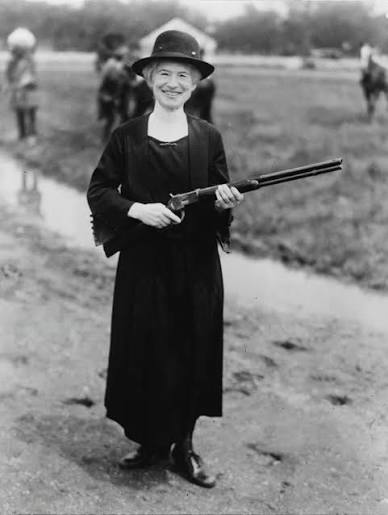
Back with her family and then, for a time, with the Edingtons at the infirmary, Annie returned to hunting. She was methodical about it. She sold wild game to Charles and G. Anthony Katzenberger, shopkeepers in Greenville who distributed it to hotels and restaurants in Cincinnati and across northern Ohio. She did not waste ammunition. She could not afford to.
By the time she was 15, she had saved enough from her hunting to pay off the mortgage on her mother’s farm.
Her name was already known across Darke County. Word reached Cincinnati. On Thanksgiving Day 1875, according to most biographical accounts, the Baughman and Butler shooting act was performing in the city. The show’s star, an Irish-American marksman named Frank E. Butler, made a side bet of $100 with hotel owner Jack Frost that he could outshoot any local challenger Frost could produce. Frost accepted.
The last opponent Butler expected was a five-foot-tall fifteen-year-old girl from Darke County.
“I was a beaten man the moment she appeared,” Butler later said, “for I was taken off guard.”
He had good reason to be. Annie hit all 25 of her targets. Butler missed his last shot. He lost the bet and the match. He began courting her shortly afterward. They married, most likely in August 1876, though a certificate on file with the Archives of Ontario gives June 20, 1882, as the date. Biographers have long argued over the discrepancy; the 1882 date may reflect when Butler’s prior divorce became legally final.
Annie joined Frank’s shooting act in May 1882, filling in for his regular partner, John Graham, who had fallen ill. She was an immediate success. At some point during their early performances together in Cincinnati, she adopted the name Oakley, reportedly taken from the Cincinnati neighbourhood where they were living. In private, she remained Mrs. Frank Butler for the rest of her life.
The couple toured the United States for several years. Frank was the marquee name on the posters. Annie performed in his shadow.
Buffalo Bill Made Oakley America’s First Star
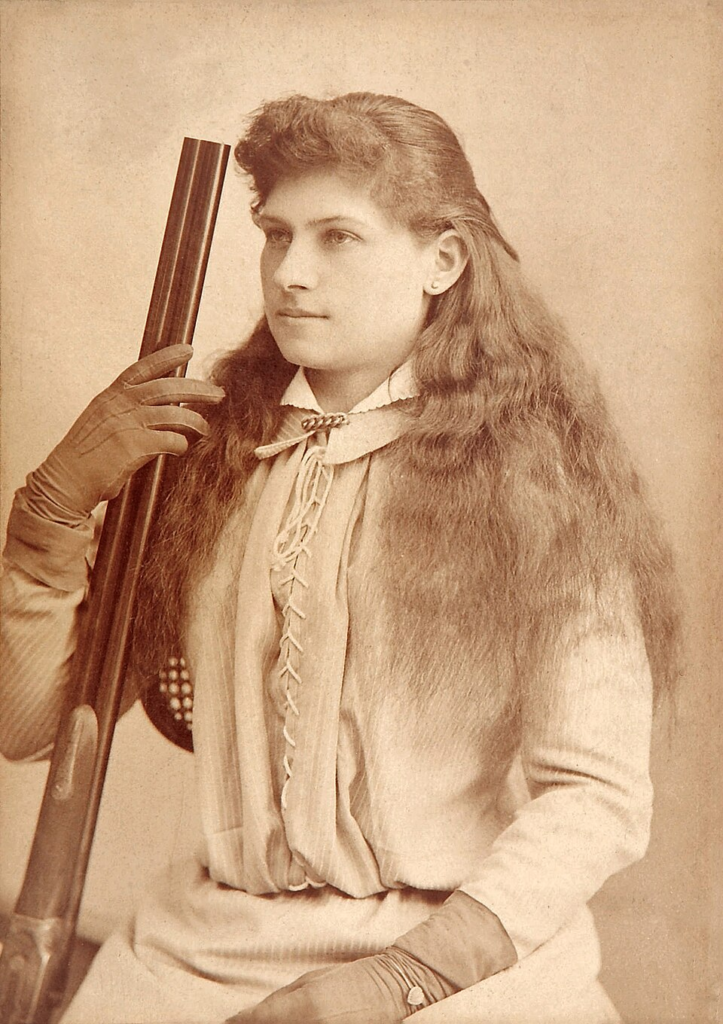
In 1885, Annie Oakley and Frank Butler joined Buffalo Bill’s Wild West show. The dynamic shifted immediately. Oakley was put on every poster. Frank stepped back from performing and became her manager and publicist, a role he accepted without apparent resentment and executed with considerable skill. Oakley earned more than any other performer in the show except Buffalo Bill himself.
A year into her time with the show, a younger rival arrived: Lillian Smith, fifteen years old and nearly as precise as Oakley, who joined the cast in 1886 and began attracting favorable press coverage. It was almost certainly in response to Smith’s rising profile that Oakley began presenting herself as six years younger than she was. The strategy worked. Smith eventually departed. Oakley remained.
In March 1884, before she joined Buffalo Bill, Oakley had already attracted one notable admirer. Sitting Bull, the Hunkpapa Lakota leader, watched her perform in Minnesota and was so impressed that he offered $65 for a photograph of the two of them together. The two became friends and maintained a lasting mutual respect. That year, Sitting Bull symbolically adopted Oakley as a daughter, having lost one of his own daughters at the Battle of Little Bighorn. He gave her the Lakota name Watanya Cicilla, translated in English as Little Sure Shot, a title she used in public advertisements for the remainder of her career.
Royalty Watched Oakley Perform and She Never Missed
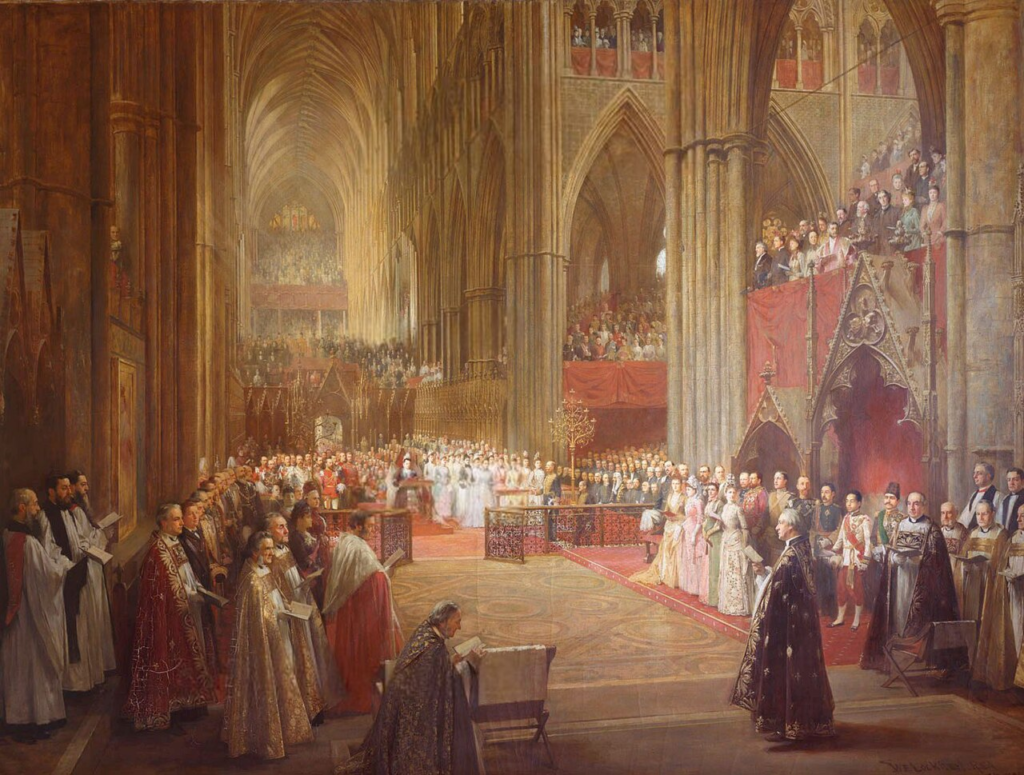
In 1887, the Wild West show was invited to London for Queen Victoria’s Golden Jubilee. The press response was immediate and enthusiastic. English papers documented her skills in detail and noted her western background with fascination. She performed for Queen Victoria, King Umberto I of Italy, President Sadi Carnot of France, and other European heads of state.
One encounter became legend. Kaiser Wilhelm II, newly crowned and apparently curious, held a lit cigarette for Oakley to shoot the ash from. She shot it. The cigarette was in his hand, not his mouth, despite how the story has sometimes been retold. Some who heard the story later noted that, in retrospect, history might have taken a different course if her aim had been slightly less precise.
The European tour cemented Oakley’s status as something entirely new: America’s first female international star. She earned more than everyone else in Buffalo Bill’s company except the man whose name was on the show.
Her stunts grew more intricate and more audacious. She split playing cards edge-on from thirty paces. She shot dimes tossed into the air. She hit targets while standing on a galloping horse. She fired while using only a hand mirror to aim. On November 1, 1894, Oakley and Butler appeared before one of Thomas Edison’s early Kinetoscope cameras at his Black Maria studio in New Jersey. The resulting film, known as Annie Oakley, ran 21 seconds. It was among the earliest films shot at the studio after commercial showings began.
On April 5, 1898, Oakley wrote to President William McKinley. She offered the government a company of 50 lady sharpshooters who would provide their own arms and ammunition should the United States go to war with Spain. “I am ready to place a company of fifty lady sharpshooters at your disposal,” she wrote. “They will be little if any expense to the government.” McKinley did not respond. The Spanish-American War broke out regardless.
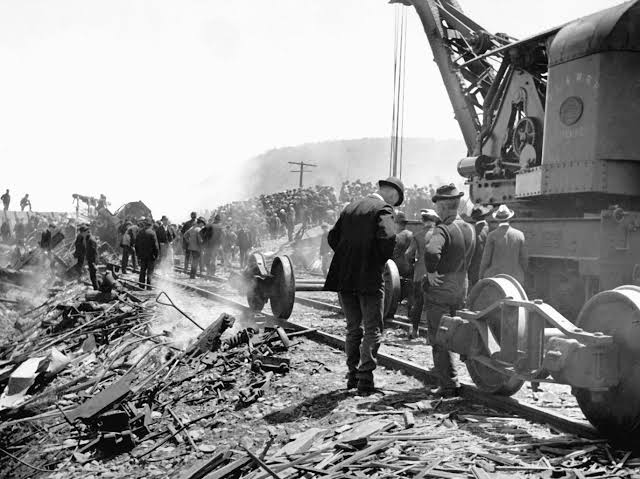
A Train Crash Nearly Ended Everything Oakley Had Built
In October 1901, the Wild West show’s private train collided with another train at Lexington, North Carolina. Oakley was badly injured. She underwent five spinal operations. She was temporarily paralyzed. The recovery took the better part of a year.
She left the Buffalo Bill show permanently and, in 1902, took a role in a stage play called The Western Girl, written specifically for her. She settled into a less physically demanding career but did not slow down. Through the first decade of the twentieth century, she filed and won 54 of 55 libel suits against newspapers that had published a false story in 1903 claiming she had been arrested for stealing to support a cocaine habit. The woman arrested had given police a false name. Oakley spent six years in courtrooms clearing her own.
When the United States entered the First World War in 1917, Oakley wrote to the Secretary of War offering to raise and fund a regiment of women volunteers. “I can guarantee a regiment of women for home protection,” she wrote, “every one of whom can and will shoot if necessary.” The offer was declined. Oakley gave shooting demonstrations at army camps instead and trained her dog to solicit Red Cross donations from spectators.
In 1922, at 62, she hit 100 clay targets in a row from 16 yards at a Pinehurst, North Carolina, shooting contest. Some still considered her the finest markswoman alive.
That November, a car crash left her requiring a steel brace on her right leg. She spent more than a year recovering. By 1924, she was setting records again.
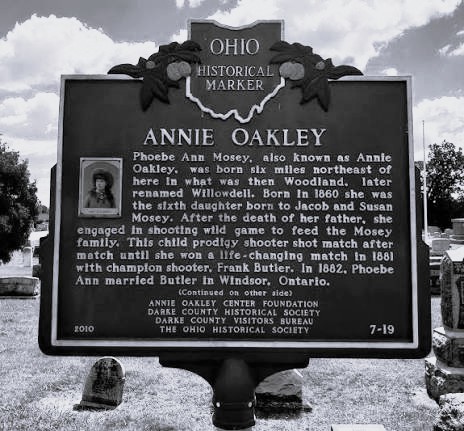
Annie Oakley Died with Nothing Left for Herself
By 1925, her health was deteriorating. She and Frank moved back to Greenville, Ohio, to be near her family. She died on November 3, 1926, of pernicious anemia. She was 66.
Her ashes were buried at Brock Cemetery outside Greenville. When her estate was settled, it was found that her entire fortune had been spent on her family and her charities. There was nothing left. The girl who had paid off her mother’s mortgage at fifteen had kept that habit for the rest of her life.
Frank Butler died 18 days later, on November 21, 1926. According to one biographer, he stopped eating after she died. His death certificate listed senility as the cause. He was buried beside her ashes.
In her lifetime, Oakley reportedly taught more than 15,000 women to use a gun. “I would like to see every woman know how to handle guns,” she said, “as naturally as they know how to handle babies.” She had been advocating for armed women since at least 1898, when McKinley ignored her first letter. The government ignored the second one too. She showed up at the army camps anyway.
Her autobiography, left incomplete at her death, was given to comedian Fred Stone. It took two wars, a train crash, a car crash, five spinal operations, and 55 libel lawsuits to slow her down. It took pernicious anemia to stop her entirely.
She had been ten years old, kneeling in the snow with her lips frozen shut, before any of that began.
Leave a Reply