
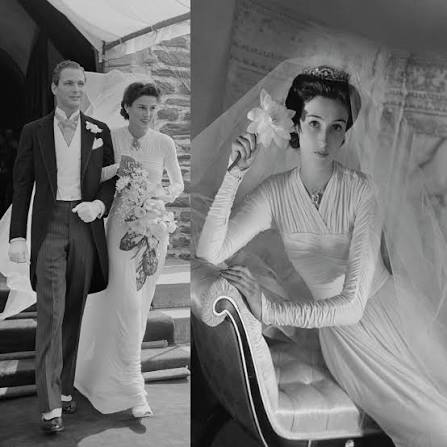
After Truman Capote published a thinly veiled portrait of her husband’s infidelities in Esquire in November 1975, Barbara ‘Babe’ Paley, the most admired socialite in America, cut him off permanently and never spoke to him again.
In November 1975, Barbara Paley sat down with the latest issue of Esquire magazine and read thirteen thousand words that dismantled her life. The piece was called “La Côte Basque, 1965,” and it was the work of Truman Capote, a man she had considered her closest friend. A character in the story was unmistakably her. The details of her husband William Paley’s extramarital affairs were rendered with the precision of someone who had listened very carefully, over a very long time.
She put down the magazine. She never spoke to Capote again.
Three Cushing Sisters Married for Power
Barbara Cushing was born on July 5, 1915, in Boston, Massachusetts, the youngest daughter of Harvey Cushing, one of the most celebrated neurosurgeons of the early twentieth century, and his wife Katharine Stone Crowell. Two older sisters preceded her: Mary, known to everyone as Minnie, and Betsey. Together, the three would become the most discussed women in East Coast society, eventually dubbed the Fabulous Cushing Sisters.
Their mother did not leave the question of social advancement to chance. Minnie accomplished the assignment first, marrying Vincent Astor, one of the great American fortunes, in 1940. Betsey married twice at the summit of the social register, first to James Roosevelt, son of President Franklin D. Roosevelt, and then in 1942 to John Hay Whitney, the U.S. Ambassador to the United Kingdom and president of the Museum of Modern Art. Barbara, the youngest and by all accounts the most beautiful, would take her time.
She had been educated first at the Winsor School in Boston, then at Westover School in Middlebury, Connecticut, where she graduated in 1933. Early in 1934, a car accident on Long Island knocked out her front teeth and required extensive reconstructive surgery. When the bruising healed, she emerged, by several accounts, looking even more striking than before.
In 1938 Barbara joined Vogue, where her position gave her access to the finest fashion houses in the world. What distinguished her was not access but judgment. She combined clothes with accessories in ways that broke established conventions and established new ones. In 1941 Time magazine placed her second on its list of the world’s best-dressed women, behind only Wallis Simpson. It was the first of fourteen appearances on the International Best Dressed List. By 1958 she had been inducted into the Fashion Hall of Fame.
By then she had long since stopped working. She had traded one kind of attention for another.
The Mortimer Marriage Did Not Hold
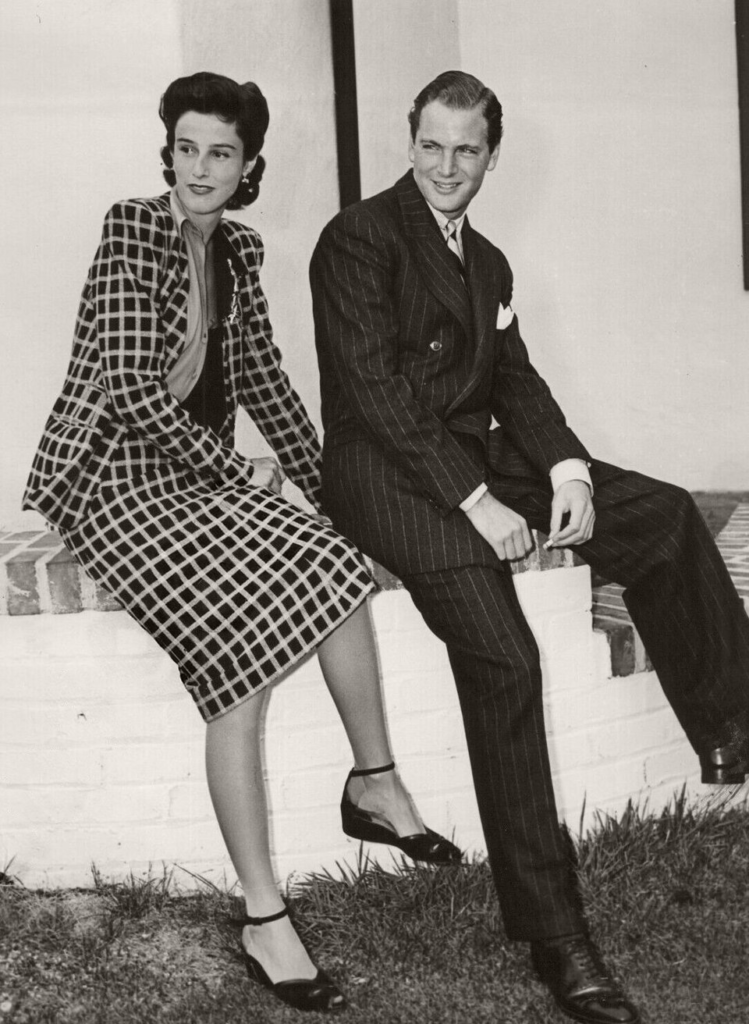
Sometime before she joined Vogue, Barbara met Stanley Grafton Mortimer Jr., whose family wealth traced in part to his maternal grandfather Henry Morgan Tilford, a senior executive who had risen to president of Standard Oil of California. They married in September 1940 in East Hampton. A son, Stanley Grafton Mortimer III, known as Tony, arrived in 1942. A daughter, Amanda, followed in 1944.
The marriage did not survive the war. Stanley served in the Pacific. When he returned, the separation was almost immediate. They divorced in 1946, and Barbara emerged from the settlement with a substantial financial award.
Her daughter Amanda went on to a distinguished career in New York City planning, eventually serving as Director of the Department of City Planning under Mayor Michael Bloomberg. She later described her relationship with her mother as “non-existent,” attributing the distance entirely to her mother’s choices. The portrait that emerges is of a woman for whom motherhood was one obligation among many, and rarely the most pressing.
William S. Paley was already among the most powerful men in American media when Barbara met him in 1946. He had built the Columbia Broadcasting System from a struggling network of affiliated radio stations into one of the foremost broadcast operations in the United States. He was also, at the time, still married.
His wife was Dorothy Hart Hearst, former daughter-in-law of William Randolph Hearst, the press baron Orson Welles had immortalized in Citizen Kane. The Paley marriage had long been in name only. William finalized his divorce from Dorothy on July 24, 1947. Four days later, he and Barbara were married.
The arrangement was, by most accounts, a mutual transaction. Barbara brought William something money could not straightforwardly purchase: entry into the innermost circles of New York and East Coast society, where old money still required its own form of vetting. He brought her an allowance of $160,000 a year, the equivalent of roughly two million dollars today, and the resources to entertain at a scale that almost no one in New York could match. Their properties in Manhattan and on Long Island became among the most coveted invitations in the city.
Two more children followed: a son in 1948 and a daughter in 1950.
The private reality was harder. William Paley conducted a series of extramarital affairs and made progressively less effort to disguise them. Barbara eventually sought comfort elsewhere as well. They never divorced. The reasons were practical and social; the arrangement served both their purposes too effectively to dismantle.
Babe’s Rivalry With Gloria Guinness
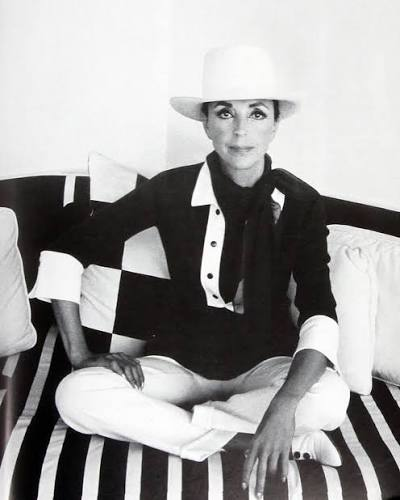
The one woman who rivaled Barbara Paley’s dominance over the same social world was Gloria Guinness. Born Gloria Rubio y Alatorre in Guadalajara, Mexico, in 1912, Guinness had a complicated backstory that she frequently altered to suit her audience. She had married four times. Her third husband was Ahmad Fakhry Bey, a grandson of King Fuad I of Egypt. Her fourth was Thomas “Loel” Guinness, a member of the celebrated Guinness banking and brewing dynasty.
The rivalry between the two women was not openly declared but it was persistent. Barbara was known to circulate stories that Gloria had worked in a Mexican nightclub before her ascent through European society. Gloria retaliated in her own register. On one occasion she invited Barbara aboard her private yacht under the pretense of an informal gathering, then appeared herself in couture and a significant collection of diamonds, making the nature of the evening clear from the moment she stepped on deck. They were never quite friends. They were never quite enemies. The distinction didn’t matter much; they occupied the same space and both knew it.
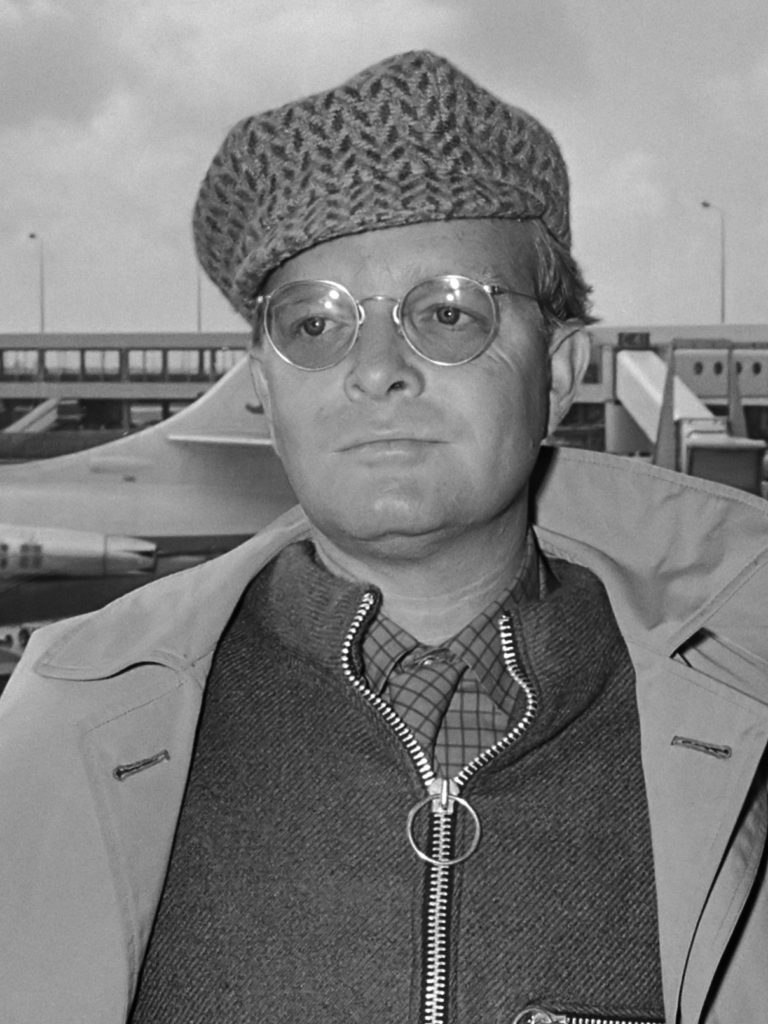
At some point in the late 1950s, Truman Capote entered Barbara Paley’s life and did not leave it for nearly two decades. By then famous for Breakfast at Tiffany’s and In Cold Blood, he had cultivated a small circle of wealthy, admired women he called his “swans.” Barbara was his acknowledged favorite.
Capote once told a journalist that Barbara Paley had exactly one flaw. She was perfect.
In November 1966, at the height of what they shared, Capote threw his Black and White Ball at the Plaza Hotel in New York City. The masquerade drew the most celebrated names in American culture, society, and politics. Barbara attended. At the time the evening was described as the party of the century. In retrospect, it was the highest point of an alliance about to begin its decline.
A Single Chapter Ended Everything
Capote had been working for years on a novel called Answered Prayers. In November 1975, Esquire published a chapter from it, titled “La Côte Basque, 1965,” set at the famous Manhattan restaurant of the same name. The chapter presented barely disguised portraits of the secrets of New York’s most prominent social circles. A character drawn unmistakably from William Paley appeared in an account of marital infidelity. The details were specific. They could only have come from someone who had spent years listening closely.
Barbara recognized herself. She recognized her husband.
She did not write to Capote. She did not telephone him. She simply became unreachable, and remained so.
They never spoke again. Answered Prayers was never finished. Capote died in August 1984. The incomplete manuscript was published posthumously in 1987. Whether the pages he never wrote held worse revelations than what he had already released, Barbara Paley never learned.
She was already gone.
Babe Planned Her Own Funeral
Diagnosed with lung cancer in 1974, Barbara Paley spent the final years of her life in the knowledge of what was coming. She had smoked two packs a day for decades. She stopped dyeing her hair and let it go grey. She began planning the details of her funeral with the same exactitude she had brought to every gathering she had ever hosted.
She died on July 6, 1978, one day after her sixty-third birthday, at her home in Manhattan. The funeral, held at St. John’s Church on Long Island, was by all accounts exactly as she had intended.
Truman Capote survived her by six years. He spent them without another novel, without the social world he had spent decades building, and without Barbara Paley. He had told a journalist she had exactly one flaw, and then spent three years trying to reach a phone that was never answered, in the care of a woman who had decided that the friendship contained something she did not owe him the chance to explain.
Leave a Reply