
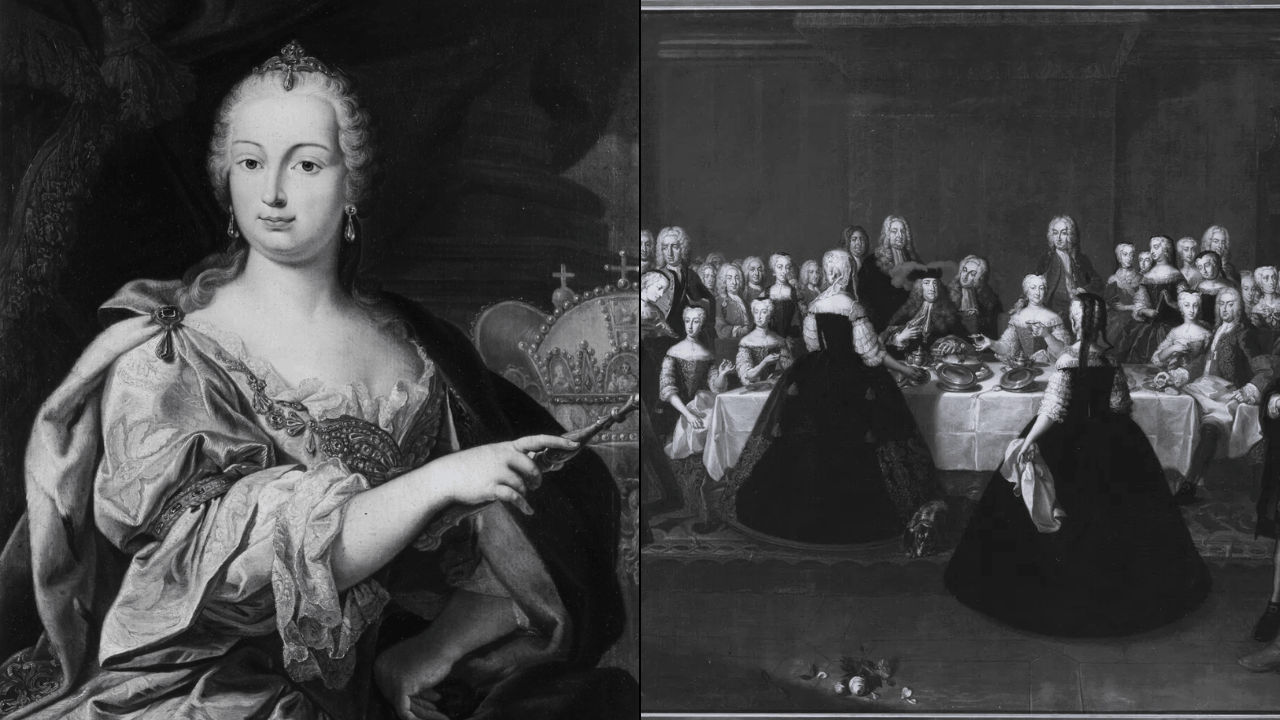
Maria Theresa of Spain entered France on June 7, 1660, crossing Pheasant Island in the Bidasoa River with her father’s final words ringing in her ears. Philip IV of Spain, ageing and exhausted from decades of ruinous war, had pulled his daughter close at the border and told her exactly who she was now permitted to be.
“You must forget that you were an Infanta,” he said, “and remember only that you are Queen of France.” They both knew they would never see each other again.She was twenty-one years old.
A Dynasty Built on Death
Maria Theresa was born on September 10, 1638, at the Royal Monastery of El Escorial, the great granite complex Philip IV had inherited outside Madrid. Her father had been King of Spain since 1621 and ruled the largest colonial empire the world had yet seen, stretching from Mexico south to Chile and Argentina. Her mother, Elisabeth of France, was a daughter of King Henry IV and the sister of Louis XIII, making her a princess born precisely at the intersection of Europe’s two greatest rival powers.
Tragedy arrived early. Elisabeth and Philip had many children together, but nearly all of them died in infancy. Only one sibling, Balthasar Carlos, survived those first dangerous years, and Maria Theresa grew close to him. In 1644, when she was six years old, her mother died from complications following a miscarriage. Two years later, Balthasar Carlos followed, dead at sixteen from smallpox, just days short of his seventeenth birthday.
His death changed everything. With no legitimate male heir, Maria Theresa became heir presumptive to the Spanish throne, an enormous weight placed on a girl of eight. Her father, aware that a daughter as sole heir invited instability, moved quickly to resolve the problem. In 1649, he remarried, choosing his own niece, the fourteen-year-old Mariana of Austria, who would provide the male succession Spain desperately needed.
By 1657 she had produced a son, Philip Prospero, who replaced Maria Theresa as heir. When Philip Prospero died suddenly on November 1, 1661, Maria Theresa held the claim again for precisely five days before Carlos II was born on November 6, and she was displaced a second and final time.What remained of her inheritance was the one thing Spain’s treasury could not afford to keep: her.
The Peace That Cost Her Everything
By the 1650s, Spain was exhausted. The country had spent more than a century fighting France across the Italian Peninsula, the Pyrenees, and the Spanish Netherlands, running its colonial wealth into the ground and suppressing rebellions in Portugal and Catalonia in the process. On November 7, 1659, the two powers signed the Treaty of the Pyrenees on Pheasant Island, a tiny strip of land in the Bidasoa River that served as neutral ground between them.
One clause of the treaty arranged a marriage between the French king and the Spanish Infanta. Their union would, in theory, cement the peace after more than 160 years of near-continuous war.In June 1660, the Spanish court traveled to the Pyrenean border for the formal handover. Maria Theresa met Louis XIV for the first time on Pheasant Island on June 7.
The French king was born just five days before her, on September 5, 1638, and had been king since the age of four, when his father Louis XIII died in 1643. He was already projecting the absolutist authority that would define his reign, presenting himself as the embodiment of divine right in France.
Their meeting was also, technically, a family reunion. The two were double first cousins. Louis XIV’s father, Louis XIII, had been the brother of Maria Theresa’s mother, Elisabeth. And Maria Theresa’s father, Philip IV, had been the brother of Anne of Austria, Louis XIV’s mother. The dynastic logic of European royalty had produced two people related through both their parents, now tasked with extending that same tradition.
Two days after the meeting on Pheasant Island, they married at the Church of Saint-Jean-Baptiste in Saint-Jean-de-Luz, a Basque fishing town on the French coast chosen precisely for its position halfway between Madrid and Paris.
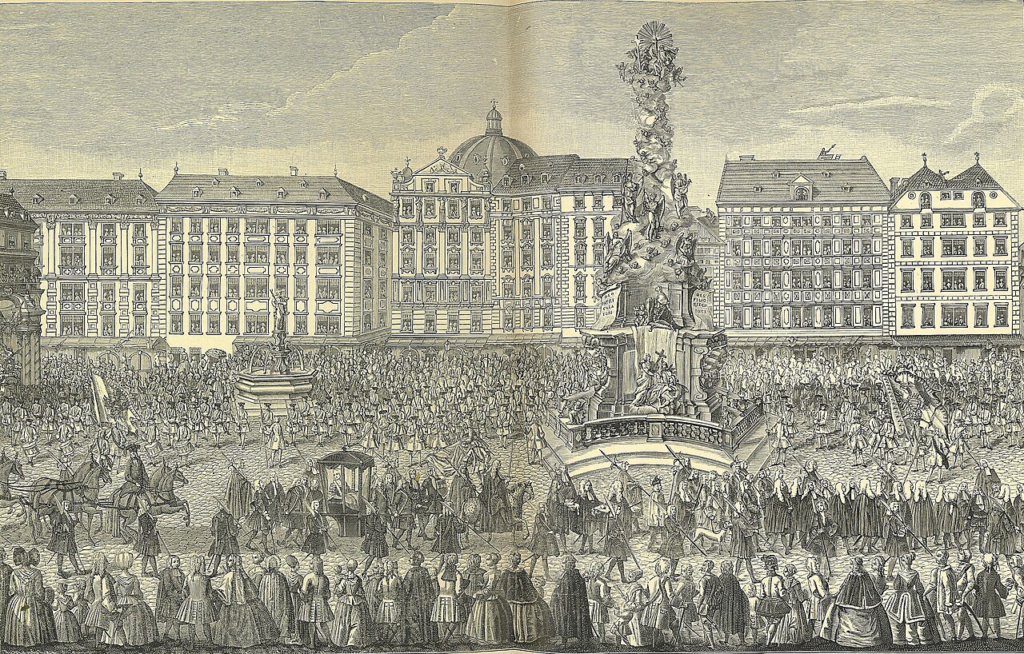
On August 26, 1660, they made their ceremonial entry into the French capital, and the crowds that lined the streets to welcome their new queen had no idea what they were watching. A woman who had just said a permanent farewell to everyone and everything she had ever known, smiling from a gilded carriage in a country not her own.
The Court That Didn’t Want Her
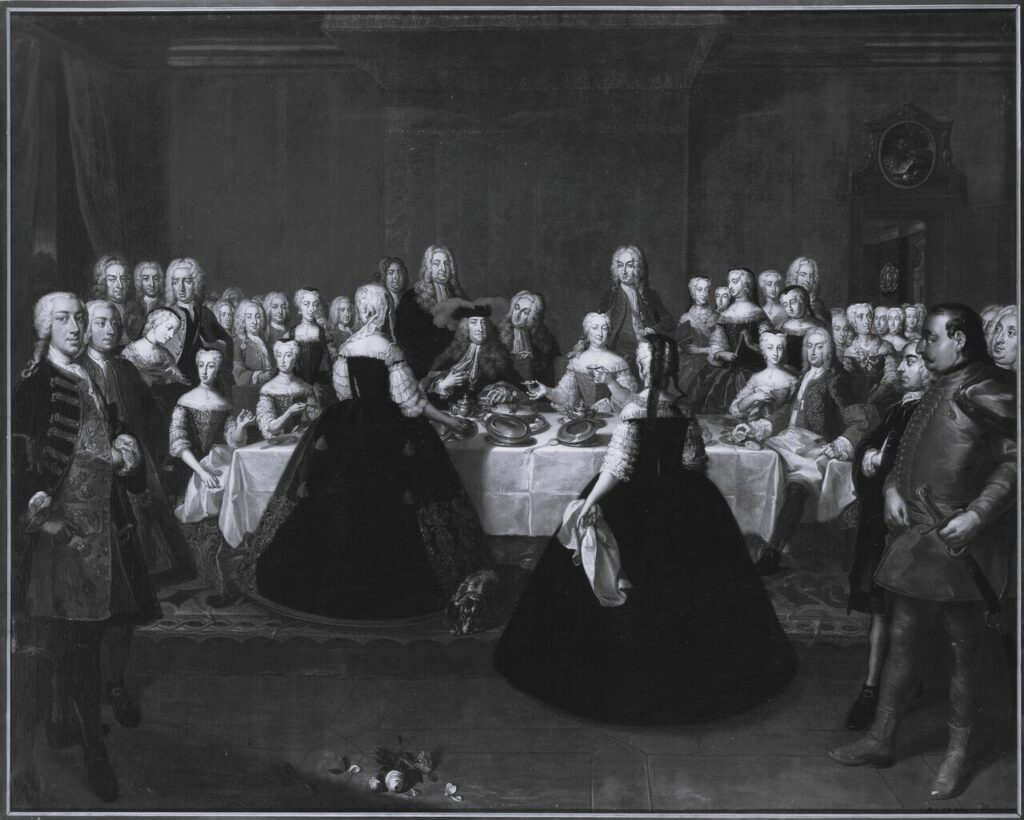
Maria Theresa was, by all accounts, a woman of genuine goodness. Her contemporaries described her as charitable, devout, and warm. She loved her dogs, her ladies-in-waiting from Spain, and her hot chocolate, a taste that had left her teeth in poor condition by the time she reached France.
She adopted French fashions, participated in the spectacular entertainments of the court, and endured the social demands of Versailles despite a natural shyness that never entirely left her. When she wore high heels to compensate for her small stature, she often fell.What she could not do was make herself matter to Louis.
The king was a serial philanderer from the earliest years of their marriage. He had affairs with multiple women before settling into a long relationship with Louise de La Vallière, and from around 1667, Françoise-Athénaïs de Rochechouart de Mortemart, the Marquise de Montespan, 27, displaced even her.
Montespan was brilliant, witty, and relentless, and her hold over Louis would last more than a decade. Maria Theresa wept in private and turned a careful blind eye in public, never confronting her husband in any forum where the humiliation could echo back. Louis, aware on some level of what he owed her, arranged for Spanish plays and comedies to be performed at court specifically because he knew she loved them.
The one relationship that sustained her was with Anne of Austria, her mother-in-law and Habsburg kin, with whom she could speak Spanish, visit churches, and exist for a few hours outside the formal scrutiny of the French court.
She called Anne “Dia.” When Anne died on January 20, 1666, of breast cancer, at the Convent of Val-de-Grâce in Paris, Maria Theresa lost the single person at that court who was genuinely hers.After Anne’s death, Louis stopped concealing his affairs.
Five Funerals Before Her Own
Maria Theresa gave birth six times. Of those six children, five did not survive her.Her firstborn, Louis, arrived on November 1, 1661, and would grow into the Grand Dauphin, the one healthy child the marriage produced. The second child, Anne Élisabeth, was born November 18, 1662, and died forty-two days later on December 30.
The third, Marie Anne, was born November 16, 1664, and died December 26, forty days after her birth. In a coincidence that must have felt like a grotesque pattern, both daughters were born in November and buried in December.The fourth child, Marie Thérèse of France, born January 2, 1667, lasted longer.
She reached the age of five before tuberculosis took her on March 1, 1672. The fifth child, Philippe Charles, born August 5, 1668, died July 10, 1671, just before his third birthday. The sixth and last, Louis François, born June 14, 1672, died November 4 of the same year, at five months old.
Historians have pointed to the couple’s close biological relationship as a likely factor in this pattern. Maria Theresa and Louis were double first cousins. Her own lineage was severely inbred, produced by generations of Habsburg intermarriage between the Spanish and Austrian branches of the family. Their children inherited the compounded result, and five of the six did not survive it.
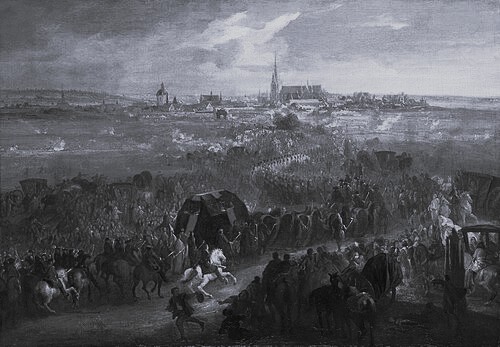
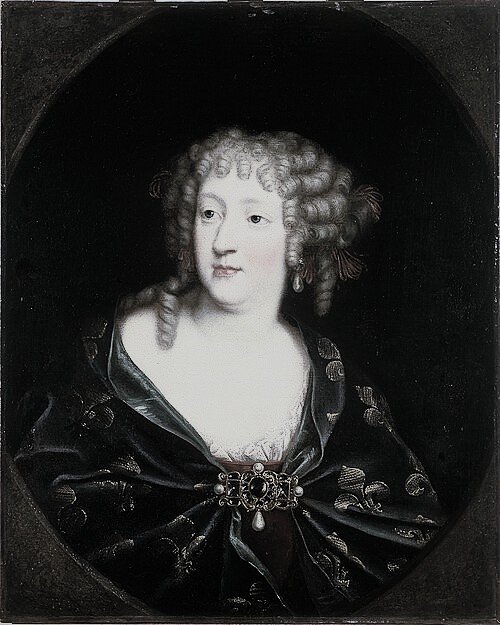
The funeral of Marie Thérèse, Queen of France, August 10, 1683. When she died, Louis XIV said it was the first trouble she had ever given him. She had said she’d had only one happy day.
A Queen Between Two Countries
Whatever her private suffering, Maria Theresa retained a public role. When Louis went to war with Spain in May 1667, launching the War of Devolution to seize the Spanish Netherlands and the Franche-Comté, she was placed in a position that had no diplomatic name.
She was Queen of France and Infanta of Spain fighting the same war from opposite sides. By the Treaty of Aix-la-Chapelle in May 1668, Spain ceded a significant portion of the Spanish Netherlands to France. Contemporaries noted that Maria Theresa had quietly moderated her husband’s demands during negotiations, and that the final terms might have been harsher without her intervention.
It was perhaps the single moment at which her position meant something concrete, a woman used as a peace offering who briefly, imperfectly, managed to be a peacekeeper.
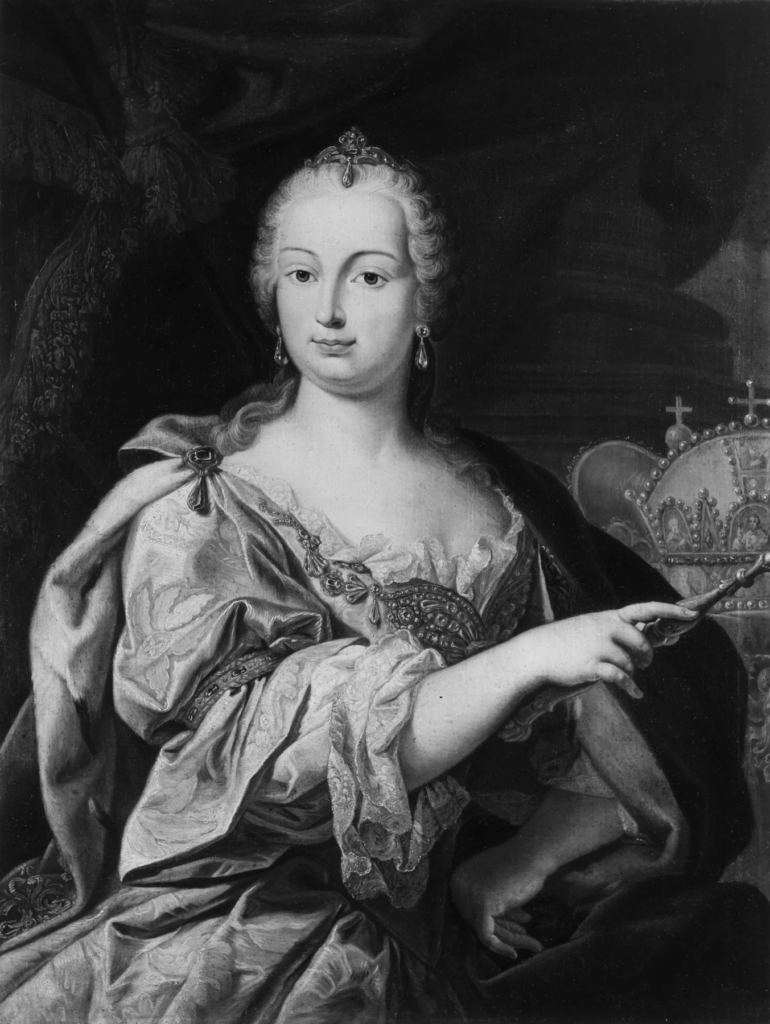
She Had Only One Happy Day
In the last week of July 1683, Maria Theresa developed a severe abscess on her left arm. A fever followed, and her physicians applied the standard remedy of the age: bloodletting. The incision severed a blood vessel she could not afford to lose.
She died at the Palace of Versailles on July 30, 1683, forty-four years old.Her last words, according to those present, were: “Since I became queen, I have been happy only one day.”Louis XIV remarried in secret not long after, to Françoise d’Aubigné, Marquise de Maintenon, formerly the governess of his illegitimate children.
The marriage was never made public and produced no legitimate heirs, leaving the Grand Dauphin as the sole heir to France. The Dauphin outlived his mother by twenty-eight years but not his father, dying in April 1711, four years before Louis XIV himself died in September 1715. The throne ultimately passed to Louis XV, Maria Theresa’s great-great-grandson through the male line.
As for Spain: the direct Habsburg line expired in November 1700 with the death of Carlos II, Maria Theresa’s half-brother, whose body had been destroyed by generations of inbreeding. His designated heir was Philip of Anjou, son of the Grand Dauphin and grandson of Maria Theresa, who acceded to the throne as Philip V of Spain.
The marriage that was arranged to end the war between France and Spain had, forty years later, placed a Frenchman on the Spanish throne.Maria Theresa had been sold as a guarantee of peace. Her descendants made peace irrelevant.
Leave a Reply