
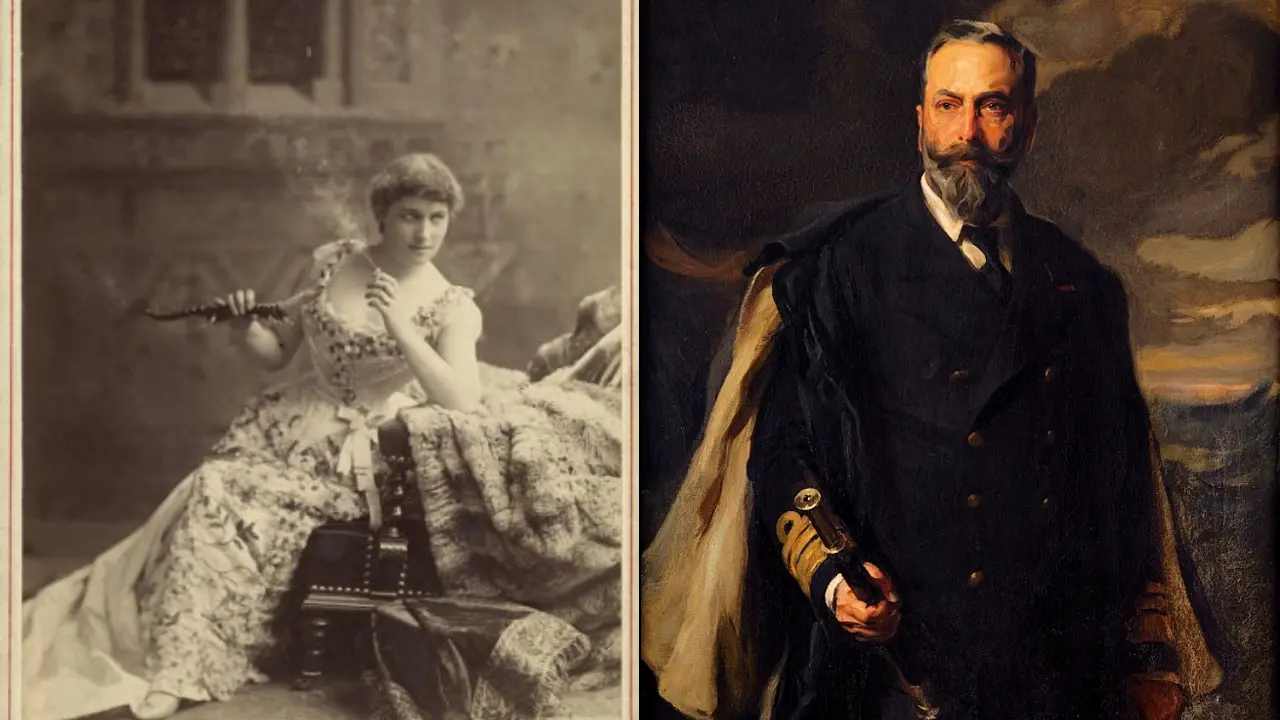
When the future King Edward VII fell publicly infatuated with a clergyman’s daughter in 1877, Lillie Langtry leveraged the scandal, a secret pregnancy of disputed royal paternity, and a prince’s quiet assistance to become Victorian England’s most celebrated actress and the first woman ever to endorse a commercial product.
The Dean’s Daughter Takes London by Storm
On 24 May 1877, the twenty-three-year-old wife of an Ulster landowner sat down to dinner next to the Prince of Wales. Her husband was at the far end of the table. Albert Edward, the future King Edward VII, was a married man with six children and a London-wide reputation for infidelity that his wife, Princess Alexandra, had learned to receive with practised equanimity.
By the end of the evening, the Prince was already asking around about the woman in the plain black dress. Within months, Lillie Langtry was the most talked-about woman in England.She had not arrived in London by accident. Emilie Charlotte Le Breton was born on 13 October 1853 in Saint Saviour, Jersey, the only daughter among seven children of the Very Reverend William Corbet Le Breton, Dean of Jersey. Her brothers called her Lillie.
She had grown up climbing trees, swimming, and riding horses with them, educated by their brothers’ tutor after her French governess found her unmanageable. Her father held one of the island’s most respectable positions while quietly fathering illegitimate children across his parish. Her mother, Emilie Davis Martin, eventually left him in 1880.
At twenty, Lillie had married Edward Langtry, an Ulster landowner six years her senior, on 9 March 1874. He wanted a quiet life in the country. She wanted London. It took her years to wear him down. In 1876 they rented an apartment at Eaton Place, Belgravia, and Lillie Langtry entered the city she had spent her marriage manoeuvring toward.
Less than a year later, at a reception on 29 April 1877 at the home of Sir John and Lady Sebright, she arrived in a simple black mourning dress with no jewellery, a stark contrast to the elaborate display of every other woman present. The artist Frank Miles filled his sketchbook with her face before they had even been introduced to each other. The resulting portrait was purchased by Prince Leopold. From that afternoon, Lillie Langtry received invitations from everyone.
The Prince of Wales Claims His Prize
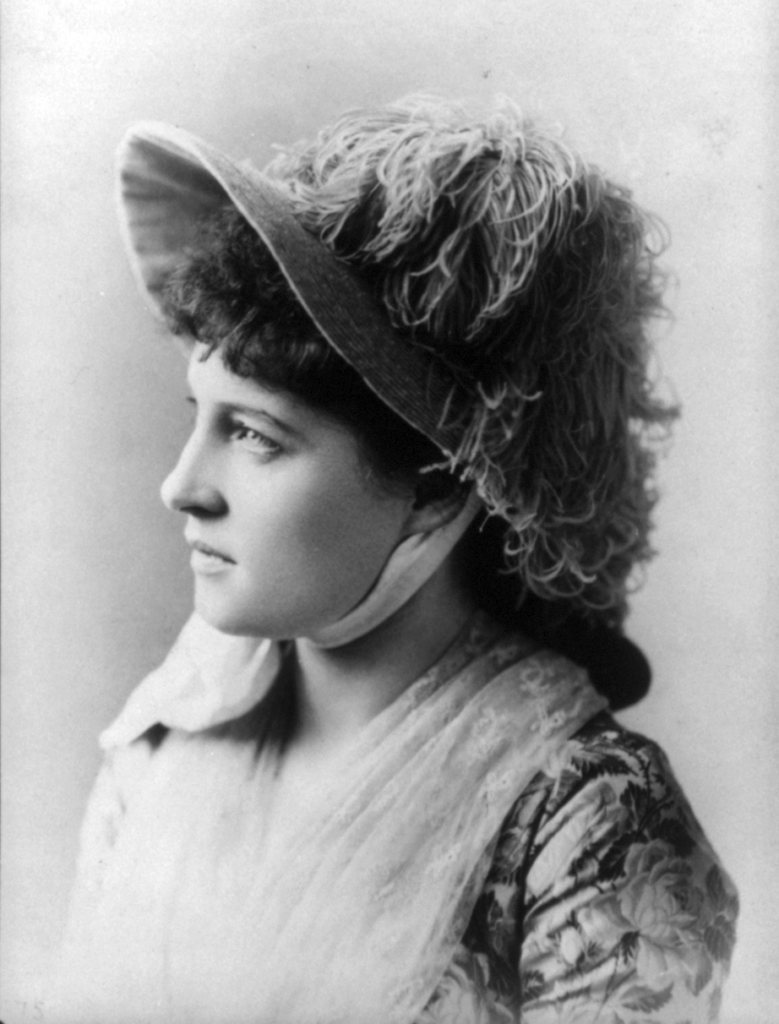
By late 1877 the Prince was infatuated, and London society watched without surprise. He was often seen with Langtry at Ascot, where crowds followed her from enclosure to enclosure. His wife received her at Marlborough House. Sir John Everett Millais, himself a Jersey native, painted her portrait and titled it A Jersey Lily, after the flower native to her home island.
When the painting was exhibited at the Royal Academy, the crowds pressed so close it had to be roped off. William Ewart Gladstone, then serving the first of his four terms as Prime Minister, became a friend and mentor after meeting her at Millais’ studio, advising her that in her coming career she should “bear them, never reply, and above all never rush into print to explain or defend yourself.”
She never did.
The liaison between Langtry and the Prince lasted from late 1877 until June 1880. Its precise nature has since been contested. The biographer Jane Ridley questioned several elements of Langtry’s own account, noting that no letters from the period survived and that at least one dramatic story she told, about Queen Victoria personally remaining at court to see her, appears to have been fabricated.
What correspondence between the Prince’s private secretary and his solicitor does confirm is that Edward Langtry attempted to exchange his silence and the Prince’s love letters for cash. The Prince maintained a lifelong friendship with Lillie regardless.
Scandal and Pregnancy Force Her Hand
In July 1879, Langtry began an affair with Lord Shrewsbury. By January 1880, they were planning to run away together. Then the journalist Adolphus Rosenberg published rumours in Town Talk alleging that Edward Langtry intended to file for divorce and name the Prince of Wales as co-respondent. The Prince’s solicitor sued. Rosenberg pleaded guilty and received two years in prison.
The damage was already done.
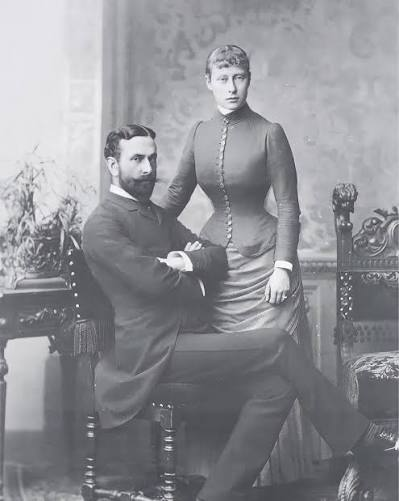
Creditors closed in. Society hostesses declined to receive her. In June 1880, Langtry discovered she was pregnant. Her husband was not the father. The most likely candidate was Prince Louis of Battenberg, with whom she had been involved since March of that year. She led Battenberg to believe the child was his. His family moved with notable speed: an aide-de-camp arrived from Germany, a financial settlement was arranged, and the Admiralty located an appointment aboard the warship HMS Inconstant. Battenberg departed on a two-year voyage around the world before the child was born.
Letters later discovered between Langtry and her childhood friend Arthur Clarence Jones suggest he may actually have been the father. She wrote to him during the pregnancy with considerable urgency, shared her doctor’s predicted dates with him, and Jones accompanied her to Paris where her daughter, Jeanne Marie, was born on 8 March 1881. No public determination was ever made. Mountbatten’s descendants maintained for the rest of the century that Louis was the father.
In October 1880, Langtry sold her possessions to satisfy her debts and prevent her husband’s bankruptcy. The Prince of Wales, consistent in his practical friendship, used his influence to open the doors of the Haymarket Theatre. It was Oscar Wilde who said what needed saying. Go on the stage.
Langtry Conquers the Stage and America
She auditioned in a Twickenham town hall on 19 November 1881. Her coach was Henrietta Labouchère, a former professional actress. Her professional debut followed in December at the Haymarket, playing Kate Hardcastle in She Stoops to Conquer. The Prince and Princess of Wales were in the audience. Critics were divided. The public paid the critics no attention. Early in 1882, she founded her own production company.
That October she sailed to America. The theatre scheduled for her opening night burned down the night before the performance. The company relocated and opened the following week. By May 1883, a coast-to-coast tour had concluded at what the American press called a “fat profit.” She returned in 1906 and again in 1912, appearing in vaudeville. Her final London stage appearance came in 1917.
Also in 1882, Langtry signed her name to advertisements for Pears soap. It was the first time any woman had formally endorsed a commercial product.
Her relationship with the American sportsman Frederick Gebhard began that same year and lasted nearly a decade. Together they purchased adjoining ranches in Lake County, California, where Langtry established a vineyard of 4,200 acres producing red wine. On 13 August 1888, a railcar transporting seventeen of their racehorses derailed at Shohola, Pennsylvania, rolled eighty feet down an embankment, and burst into flames. One person died. Fifteen horses were lost, including Gebhard’s champion runner Eole. The relationship did not survive the disaster by long. They separated in 1891.
Lady de Bathe Sells Everything, Retreats to Monaco
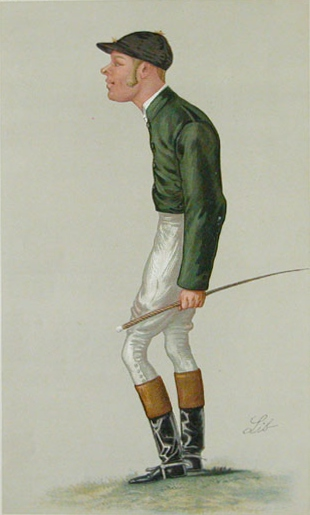
In 1889, at a racecourse, an eccentric young heir named George Alexander Baird handed Langtry a betting tip and the stake money to place on a horse. The horse won. He subsequently gifted her a two-year-old called Milford. Milford went on to win several races. Baird died in March 1893, widely regarded as violent and dissolute, and Langtry purchased two horses from his estate. She moved her training operation to Sam Pickering’s stables at Kentford House, near Newmarket in Suffolk, and took up residence at Regal Lodge in the village of Kentford.
The property was her home for twenty-three years. Over that time her horse Merman won the Ascot Gold Cup and she took the Cesarewitch twice.On 13 May 1897, she divorced Edward Langtry in California. He issued a statement to the New York Journal giving his account of the marriage. Months later, police found him in a confused state at Crewe railway station.
He died in Chester Asylum, probably from a brain haemorrhage sustained in a fall during a sea crossing. Langtry later wrote to another widow: “I too have lost a husband, but alas! it was no great loss.”
On 27 July 1899, she married Hugo Gerald de Bathe, twenty-eight years old to her forty-five. The ceremony took place at St Saviour’s Church in Jersey, with Jeanne Marie as the only other person present besides the officiants. When Hugo’s father died in 1907, Hugo became the 5th Baronet. Lillie Langtry became Lady de Bathe.
In 1919 she sold Regal Lodge, dispersed her horses, and moved to Monaco. She published her memoirs, The Days I Knew, in 1925. Her husband Hugo lived in Vence, in the Alpes Maritimes. They saw each other at social gatherings and in private encounters, but not often.
Lillie Langtry died in Monte Carlo on 12 February 1929, of pneumonia. She was seventy-five. Her body was carried to Jersey through blizzards and buried at St Saviour’s Church alongside her parents, as she had asked. Her closest companion in Monaco, Mathilde Marie Peat, inherited £10,000, the Monaco villa, and Langtry’s motor car. Jeanne Marie received the old family silver from Jersey.
The question of Jeanne Marie’s paternity was never publicly settled in Langtry’s lifetime. When Jeanne Marie was twenty, Margot Asquith told her the name her mother had given. Jeanne Marie, by all accounts, complained bitterly about her illegitimacy.
Lillie’s reply has since been widely repeated: “Who would you prefer to have as a father, a penniless drunken Irishman or a Royal Prince and the most handsome of all naval officers?”
Leave a Reply