
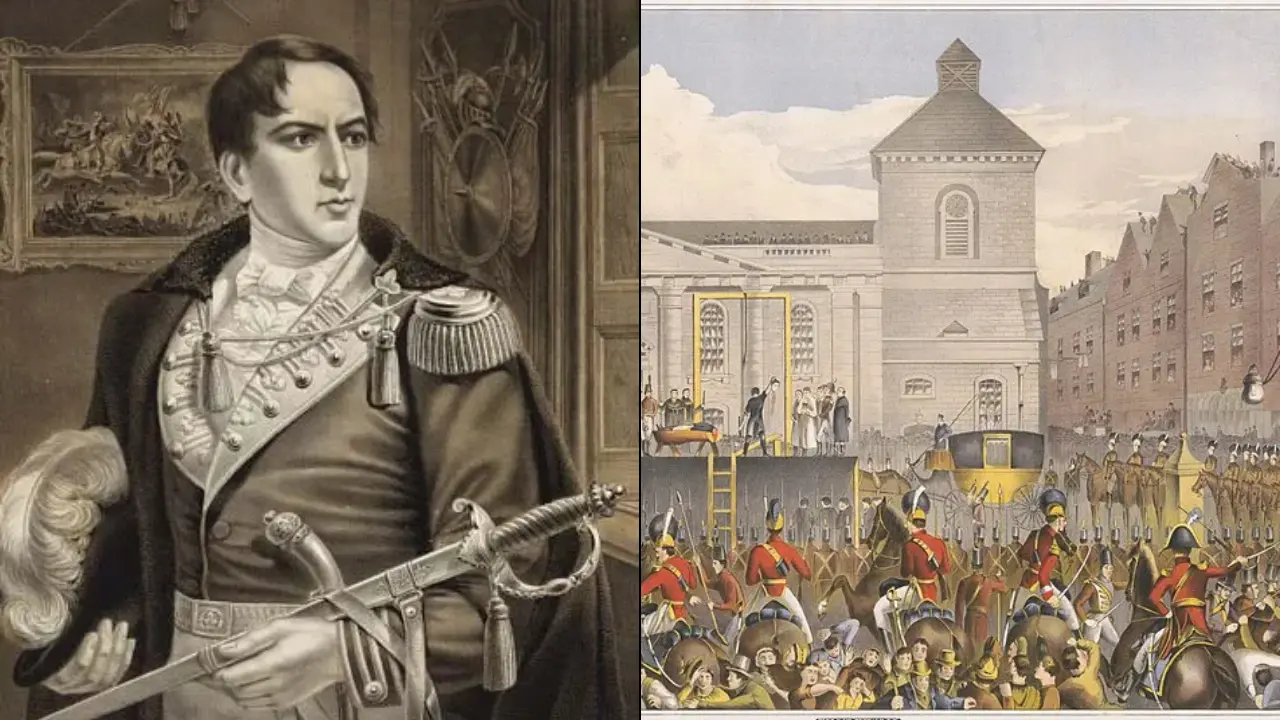
On September 20, 1803, Robert Emmet was hanged and beheaded at 25 years old in Dublin after the attorney retained to defend him accepted £200 and a pension from the Crown to throw the case.
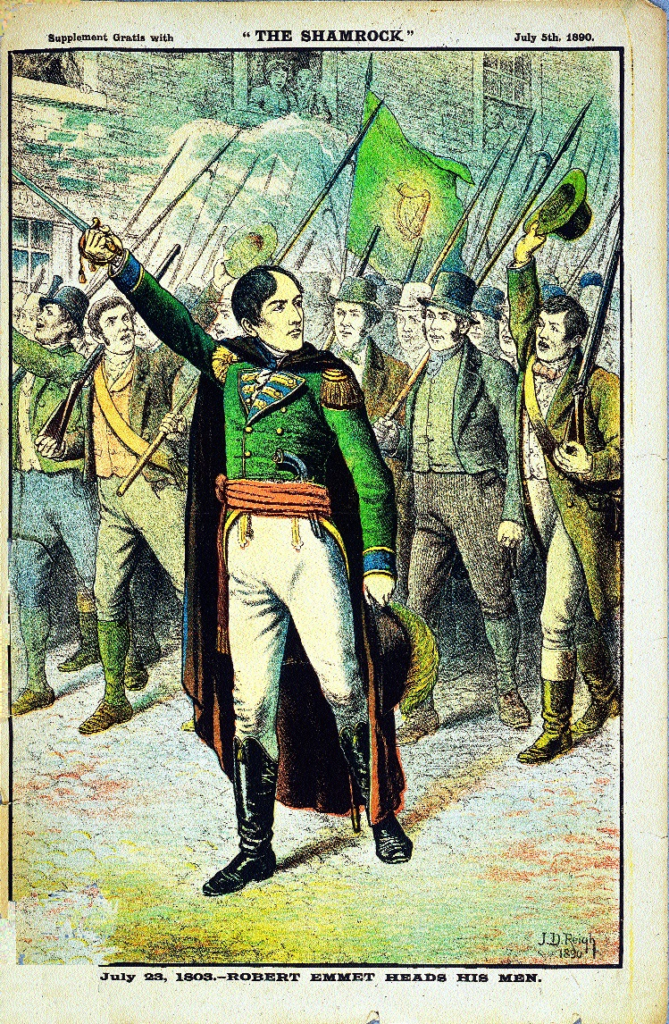
On the evening of July 23, 1803, a 25-year-old man in a green and gold uniform stood in Thomas Street, Dublin, and watched his revolution die in front of him.
Robert Emmet had spent years preparing. He had manufactured weapons in secret depots across the city, printed 10,000 copies of a revolutionary proclamation, and built a network of men ready to storm Dublin Castle and overthrow British rule in Ireland. The rebels who answered his call that night numbered approximately 80. Several were visibly drunk. The plan had fractured weeks earlier when an accidental explosion at the arms depot on Patrick Street forced the date of the rising forward before his forces were ready. By the time the violence in the surrounding streets became uncontrollable a carriage ambushed, a lord chief justice stabbed with pikes, British soldiers flooding the area Emmet had already seen enough.
He called off the rebellion. He walked away into the dark. He could have escaped to France by morning.
He did not.
A Protestant Family Raised Its Son to Question the Crown
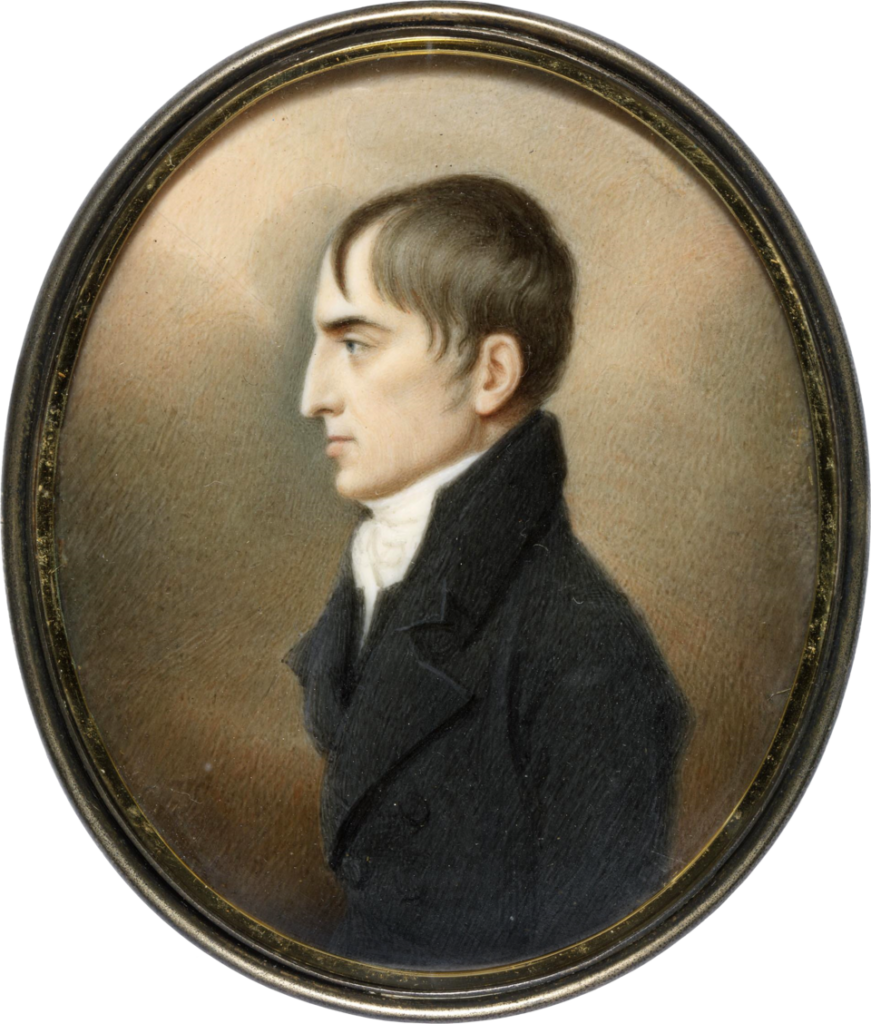
Robert Emmet was born on 4 March 1778 at 109 St. Stephen’s Green in Dublin, the youngest son of Robert Emmet Sr., physician to the Lord Lieutenant of Ireland, and his wife Elizabeth Mason. The family was financially comfortable. They kept a townhouse on St. Stephen’s Green and a country residence near Milltown, and they belonged to the Protestant Ascendancy that dominated Irish political and professional life under British rule.
The household was not politically neutral. The elder Emmet supported American independence and moved on the fringes of the Irish patriot movement. Theobald Wolfe Tone, a leading advocate for Catholic emancipation and close friend of Emmet’s older brother Thomas Addis Emmet, was a regular visitor. The ideas circulating at 109 St. Stephen’s Green were not ordinary for the Protestant professional class of late eighteenth-century Dublin. They were ideas about national self-determination, about what Britain owed Ireland, about what Ireland might become without British interference.
Robert absorbed them young.
After attending Oswald’s School and a grammar school on Grafton Street, where one of his classmates was the poet Thomas Moore, Emmet entered Trinity College Dublin in October 1793 at the age of 15. By 1797 he had joined Moore in the College Historical Society, debating questions of democracy with a force his contemporaries struggled to match. Moore later recalled that men of advanced standing and reputation came specifically to answer Robert Emmet in debate. They rarely managed it.
Emmet Withdrew From Trinity to Protect His Comrades
In April 1798, Emmet was identified as secretary of a secret college committee operating in support of the Society of United Irishmen, an organisation dedicated to Catholic emancipation and Irish independence. His brother Thomas was a leading executive member. Theobald Wolfe Tone had helped found it.
Rather than submit to questioning under oath that might have inculpated colleagues, Emmet withdrew from Trinity. He was 20 years old. He would never return.
That same year, the United Irish uprising Tone had spent years organising broke out across Ireland. Emmet did not participate. The rebellion collapsed after five months of fighting that left an estimated 20,000 dead. The Acts of Union of 1800 followed, formally dissolving the Irish Parliament and placing Ireland under direct governance from Westminster. The Society of United Irishmen lay in ruin. Its leaders were dead, imprisoned, or in exile.
Emmet began rebuilding it almost immediately.
A Paris Mission Produced Promises Napoleon Never Kept
In the summer of 1800, Emmet traveled to Paris as part of a covert effort to secure French military support for a renewed uprising. He and a colleague presented Napoleon with a detailed memorial arguing that the Act of Union had done nothing to ease Irish discontent, and that the United Irishmen were prepared to rise again the moment French forces landed.
Napoleon was not persuaded. He was focused on securing a peace settlement with Britain. Ireland was not part of his immediate calculations.
Emmet returned to Ireland in October 1802. His own interviews with Napoleon and Talleyrand had left him under no illusions about French reliability. The rising he now planned was to be Irish in origin, Irish in execution, and Irish in outcome. He would later tell his trial court that while a connection with France had been intended, it was only “as far as mutual interest would sanction or require.” No man, he insisted, should “calumniate” his memory by believing he had hoped for liberation from a foreign government.
An Accidental Explosion Forced Emmet to Act Too Soon
In March 1803, Emmet, Thomas Russell, and James Hope began final preparations in Dublin. They manufactured pikes, rockets, grenades, and powder-packed hollow beams designed to block cavalry charges. They printed 10,000 copies of a Proclamation of the Provisional Government. Emmet had designed a foldable pike compact enough to be concealed beneath a coat.
On July 16, gunpowder at the arms depot on Patrick Street detonated accidentally. The explosion drew the attention of the authorities and closed Emmet’s window of secrecy. He moved the date of the rising forward to July 23. That decision meant proceeding without the weapons, the numbers, or the coordination his plan required. Kildare insurgents who arrived to inspect the arsenal found only pikes where firearms had been promised. They turned back before reaching Dublin.
By evening, Emmet had approximately 80 men around him in Thomas Street.
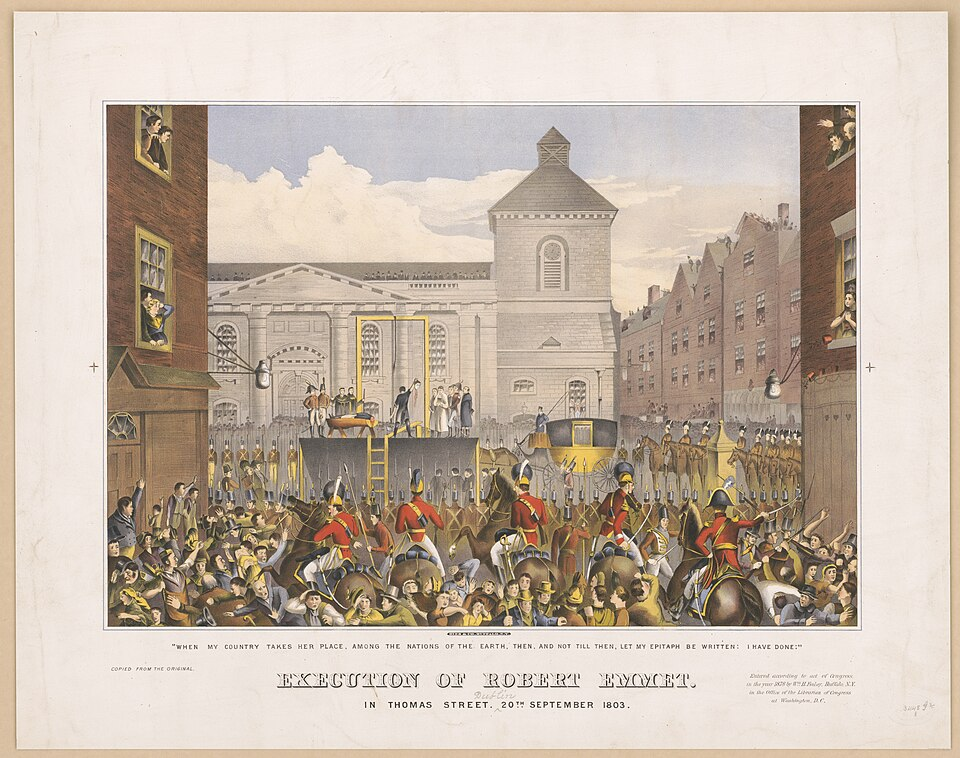
The Rising of 1803 Collapsed Into Slaughter on Dublin’s Streets
The plan to storm Dublin Castle and seize the viceroy was botched when the assault party revealed themselves prematurely. Around Emmet in Thomas Street, R.R. Madden would later describe the assembled force as a motley group, a significant number visibly drunk. A lone dragoon was pulled from his horse and piked to death as Emmet watched. He ordered the men to disperse, sending a prearranged signal, a solitary rocket, to stand down the insurgent groups waiting on the approach roads into the city.
The chaos he tried to stop did not stop.
Lord Kilwarden, the Lord Chief Justice of Ireland, was dragged from his carriage in the surrounding streets and stabbed with pikes. His nephew, the Reverend Mr. Wolfe, was killed alongside him. Kilwarden, who had used his position to shield Wolfe Tone from prosecution years earlier, was found still alive and died in a watch-house shortly afterward. Sporadic fighting between rebels and British soldiers continued through the night. By the time order was restored, approximately 50 rebels and 20 British soldiers were dead.
Emmet fled the city to Rathfarnham, south of Dublin.
Emmet Chose Love Over Escape and Lost Everything
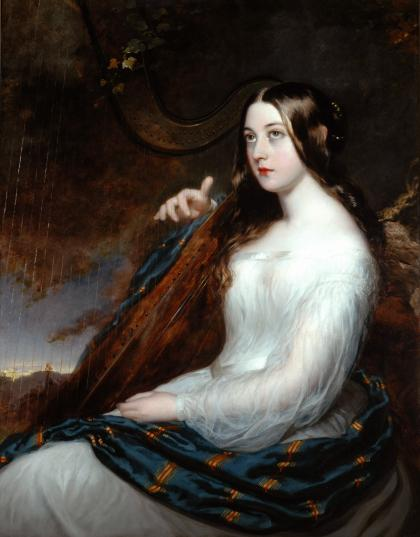
From Rathfarnham, Emmet made his way to Harold’s Cross. His motive was not tactical. Sarah Curran, his fiancée and the daughter of the prominent barrister John Philpot Curran, lived nearby. Curran disapproved of the relationship entirely. Emmet believed he could remain hidden while staying close to the woman he loved.
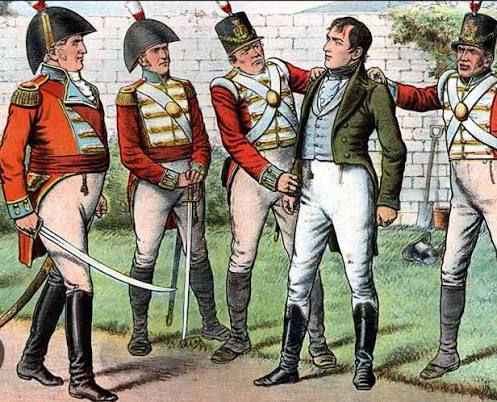
On 25 August 1803, one month after the rising, he was captured. He was taken first to Dublin Castle, then transferred to Kilmainham Gaol. Vigorous efforts to procure his escape came to nothing.
His trial was set for 19 September.
The Barrister Paid to Defend Emmet Accepted £200 to Destroy Him
The Crown’s case was overwhelming. The evidence against Emmet was documented. But the prosecution took an additional precaution.
Leonard McNally, the barrister retained to represent Emmet, accepted £200 and a pension from the Crown in exchange for throwing the case. McNally’s assistant Peter Burrowes refused the same offer and represented Emmet as best he could. Emmet, for his part, had instructed his counsel to call no witnesses and mount no formal defence.
He was found guilty of high treason. Chief Justice Lord Norbury sentenced him to be hanged, drawn and quartered. Out of deference to Emmet’s Protestant Ascendancy background, the disembowelment was omitted.
The Speech From the Dock Outlasted the Man Who Gave It
Before sentencing was formally recorded, Emmet addressed the court. Historian Patrick Geoghegan has since identified over seventy different versions of the text. Based on notes taken by Peter Burrowes, one of the earliest printings records Emmet’s closing words as:
“I am here ready to die. I am not allowed to vindicate my character; no man shall dare to vindicate my character; and when I am prevented from vindicating myself, let no man dare to calumniate me. Let my character and my motives repose in obscurity and peace, till other times and other men can do them justice. Then shall my character be vindicated; then may my epitaph be written.”
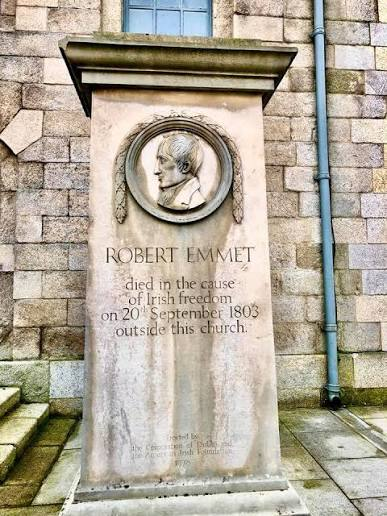
On 20 September 1803, Robert Emmet was hanged in Thomas Street in front of St. Catherine’s Church, and then beheaded. He was 25 years old.
The Grave That Ireland Has Never Found
With friends and family members arrested on suspicion of treason in the weeks that followed, no one came forward to claim Emmet’s remains. To do so risked sharing his fate. His body was returned to Kilmainham Gaol, where the jailer held orders to bury it in a nearby hospital burial ground called Bully’s Acre if it went unclaimed.
Family tradition holds that in 1804, under cover of the burial of Emmet’s sister Mary Anne Holmes, his remains were quietly removed from Bully’s Acre and reinterred in the family vault at St. Peter’s Church in Aungier Street. A search of that vault in 1903 found nothing.
Where Robert Emmet is buried has never been established.
The phrase that endures among Irish nationalists offers no resolution, only acknowledgment: Do not look for him. His grave is Ireland
Leave a Reply